
Example summary Organisational Behaviour - Part 1 2026/2027
Welcome to Slim Academy!
In front of you is the example summary for the course Organisational Behaviour, taught in
block 1 of the first year of the International Business Administration Bachelor’s programme at
Erasmus University Rotterdam. In this course, you will explore how individuals, groups, and
organisations behave in the workplace. You will learn about topics such as motivation,
leadership, team dynamics, communication, decision-making, organisational culture, and change
management.
At Slim Academy, our goal is to help you study smarter. We do this by summarising the core of
the material clearly, simplifying complex topics, and offering the right tools to help you practise
actively. For the best preparation for your exam, we recommend using our full range of study
materials. For this course, the following products are available.
🎁 Tip: Use the code ABO-STAR on with
SlimAcademy.nl and receive your First month for free
a subscription!
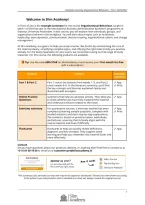
Product Content Available
versions
Part 1 & Part 2 Part 1 covers the material from weeks 1–3, and Part 2 ✓ App
covers weeks 4–6. In the literature summary, you’ll find ✓ Print
the key concepts and theories explained clearly and
illustrated with examples.
Online Practice Questions that help you practise actively. They allow you ✓ App
Questions to check whether you have fully mastered the material
and understand what to expect on the exam.
Exercises summary For quantitative courses, a exercises booklet has been ✓ App
compiled containing sample questions, complete with ✓ Print
worked solutions and clear step-by-step explanations.
The content is based on previous exams, workshops,
and lectures, ensuring that it closely aligns with the
course material and level of difficulty.
Flashcards Flashcards to help you quickly review definitions, ✓ App
diagrams, and key concepts. They support active
learning and help you remember the material faster and
more effectively.
Contact
Do you have questions about our products, delivery, or anything else? Feel free to contact us at
+31 6 81 60 19 60 or email us at .
This summary is for personal use only and may not be copied or distributed. The text has been written according
to the author’s own interpretation and is intended as a study aid. Always consult the original sources.
1
, Example summary Organisational Behaviour - Part 1 2026/2027
Digital and Print Updates
Note! In this sample summary, we have included the material from the first 2 weeks of the previous
academic year.
At Slim Academy, you receive a digital update of the summary every week. At the beginning of
the block, not all lectures have taken place yet, which is why we update the summary weekly as
soon as our authors have followed the newest course material. This way, the content remains
current, reliable, and of high quality. So you don’t have to wait until the end of the block: every
week a new part becomes available. In the overview below, you can see when which material is
digitally available.
Later in the block, we bundle all weekly updates into one clear, paper summary. Is new material
added after the shipping date? No worries! As soon as it appears, we summarise everything
quickly and send an update in the app.
Week Content
Week 1 Essentials of organizational behaviour, 16e, Global edition, Robbins S., & Judge T.,
2025 - Chapter 1, 3 + lecture 1
Week 2 Essentials of organizational behaviour, 16e, Global edition, Robbins S., & Judge T.,
2025 - Chapters 2, 5 + lecture 2
Week 3 Essentials of organizational behaviour, 16e, Global edition, Robbins S., & Judge T.,
2025 - Chapters 7, 8 + lecture 3
Week 4 Essentials of organizational behaviour, 16e, Global edition, Robbins S., & Judge T.,
2025 - Chapter 6 + lecture 4
Week 5 Essentials of organizational behaviour, 16e, Global edition, Robbins S., & Judge T.,
2025 - Chapters 9, 10 + lecture 5
Week 6 Essentials of organizational behaviour, 16e, Global edition, Robbins S., & Judge T.,
2025 - Chapter 12, 13 + lecture 6
We wish you the best of luck with your studies and your exams!
Team Slim Academy
2
, Example summary Organisational Behaviour - Part 1 2026/2027
Table of Contents
Welcome to Slim Academy! 1
Digital and Print Updates 2
Table of Contents 3
Week 1: Introduction to OB 4
Lecture 1: What is OB? 4
Chapter 1: What is Organisational Behaviour? 12
Chapter 3: Job attitudes 20
Week 2: Diversity in organisations 24
Lecture 2: Diversity in organisations: Ability, Personality and Values 24
Chapter 2: Diversity in organisations 30
Chapter 5: Personality and individual differences 34
Practice questions and flashcards 40
3
, Example summary Organisational Behaviour - Part 1 2026/2027
Week 1: Introduction to OB
Introduction
This week, we will cover Lecture 1 and the corresponding Chapters 1 and 3.
Lecture 1: What is OB?
The field of organisational behaviour investigates the impact individuals, groups, and structure
have on behaviour within organisations, for the purpose of applying such knowledge toward
improving an organisation’s effectiveness. Some contributing disciplines to organisational
behaviour are psychology, sociology, anthropology and social psychology.
For this course, we will look at two main classes of outcome: job performance and
organisational commitment. Job performance stems from three categories:
1. Task performance: effort, productivity, and creativity;
2. Citizenship behaviour: helping, courtesy, and voice;
3. Counterproductive behaviour: theft, incivility, and sabotage.
For organisational commitment, we want workers to identify with the organisation and its goals.
Ultimately, we want workers to feel welcome and like they want to maintain a connection with
the company. This in turn will cause less withdrawal, which means that there is less turnover,
tardiness, cyberloafing, daydreaming, and absenteeism.
With organisational behaviour, we look at the organisation as a whole, but also the groups and
individuals that fit within the organisation.
What is managing in an organisation?
Managing requires several skills: planning, organising, leading and controlling. This is because
managers need to set the direction of the company, create structures within the company,
inspire effort in the workers, and ensure results for the company. These skills can be used in
order to perform four managerial tasks:
1. Traditional management: this task requires decision-making, planning and controlling;
2. Communication: this task requires doing paperwork and exchanging routine
information;
3. Human resource management: this task requires motivating and disciplining,
managing conflict, staffing and training employees;
4. Networking: this task requires socialising and interacting with others.
From a study conducted, three different types of managers who dedicate different portions of
their time to these tasks can be identified:
1. The average manager: Spends approximately equal amounts of his time on these tasks;
2. The successful manager: Spends most of his time on networking (about half), and half of
the rest of his time on communicating;
3. The effective manager: Spends most of his time communicating (about half), and half of
the rest of his time on human resource management.
4



