SUMMARY RISK BEHAVIOR AND ADDICTION IN ADOLESCENCE
WEEK 1
Lecture 1 – 4/9: Introduction Risk Behavior and Addiction in Adolescence
How do we define Risk Behaviour?
Risk Behaviour
- Risk Behaviour: Behaviours that pose a risk to a healthy physical, cognitive, psychosocial development of
adolescents
• Substance use (e.g., smoking/vaping, alcohol use, cannabis use, use of XTC and other
party/designer drugs)
• Other risk behaviors (e.g., (online) gambling, gaming, social media use)
- Addiction
The general development process of addiction
Contact with a substance → Experimenting with a substance → Integrated use (part of daily life) → Excessive
use (higher proportions) → Addicted use
Something can become a risk behavior when it becomes excessive
→ Nicotine addiction can develop on very early on, when someone is in a position to start with smoking
What we tend to regard as ‘risks behavior’ depends on…
- Characteristics of the particular substance or behavior
• For instance, smoking/vaping versus gaming
- Cultural and societal norms: what is seen as risk behavior
• Example: alcohol use in western versus Islamic cultures
- Advances in scientific knowledge:
• Example: knowledge on the risks of alcohol use for the development of the adolescent brain
Predictors of Risk Behavior
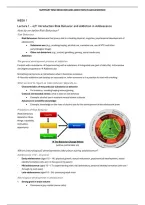
(Risk) behaviors
depend on three
things: capability,
motivation,
opportunity
→ The Behavior Change Wheel
(will be central later on)
Which (neurological) developments take place during adolescence?
Adolescence (+10 – 24 years)
- Early adolescence (aged 10 – 14): physical growth, sexual maturation, psychosocial development, social
identity formation (who am I in the eyes of my peers)
- Mid adolescence (aged 15 – 17): experimenting with (risk) behaviours, personal identity formation (who am I
through my own eyes)
- Late adolescence (aged 18 – 24): practicing adult roles
Neurological development in adolescence
1. Strong grow in brain volume
• Decrease in grey matter (nerve cells)
, SUMMARY RISK BEHAVIOR AND ADDICTION IN ADOLESCENCE
• Increase in white matter (connections – brain and cells)
• Decrease starts age 11 girls, age 14 boys
• Not all parts grey matter is decreasing → Pruning
(snoeien); depends on which parts of the grey matters is
used, the parts who are less used will disappear – if you
don’t use it, you lose it
2. High plasticity and flexibility of the brain
• Phones → no sustains attention – through flexibility certain skills can be trained again and you can
gain it again
3. Increase in white matter: communication between brain regions strongly improves
• Long term memory increases
• Capacity for abstract (critical) thinking and metacognition
increases
• This development certainly results in conflicts between
child and parents
• All smaller roads are disappearing, but bigger stronger
roads will appear
Why is there a peak in risk behaviours during adolescence?
Risk behavior follows an inverted U-shaped curve
Neurological development in adolescence
- The speed of the development of two different brain regions differs
• The affective-motivational system (emotional brain)
develops fast
▪ the VTA produces dopamine and sends it to the
nucleus accumbens, thereby creating feelings of
reward
▪ Old part of the brain
▪ Part plays an important role regarding rewards
and motivation
▪ Is overactive during early and mid-adolescence
▪ Adolescents experience stronger positive
emotions than adults when they receive or
anticipate a reward → process is enhanced by
testosterone
▪ Boys: generally higher testosterone, they tend to show more risk behavior
• The control system (rational brain) develops slowly
▪ Outside of the brain
▪ Develops very slowly (until about 25 years)
▪ Plays important role in the development of executive functions:
, SUMMARY RISK BEHAVIOR AND ADDICTION IN ADOLESCENCE
• Risk estimations
• Monitoring long-term goals
• Inhibition of the tendency to respond to (short-term) possibilities for reward
(impulse control, behavioral inhibition, self-control)
• Systems interact
The Maturational Imbalance Model
- Increased risk-taking during adolescence is a result of
an imbalance between reward sensitivity (the
affective-motivational system) and impulse control
(control system)
- Risk taking during adolescence is result of an
imbalance
The horse and rider metaphor
- Rider: Control system; keep it in control – top-down
processes, behavioral inhabitation system (BIS)
- Horse: Motivational system; wants to run – bottom-
up processes, behavioral activation system (BAS)
What are psycho-active substances (drugs)?
How can we define drugs or psycho-active
substances?
- Psychoactive substances are chemical substances that cross the blood-brain barrier and affect the
function of the central nervous system thereby changing mood, perceptions, or consciousness (e.g., high/
euphoria, relaxation)
- Other characteristics of psychoactive substances:
• They often induce craving after (regular) use
• They often evoke loss of control after they have been used (regularly)
Psychoactive substances differ in…
- Type and strength of the psychoactive effect
- The degree to which they elicit craving and loss of control
For which substance is the risk highest to develop addiction after one has used the substance only once?
NICOTINE!
Types of drugs (based on their psychoactive effects)
, SUMMARY RISK BEHAVIOR AND ADDICTION IN ADOLESCENCE
How do we define Addiction?
- Intensional: these definitions aim to describe a causal addiction process (see Sussman, Table 1.2)
- Extensional: a classification of characteristics of an addiction (e.g. DSM-5, ICD-11)
Substance use disorder (DSM-5 TR, 2022)
- Classification system: you are defined as addicted if you have certain criteria
- Recurrent use over the last 12 months AND meeting at least two or more criteria (2-3 mild, 4-5 moderate, 6>
severe SUD)
Which implicit/automatic processes underlie the development of addiction?
Two learning principles underlying the development of addiction
1. Positive reinforcement occurs when the rate of a behavior increases because a desirable experience (e.g.,
euphoria, relaxation) is resulting from the behavior
2. Negative reinforcement occurs when the rate of a behavior increases because an aversive experience is
prevented from happening (e.g., withdrawal symptoms)
The neurobiological of withdrawal symptoms?
VIDEO LECTURE 1
This decreases in the sensitivity of the brain reward system results from…
- Reduction in the number of dopamine receptors
- The existing dopamine receptors become less sensitive to dopamine
- Resulting in…
• Tolerance (needing a higher dose of the drug to have the same effect)
• Withdrawal symptoms (during abstinence)
• A reduced sensitivity to natural incentives → example: reduced sexual interest in cocaine users
Associative learning
- Drug use is rewarded with positive feelings (positive reinforcement)
WEEK 1
Lecture 1 – 4/9: Introduction Risk Behavior and Addiction in Adolescence
How do we define Risk Behaviour?
Risk Behaviour
- Risk Behaviour: Behaviours that pose a risk to a healthy physical, cognitive, psychosocial development of
adolescents
• Substance use (e.g., smoking/vaping, alcohol use, cannabis use, use of XTC and other
party/designer drugs)
• Other risk behaviors (e.g., (online) gambling, gaming, social media use)
- Addiction
The general development process of addiction
Contact with a substance → Experimenting with a substance → Integrated use (part of daily life) → Excessive
use (higher proportions) → Addicted use
Something can become a risk behavior when it becomes excessive
→ Nicotine addiction can develop on very early on, when someone is in a position to start with smoking
What we tend to regard as ‘risks behavior’ depends on…
- Characteristics of the particular substance or behavior
• For instance, smoking/vaping versus gaming
- Cultural and societal norms: what is seen as risk behavior
• Example: alcohol use in western versus Islamic cultures
- Advances in scientific knowledge:
• Example: knowledge on the risks of alcohol use for the development of the adolescent brain
Predictors of Risk Behavior
(Risk) behaviors
depend on three
things: capability,
motivation,
opportunity
→ The Behavior Change Wheel
(will be central later on)
Which (neurological) developments take place during adolescence?
Adolescence (+10 – 24 years)
- Early adolescence (aged 10 – 14): physical growth, sexual maturation, psychosocial development, social
identity formation (who am I in the eyes of my peers)
- Mid adolescence (aged 15 – 17): experimenting with (risk) behaviours, personal identity formation (who am I
through my own eyes)
- Late adolescence (aged 18 – 24): practicing adult roles
Neurological development in adolescence
1. Strong grow in brain volume
• Decrease in grey matter (nerve cells)
, SUMMARY RISK BEHAVIOR AND ADDICTION IN ADOLESCENCE
• Increase in white matter (connections – brain and cells)
• Decrease starts age 11 girls, age 14 boys
• Not all parts grey matter is decreasing → Pruning
(snoeien); depends on which parts of the grey matters is
used, the parts who are less used will disappear – if you
don’t use it, you lose it
2. High plasticity and flexibility of the brain
• Phones → no sustains attention – through flexibility certain skills can be trained again and you can
gain it again
3. Increase in white matter: communication between brain regions strongly improves
• Long term memory increases
• Capacity for abstract (critical) thinking and metacognition
increases
• This development certainly results in conflicts between
child and parents
• All smaller roads are disappearing, but bigger stronger
roads will appear
Why is there a peak in risk behaviours during adolescence?
Risk behavior follows an inverted U-shaped curve
Neurological development in adolescence
- The speed of the development of two different brain regions differs
• The affective-motivational system (emotional brain)
develops fast
▪ the VTA produces dopamine and sends it to the
nucleus accumbens, thereby creating feelings of
reward
▪ Old part of the brain
▪ Part plays an important role regarding rewards
and motivation
▪ Is overactive during early and mid-adolescence
▪ Adolescents experience stronger positive
emotions than adults when they receive or
anticipate a reward → process is enhanced by
testosterone
▪ Boys: generally higher testosterone, they tend to show more risk behavior
• The control system (rational brain) develops slowly
▪ Outside of the brain
▪ Develops very slowly (until about 25 years)
▪ Plays important role in the development of executive functions:
, SUMMARY RISK BEHAVIOR AND ADDICTION IN ADOLESCENCE
• Risk estimations
• Monitoring long-term goals
• Inhibition of the tendency to respond to (short-term) possibilities for reward
(impulse control, behavioral inhibition, self-control)
• Systems interact
The Maturational Imbalance Model
- Increased risk-taking during adolescence is a result of
an imbalance between reward sensitivity (the
affective-motivational system) and impulse control
(control system)
- Risk taking during adolescence is result of an
imbalance
The horse and rider metaphor
- Rider: Control system; keep it in control – top-down
processes, behavioral inhabitation system (BIS)
- Horse: Motivational system; wants to run – bottom-
up processes, behavioral activation system (BAS)
What are psycho-active substances (drugs)?
How can we define drugs or psycho-active
substances?
- Psychoactive substances are chemical substances that cross the blood-brain barrier and affect the
function of the central nervous system thereby changing mood, perceptions, or consciousness (e.g., high/
euphoria, relaxation)
- Other characteristics of psychoactive substances:
• They often induce craving after (regular) use
• They often evoke loss of control after they have been used (regularly)
Psychoactive substances differ in…
- Type and strength of the psychoactive effect
- The degree to which they elicit craving and loss of control
For which substance is the risk highest to develop addiction after one has used the substance only once?
NICOTINE!
Types of drugs (based on their psychoactive effects)
, SUMMARY RISK BEHAVIOR AND ADDICTION IN ADOLESCENCE
How do we define Addiction?
- Intensional: these definitions aim to describe a causal addiction process (see Sussman, Table 1.2)
- Extensional: a classification of characteristics of an addiction (e.g. DSM-5, ICD-11)
Substance use disorder (DSM-5 TR, 2022)
- Classification system: you are defined as addicted if you have certain criteria
- Recurrent use over the last 12 months AND meeting at least two or more criteria (2-3 mild, 4-5 moderate, 6>
severe SUD)
Which implicit/automatic processes underlie the development of addiction?
Two learning principles underlying the development of addiction
1. Positive reinforcement occurs when the rate of a behavior increases because a desirable experience (e.g.,
euphoria, relaxation) is resulting from the behavior
2. Negative reinforcement occurs when the rate of a behavior increases because an aversive experience is
prevented from happening (e.g., withdrawal symptoms)
The neurobiological of withdrawal symptoms?
VIDEO LECTURE 1
This decreases in the sensitivity of the brain reward system results from…
- Reduction in the number of dopamine receptors
- The existing dopamine receptors become less sensitive to dopamine
- Resulting in…
• Tolerance (needing a higher dose of the drug to have the same effect)
• Withdrawal symptoms (during abstinence)
• A reduced sensitivity to natural incentives → example: reduced sexual interest in cocaine users
Associative learning
- Drug use is rewarded with positive feelings (positive reinforcement)