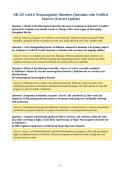
NR 547 week 6 Neurocognitive disorders Questions with Verified
Answers (Correct Update)
Question 1: Which of the following best describes the onset of symptoms in dementia? a) Sudden
and acute b) Gradual, over months to years c) Abrupt, with a clear trigger d) Fluctuating
throughout the day
Answer: Answer:b) Gradual, over months to years Rationale: Dementia symptoms typically begin
gradually, making it diflcult to pinpoint an exact start, unlike delirium which has a sudden onset.
Question 2: A key distinguishing feature of delirium compared to dementia is its primary impact
on: a) Memory recall b) Executive function c) Attention and awareness d) Language abilities
Answer: Answer: c) Attention and awareness Rationale: Delirium primarily attects attention and
awareness, characterized by diflculty focusing and maintaining attention. While memory and other
cognitive functions can be attected in delirium, the primary deficit is in attention.
Question 3: Which of the following is most like- Answer: ly to be a reversible condition?
a) Alzheimer's disease b) Vascular neurocognitive disorder c) Delirium due to a urinary tract
infection forms
d) Frontotemporal neurocognitive disorder
Answer: c) Delirium due to a urinary tract infection Rationale: Delirium is often reversible if the
underlying cause (like an infection) is identified and treated promptly. The other options are typically
progressive and irreversible of dementia.
Question 4: Symptoms of dementia are gener- Answer: ally considered: a) Short-term and
temporary b) Fluctuating and intermittent c) Permanent and progressive d) Rapidly resolving
with medication
Answer: c) Permanent and progressive Rationale: Dementia is characterized by a chronic and generally
permanent or progressive decline in cognitive function due to neurodegenerative processes.
Question 5: A patient experiencing significant shifts in alertness and confusion within the same
day, often worsening at night, is most likely experiencing: a) Major Neurocognitive Disorder due
to Alzheimer's
b) Mild Cognitive Impairment c) Delirium d) Major Depressive Disorder
Answer: Answer: c) Delirium Rationale: Significant fluctuations in symptoms, often with worsening at
night, are hallmark features of delirium. Dementia symptoms are relatively stable, though they may
worsen slowly over time.
Page 1
, Question 6: Which of the following is a common cause of delirium? a) Long-standing Alzheimer's
disease b) Untreated hypothyroidism
c) Chronic alcohol abuse d) Severe sleep deprivation
Answer: Answer: d) Severe sleep deprivation Rationale: Delirium is usually triggered by acute medical
conditions or external factors, including severe pain, infections, medication side ettects, and sleep
deprivation. While chronic conditions can increase susceptibility, acute triggers are characteristic of
delirium.
Question 7: When delirium and dementia coexist in a patient, it is often referred to as: a)
Concurrent cognitive decline b) Delirium superimposed on dementia c) Mixed neurocognitive
disorder d) Dual diagnosis of cognitive impairment
Answer: Answer: b) Delirium superimposed on dementia Rationale: Individuals with underlying
dementia are at a significantly higher risk of developing delirium, and this co-occurrence is specifically
termed "delirium superimposed on dementia."
Question 8: Which of the following cognitive domains is primarily affected in dementia? a)
Attention b) Awareness c) Memory and other cognitive functions (e.g., language, judgment) d)
Level of consciousness
Answer: Answer: c) Memory and other cognitive functions (e.g., language, judgment) Rationale: While
attention can be attected, the primary impairment in dementia is in memory and other higher cognitive
functions, interfering with daily activities. In delirium, attention is the primary deficit.
Question 9: The Confusion Assessment Method (CAM) is primarily used for the diagnosis of: a)
Alzheimer's delirium disease b) Parkinson's disease dementia c) Delirium d) Major Depressive
Disorder
Answer: Answer: c) Delirium Rationale: The CAM is a widely used screening tool specifically designed
to help diagnose by evaluating its key features.
Question 10: A patient presenting with "difficulty with memory and thinking" and "agitation or
other behavioral changes" could potentially have:
a) Delirium b) Dementia c) Both delirium and dementia d) Neither, these are not typical
symptoms
Answer: Answer: c) Both delirium and dementia Rationale: Confusion, disorientation, memory and
thinking diflculties, and behavioral changes can be present in both delirium and dementia. It's the onset,
duration, and primary impairment that ditterentiate them.
Page 2
Answers (Correct Update)
Question 1: Which of the following best describes the onset of symptoms in dementia? a) Sudden
and acute b) Gradual, over months to years c) Abrupt, with a clear trigger d) Fluctuating
throughout the day
Answer: Answer:b) Gradual, over months to years Rationale: Dementia symptoms typically begin
gradually, making it diflcult to pinpoint an exact start, unlike delirium which has a sudden onset.
Question 2: A key distinguishing feature of delirium compared to dementia is its primary impact
on: a) Memory recall b) Executive function c) Attention and awareness d) Language abilities
Answer: Answer: c) Attention and awareness Rationale: Delirium primarily attects attention and
awareness, characterized by diflculty focusing and maintaining attention. While memory and other
cognitive functions can be attected in delirium, the primary deficit is in attention.
Question 3: Which of the following is most like- Answer: ly to be a reversible condition?
a) Alzheimer's disease b) Vascular neurocognitive disorder c) Delirium due to a urinary tract
infection forms
d) Frontotemporal neurocognitive disorder
Answer: c) Delirium due to a urinary tract infection Rationale: Delirium is often reversible if the
underlying cause (like an infection) is identified and treated promptly. The other options are typically
progressive and irreversible of dementia.
Question 4: Symptoms of dementia are gener- Answer: ally considered: a) Short-term and
temporary b) Fluctuating and intermittent c) Permanent and progressive d) Rapidly resolving
with medication
Answer: c) Permanent and progressive Rationale: Dementia is characterized by a chronic and generally
permanent or progressive decline in cognitive function due to neurodegenerative processes.
Question 5: A patient experiencing significant shifts in alertness and confusion within the same
day, often worsening at night, is most likely experiencing: a) Major Neurocognitive Disorder due
to Alzheimer's
b) Mild Cognitive Impairment c) Delirium d) Major Depressive Disorder
Answer: Answer: c) Delirium Rationale: Significant fluctuations in symptoms, often with worsening at
night, are hallmark features of delirium. Dementia symptoms are relatively stable, though they may
worsen slowly over time.
Page 1
, Question 6: Which of the following is a common cause of delirium? a) Long-standing Alzheimer's
disease b) Untreated hypothyroidism
c) Chronic alcohol abuse d) Severe sleep deprivation
Answer: Answer: d) Severe sleep deprivation Rationale: Delirium is usually triggered by acute medical
conditions or external factors, including severe pain, infections, medication side ettects, and sleep
deprivation. While chronic conditions can increase susceptibility, acute triggers are characteristic of
delirium.
Question 7: When delirium and dementia coexist in a patient, it is often referred to as: a)
Concurrent cognitive decline b) Delirium superimposed on dementia c) Mixed neurocognitive
disorder d) Dual diagnosis of cognitive impairment
Answer: Answer: b) Delirium superimposed on dementia Rationale: Individuals with underlying
dementia are at a significantly higher risk of developing delirium, and this co-occurrence is specifically
termed "delirium superimposed on dementia."
Question 8: Which of the following cognitive domains is primarily affected in dementia? a)
Attention b) Awareness c) Memory and other cognitive functions (e.g., language, judgment) d)
Level of consciousness
Answer: Answer: c) Memory and other cognitive functions (e.g., language, judgment) Rationale: While
attention can be attected, the primary impairment in dementia is in memory and other higher cognitive
functions, interfering with daily activities. In delirium, attention is the primary deficit.
Question 9: The Confusion Assessment Method (CAM) is primarily used for the diagnosis of: a)
Alzheimer's delirium disease b) Parkinson's disease dementia c) Delirium d) Major Depressive
Disorder
Answer: Answer: c) Delirium Rationale: The CAM is a widely used screening tool specifically designed
to help diagnose by evaluating its key features.
Question 10: A patient presenting with "difficulty with memory and thinking" and "agitation or
other behavioral changes" could potentially have:
a) Delirium b) Dementia c) Both delirium and dementia d) Neither, these are not typical
symptoms
Answer: Answer: c) Both delirium and dementia Rationale: Confusion, disorientation, memory and
thinking diflculties, and behavioral changes can be present in both delirium and dementia. It's the onset,
duration, and primary impairment that ditterentiate them.
Page 2