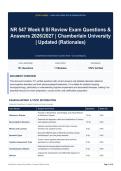
[STUDY GUIDE] • HIGH-YIELD PRACTICE & REVIEW EDITION
NR 547 Week 6 SI Review Exam Questions &
Answers 2026/2027 | Chamberlain University
| Updated (Rationales)
Comprehensive Examination Question Bank • Concept Mapping
TOTAL QUESTIONS EXAM TOPICS RATIONALES
101 Questions 11 Modules 100% Verified
DOCUMENT OVERVIEW
This document contains 101 verified questions with correct answers and detailed rationales related to
neurocognitive disorders and their pharmacological treatments. It is suitable for students studying
neuropsychology, particularly in understanding cognitive impairments and associated therapies, making it an
essential resource for exam preparation, course review, and certification preparation.
EXAM BLUEPRINT & TOPIC DISTRIBUTION
Systematic breakdown of subject domains and exam coverage.
Topic Module Scope & Core Focus Questions Share (%)
Focuses on the genetics, neuroimaging, and clinical features
Alzheimer's Disease of Alzheimer's disease. 10 Qs 9.9%
Examines the diagnostic criteria and classifications of various
Neurocognitive Disorders neurocognitive disorders. 10 Qs 9.9%
Explores neurotransmitters and their roles in memory
Memory and Learning formation and cognitive function. 9 Qs 8.9%
Discusses different types of dementia including vascular,
Dementia Types frontotemporal, and Lewy body dementia. 9 Qs 8.9%
Covers various cognitive assessment tools and their
Cognitive Assessment Tools applications in clinical settings. 9 Qs 8.9%
Examines the pharmacological mechanisms and
Cholinesterase Inhibitors considerations of cholinesterase inhibitors. 9 Qs 8.9%
Analyzes the characteristics and differential diagnosis of
Delirium delirium. 9 Qs 8.9%
Confidential • Student Study Edition • Practice & Review Guide Page 1 of 35
,STUDENT STUDY & MASTERY EDITION PRACTICE & REVIEW GUIDE
Identifies the stages and characteristics of mild cognitive
Mild Cognitive Impairment impairment. 9 Qs 8.9%
Pharmacological Treatment of Discusses treatment options for depression in the context of
Depression neurocognitive disorders. 9 Qs 8.9%
Explores neuroimaging methods used to identify brain
Neuroimaging Techniques abnormalities in neurocognitive disorders. 9 Qs 8.9%
Clinical Presentation and Examines common clinical presentations associated with
Symptoms various neurocognitive disorders. 9 Qs 8.9%
Total Exam Coverage 11 Integrated Topic Modules 101 Qs 100.0%
Confidential • Student Study Edition • Practice & Review Guide Page 2 of 35
,STUDENT STUDY & MASTERY EDITION PRACTICE & REVIEW GUIDE
TOPIC 1: ALZHEIMER'S DISEASE
10 Questions • 9.9% of Exam • Focuses on the genetics, neuroimaging, and clinical features of Alzheimer's disease.
QUESTION 1
Genetics AD
Answer: Genes play a strong role- heritability of 58-79% for late onset and over 90% for early onset.
Rationale: The provided answer correctly identifies the significant genetic influence on Alzheimer's disease
(AD). It highlights that heritability estimates for late-onset AD range from 58% to 79%, and for earlyonset AD, it exceeds
90%, indicating a strong genetic predisposition.
QUESTION 2
Neural networks AD
Answer: Damage to synapses, mitochondrial abnormalities, and inflammatory processes cause NTM failure
and neuronal death.
Rationale: Neurotransmitter (NTM) failure in Alzheimer's disease (AD) stems from damage to synapses, which are critical
for neuronal communication. Additionally, mitochondrial abnormalities impair energy production within neurons, and
inflammatory processes contribute to neuronal degeneration.
QUESTION 3
Does AD lead to an increase or decrease in this NTM activity
Answer: Leads to a decrease in NTM activity.
Rationale: Leads to a decrease in NTM activity, a hallmark of Alzheimer's disease (AD), are known to disrupt synaptic
function. This disruption is mediated, in part, by Aβ's interaction with neuronal receptors and signaling pathways.
Confidential • Student Study Edition • Practice & Review Guide Page 3 of 35
, STUDENT STUDY & MASTERY EDITION PRACTICE & REVIEW GUIDE
QUESTION 4
What are the hallmark signs on neuroimaging studies that distinguish AD from other
disorders?
Answer: Amyloid plaques and neurofibrillary tangles.
Rationale: Amyloid plaques and neurofibrillary tangles are the defining neuropathological hallmarks of Alzheimer's disease
(AD). While neuroimaging cannot directly visualize these microscopic structures, their presence leads to characteristic
macroscopic changes that can be detected.
QUESTION 5
WHAT ARE THE TWO HALLMARKS OF AD?
Answer: Amyloid plaques and neurofibrillary tangles -•Responsible for issues with memory and higherlevel
thinking.
Rationale: Alzheimer's disease (AD) is pathologically defined by the presence of extracellular amyloid plaques and
intracellular neurofibrillary tangles. These protein aggregates disrupt normal neuronal function and synaptic transmission,
leading to the cognitive deficits characteristic of AD, such as memory impairment and difficulties with higher-level cognitive
processes.
QUESTION 6
Major Neurocognitive disorder d/t a specific medical etiology:
Answer: •Parkinson's disease, traumatic brain injury, HIV infection, Huntington's disease, prion disease (e.g.,
Creutzfeldt-Jakob disease), frontotemporal lobar degeneration (e.g., Pick's disease), Lewy body disease,
vascular disease, and Alzheimer's disease.
Rationale: Major neurocognitive disorders can be caused by specific underlying medical conditions. The provided answer
lists several such conditions, including neurodegenerative diseases like Parkinson's, Huntington's, and Alzheimer's, as well
as acquired conditions such as traumatic brain injury, HIV infection, and vascular disease.
Confidential • Student Study Edition • Practice & Review Guide Page 4 of 35
NR 547 Week 6 SI Review Exam Questions &
Answers 2026/2027 | Chamberlain University
| Updated (Rationales)
Comprehensive Examination Question Bank • Concept Mapping
TOTAL QUESTIONS EXAM TOPICS RATIONALES
101 Questions 11 Modules 100% Verified
DOCUMENT OVERVIEW
This document contains 101 verified questions with correct answers and detailed rationales related to
neurocognitive disorders and their pharmacological treatments. It is suitable for students studying
neuropsychology, particularly in understanding cognitive impairments and associated therapies, making it an
essential resource for exam preparation, course review, and certification preparation.
EXAM BLUEPRINT & TOPIC DISTRIBUTION
Systematic breakdown of subject domains and exam coverage.
Topic Module Scope & Core Focus Questions Share (%)
Focuses on the genetics, neuroimaging, and clinical features
Alzheimer's Disease of Alzheimer's disease. 10 Qs 9.9%
Examines the diagnostic criteria and classifications of various
Neurocognitive Disorders neurocognitive disorders. 10 Qs 9.9%
Explores neurotransmitters and their roles in memory
Memory and Learning formation and cognitive function. 9 Qs 8.9%
Discusses different types of dementia including vascular,
Dementia Types frontotemporal, and Lewy body dementia. 9 Qs 8.9%
Covers various cognitive assessment tools and their
Cognitive Assessment Tools applications in clinical settings. 9 Qs 8.9%
Examines the pharmacological mechanisms and
Cholinesterase Inhibitors considerations of cholinesterase inhibitors. 9 Qs 8.9%
Analyzes the characteristics and differential diagnosis of
Delirium delirium. 9 Qs 8.9%
Confidential • Student Study Edition • Practice & Review Guide Page 1 of 35
,STUDENT STUDY & MASTERY EDITION PRACTICE & REVIEW GUIDE
Identifies the stages and characteristics of mild cognitive
Mild Cognitive Impairment impairment. 9 Qs 8.9%
Pharmacological Treatment of Discusses treatment options for depression in the context of
Depression neurocognitive disorders. 9 Qs 8.9%
Explores neuroimaging methods used to identify brain
Neuroimaging Techniques abnormalities in neurocognitive disorders. 9 Qs 8.9%
Clinical Presentation and Examines common clinical presentations associated with
Symptoms various neurocognitive disorders. 9 Qs 8.9%
Total Exam Coverage 11 Integrated Topic Modules 101 Qs 100.0%
Confidential • Student Study Edition • Practice & Review Guide Page 2 of 35
,STUDENT STUDY & MASTERY EDITION PRACTICE & REVIEW GUIDE
TOPIC 1: ALZHEIMER'S DISEASE
10 Questions • 9.9% of Exam • Focuses on the genetics, neuroimaging, and clinical features of Alzheimer's disease.
QUESTION 1
Genetics AD
Answer: Genes play a strong role- heritability of 58-79% for late onset and over 90% for early onset.
Rationale: The provided answer correctly identifies the significant genetic influence on Alzheimer's disease
(AD). It highlights that heritability estimates for late-onset AD range from 58% to 79%, and for earlyonset AD, it exceeds
90%, indicating a strong genetic predisposition.
QUESTION 2
Neural networks AD
Answer: Damage to synapses, mitochondrial abnormalities, and inflammatory processes cause NTM failure
and neuronal death.
Rationale: Neurotransmitter (NTM) failure in Alzheimer's disease (AD) stems from damage to synapses, which are critical
for neuronal communication. Additionally, mitochondrial abnormalities impair energy production within neurons, and
inflammatory processes contribute to neuronal degeneration.
QUESTION 3
Does AD lead to an increase or decrease in this NTM activity
Answer: Leads to a decrease in NTM activity.
Rationale: Leads to a decrease in NTM activity, a hallmark of Alzheimer's disease (AD), are known to disrupt synaptic
function. This disruption is mediated, in part, by Aβ's interaction with neuronal receptors and signaling pathways.
Confidential • Student Study Edition • Practice & Review Guide Page 3 of 35
, STUDENT STUDY & MASTERY EDITION PRACTICE & REVIEW GUIDE
QUESTION 4
What are the hallmark signs on neuroimaging studies that distinguish AD from other
disorders?
Answer: Amyloid plaques and neurofibrillary tangles.
Rationale: Amyloid plaques and neurofibrillary tangles are the defining neuropathological hallmarks of Alzheimer's disease
(AD). While neuroimaging cannot directly visualize these microscopic structures, their presence leads to characteristic
macroscopic changes that can be detected.
QUESTION 5
WHAT ARE THE TWO HALLMARKS OF AD?
Answer: Amyloid plaques and neurofibrillary tangles -•Responsible for issues with memory and higherlevel
thinking.
Rationale: Alzheimer's disease (AD) is pathologically defined by the presence of extracellular amyloid plaques and
intracellular neurofibrillary tangles. These protein aggregates disrupt normal neuronal function and synaptic transmission,
leading to the cognitive deficits characteristic of AD, such as memory impairment and difficulties with higher-level cognitive
processes.
QUESTION 6
Major Neurocognitive disorder d/t a specific medical etiology:
Answer: •Parkinson's disease, traumatic brain injury, HIV infection, Huntington's disease, prion disease (e.g.,
Creutzfeldt-Jakob disease), frontotemporal lobar degeneration (e.g., Pick's disease), Lewy body disease,
vascular disease, and Alzheimer's disease.
Rationale: Major neurocognitive disorders can be caused by specific underlying medical conditions. The provided answer
lists several such conditions, including neurodegenerative diseases like Parkinson's, Huntington's, and Alzheimer's, as well
as acquired conditions such as traumatic brain injury, HIV infection, and vascular disease.
Confidential • Student Study Edition • Practice & Review Guide Page 4 of 35