[STUDY GUIDE] • HIGH-YIELD PRACTICE & REVIEW EDITION
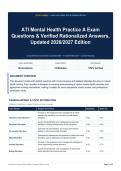
ATI Mental Health Practice A Exam
Questions & Verified Rationalized Answers,
Updated 2026/2027 Edition
Comprehensive Examination Question Bank • In-Depth Rationales • Concept Mapping
TOTAL QUESTIONS EXAM TOPICS RATIONALES
60 Questions 14 Modules 100% Verified
DOCUMENT OVERVIEW
This document contains 60 verified questions with correct answers and detailed rationales focusing on mental
health nursing. Each question is designed to enhance understanding of various mental health disorders and
appropriate nursing interventions, making it suitable for exam preparation, course review, and professional
certification study.
EXAM BLUEPRINT & TOPIC DISTRIBUTION
Systematic breakdown of subject domains and exam coverage.
Topic Module Scope & Core Focus Questions Share (%)
Focuses on the assessment and management of clients
experiencing substance use disorders and withdrawal
Substance Use Disorders symptoms. 5 Qs 8.3%
Covers the identification and management of psychotic
Psychotic Disorders disorders, including schizophrenia and its symptoms. 5 Qs 8.3%
Examines the characteristics and nursing interventions
Personality Disorders related to various personality disorders. 5 Qs 8.3%
Addresses the assessment and treatment of clients with mood
Mood Disorders disorders, such as depression and bipolar disorder. 5 Qs 8.3%
Focuses on the assessment and management strategies for
Anxiety Disorders clients experiencing anxiety disorders. 4 Qs 6.7%
Covers the identification and management of clients with
Eating Disorders eating disorders like anorexia nervosa. 4 Qs 6.7%
Confidential • Student Study Edition • Practice & Review Guide Page 1 of 23
,STUDENT STUDY & MASTERY EDITION PRACTICE & REVIEW GUIDE
Explores the assessment and care considerations for clients
Cognitive Disorders with cognitive disorders, including dementia. 4 Qs 6.7%
Examines the pharmacological interventions for various
Medication Management mental health conditions and their implications. 4 Qs 6.7%
Focuses on the importance of effective communication in
Therapeutic Communication establishing therapeutic relationships with clients. 4 Qs 6.7%
Addresses the nursing approach to clients experiencing crises
Crisis Intervention and acute mental health challenges. 4 Qs 6.7%
Legal and Ethical Issues in Covers the legal and ethical considerations relevant to mental
Mental Health health nursing practice. 4 Qs 6.7%
Examines the dynamics and nursing interventions related to
Group Therapy group therapy settings. 4 Qs 6.7%
Focuses on the assessment techniques used for various
Assessment Techniques mental health conditions. 4 Qs 6.7%
Explores behavioral therapies and interventions applicable to
Behavioral Interventions various mental health disorders. 4 Qs 6.7%
Total Exam Coverage 14 Integrated Topic Modules 60 Qs 100.0%
Confidential • Student Study Edition • Practice & Review Guide Page 2 of 23
, STUDENT STUDY & MASTERY EDITION PRACTICE & REVIEW GUIDE
TOPIC 1: SUBSTANCE USE DISORDERS
5 Questions • 8.3% of Exam • Focuses on the assessment and management of clients experiencing substance use disorders and
withdrawal symptoms.
QUESTION 1
A nurse is assessing a client who recently used cocaine. Which of the following
findings should the nurse expect?
Correct Answer: Hypertension.
Rationale: Cocaine use can lead to increased heart rate and blood pressure due to its vasoconstrictive properties, causing
blood vessels to constrict and increase the workload on the heart, resulting in hypertension. As a result, the nurse should
expect to find elevated blood pressure readings in the client who recently used cocaine.
QUESTION 2
A nurse is caring for a client who is experiencing alcohol withdrawal. Which of the
following medications should the nurse administer first?
Correct Answer: Diazepam 5 mg IV bolus.
Rationale: Administering Diazepam 5 mg IV bolus first helps to rapidly reduce the client's anxiety and agitation associated
with alcohol withdrawal, thereby preventing the progression to more severe symptoms such as seizures and delirium
tremens. Diazepam's benzodiazepine action helps to modulate the GABA receptors in the brain, countering the excitatory
effects caused by the withdrawal of alcohol, which is a GABA receptor agonist.
QUESTION 3
A nurse in the emergency department is caring for a client who has alcohol toxicity and
is unresponsive. Which of the following interventions should the nurse take?
Correct Answer: Gather supplies for endotracheal intubation.
Rationale: The nurse should gather supplies for endotracheal intubation because the client's unresponsiveness due to
alcohol toxicity indicates a high risk of aspiration, making endotracheal intubation a necessary measure to protect the airway
and ensure safe ventilation. This intervention is crucial in a clinical setting where clients with altered mental status are at risk
of airway compromise.
Confidential • Student Study Edition • Practice & Review Guide Page 3 of 23
ATI Mental Health Practice A Exam
Questions & Verified Rationalized Answers,
Updated 2026/2027 Edition
Comprehensive Examination Question Bank • In-Depth Rationales • Concept Mapping
TOTAL QUESTIONS EXAM TOPICS RATIONALES
60 Questions 14 Modules 100% Verified
DOCUMENT OVERVIEW
This document contains 60 verified questions with correct answers and detailed rationales focusing on mental
health nursing. Each question is designed to enhance understanding of various mental health disorders and
appropriate nursing interventions, making it suitable for exam preparation, course review, and professional
certification study.
EXAM BLUEPRINT & TOPIC DISTRIBUTION
Systematic breakdown of subject domains and exam coverage.
Topic Module Scope & Core Focus Questions Share (%)
Focuses on the assessment and management of clients
experiencing substance use disorders and withdrawal
Substance Use Disorders symptoms. 5 Qs 8.3%
Covers the identification and management of psychotic
Psychotic Disorders disorders, including schizophrenia and its symptoms. 5 Qs 8.3%
Examines the characteristics and nursing interventions
Personality Disorders related to various personality disorders. 5 Qs 8.3%
Addresses the assessment and treatment of clients with mood
Mood Disorders disorders, such as depression and bipolar disorder. 5 Qs 8.3%
Focuses on the assessment and management strategies for
Anxiety Disorders clients experiencing anxiety disorders. 4 Qs 6.7%
Covers the identification and management of clients with
Eating Disorders eating disorders like anorexia nervosa. 4 Qs 6.7%
Confidential • Student Study Edition • Practice & Review Guide Page 1 of 23
,STUDENT STUDY & MASTERY EDITION PRACTICE & REVIEW GUIDE
Explores the assessment and care considerations for clients
Cognitive Disorders with cognitive disorders, including dementia. 4 Qs 6.7%
Examines the pharmacological interventions for various
Medication Management mental health conditions and their implications. 4 Qs 6.7%
Focuses on the importance of effective communication in
Therapeutic Communication establishing therapeutic relationships with clients. 4 Qs 6.7%
Addresses the nursing approach to clients experiencing crises
Crisis Intervention and acute mental health challenges. 4 Qs 6.7%
Legal and Ethical Issues in Covers the legal and ethical considerations relevant to mental
Mental Health health nursing practice. 4 Qs 6.7%
Examines the dynamics and nursing interventions related to
Group Therapy group therapy settings. 4 Qs 6.7%
Focuses on the assessment techniques used for various
Assessment Techniques mental health conditions. 4 Qs 6.7%
Explores behavioral therapies and interventions applicable to
Behavioral Interventions various mental health disorders. 4 Qs 6.7%
Total Exam Coverage 14 Integrated Topic Modules 60 Qs 100.0%
Confidential • Student Study Edition • Practice & Review Guide Page 2 of 23
, STUDENT STUDY & MASTERY EDITION PRACTICE & REVIEW GUIDE
TOPIC 1: SUBSTANCE USE DISORDERS
5 Questions • 8.3% of Exam • Focuses on the assessment and management of clients experiencing substance use disorders and
withdrawal symptoms.
QUESTION 1
A nurse is assessing a client who recently used cocaine. Which of the following
findings should the nurse expect?
Correct Answer: Hypertension.
Rationale: Cocaine use can lead to increased heart rate and blood pressure due to its vasoconstrictive properties, causing
blood vessels to constrict and increase the workload on the heart, resulting in hypertension. As a result, the nurse should
expect to find elevated blood pressure readings in the client who recently used cocaine.
QUESTION 2
A nurse is caring for a client who is experiencing alcohol withdrawal. Which of the
following medications should the nurse administer first?
Correct Answer: Diazepam 5 mg IV bolus.
Rationale: Administering Diazepam 5 mg IV bolus first helps to rapidly reduce the client's anxiety and agitation associated
with alcohol withdrawal, thereby preventing the progression to more severe symptoms such as seizures and delirium
tremens. Diazepam's benzodiazepine action helps to modulate the GABA receptors in the brain, countering the excitatory
effects caused by the withdrawal of alcohol, which is a GABA receptor agonist.
QUESTION 3
A nurse in the emergency department is caring for a client who has alcohol toxicity and
is unresponsive. Which of the following interventions should the nurse take?
Correct Answer: Gather supplies for endotracheal intubation.
Rationale: The nurse should gather supplies for endotracheal intubation because the client's unresponsiveness due to
alcohol toxicity indicates a high risk of aspiration, making endotracheal intubation a necessary measure to protect the airway
and ensure safe ventilation. This intervention is crucial in a clinical setting where clients with altered mental status are at risk
of airway compromise.
Confidential • Student Study Edition • Practice & Review Guide Page 3 of 23