[STUDY GUIDE] • HIGH-YIELD PRACTICE & REVIEW EDITION
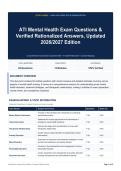
ATI Mental Health Exam Questions &
Verified Rationalized Answers, Updated
2026/2027 Edition
Comprehensive Examination Question Bank • In-Depth Rationales • Concept Mapping
TOTAL QUESTIONS EXAM TOPICS RATIONALES
82 Questions 12 Modules 100% Verified
DOCUMENT OVERVIEW
This document contains 82 verified questions with correct answers and detailed rationales covering various
aspects of mental health nursing. It serves as a comprehensive resource for understanding acute mental
health disorders, treatment strategies, and therapeutic relationships, making it suitable for exam preparation,
course review, and competency evaluation.
EXAM BLUEPRINT & TOPIC DISTRIBUTION
Systematic breakdown of subject domains and exam coverage.
Topic Module Scope & Core Focus Questions Share (%)
Focuses on the principles and components of conducting
Mental Status Examination mental status exams. 7 Qs 8.5%
Addresses the nursing approaches and interventions in
Crisis Intervention emergency mental health situations. 7 Qs 8.5%
Explores the stages and characteristics of nurse-client
Therapeutic Relationships therapeutic relationships. 7 Qs 8.5%
Covers various anxiety disorders and appropriate nursing
Anxiety Disorders interventions. 7 Qs 8.5%
Examines the assessment and treatment strategies for mood
Mood Disorders disorders like depression and bipolar disorder. 7 Qs 8.5%
Focuses on the characteristics and management of various
Personality Disorders personality disorders. 7 Qs 8.5%
Covers assessment and management of psychotic disorders
Psychotic Disorders including schizophrenia and schizoaffective disorder. 7 Qs 8.5%
Confidential • Student Study Edition • Practice & Review Guide Page 1 of 43
,STUDENT STUDY & MASTERY EDITION PRACTICE & REVIEW GUIDE
Addresses the implications and nursing care for clients with
Substance Use Disorders substance use disorders. 7 Qs 8.5%
Explores the assessment and nursing care strategies for
Cognitive Disorders clients with cognitive impairments like dementia. 7 Qs 8.5%
Examines the effects of stress and various coping
Stress and Coping Strategies mechanisms in mental health. 7 Qs 8.5%
Focuses on the role of community mental health services and
Community Mental Health the nurse’s role in community settings. 6 Qs 7.3%
Covers nursing interventions for clients experiencing trauma
Crisis and Trauma Responses and acute stress reactions. 6 Qs 7.3%
Total Exam Coverage 12 Integrated Topic Modules 82 Qs 100.0%
Confidential • Student Study Edition • Practice & Review Guide Page 2 of 43
,STUDENT STUDY & MASTERY EDITION PRACTICE & REVIEW GUIDE
TOPIC 1: MENTAL STATUS EXAMINATION
7 Questions • 8.5% of Exam • Focuses on the principles and components of conducting mental status exams.
QUESTION 1
A charge nurse is discussing mental status exams with a newly licensed nurse. Which
of the following statements by the newly licensed nurse indicates an understanding of
the teaching? (Select all that apply)
[A)] To assess cognitive ability, I should ask the client to count backward by sevens.
[B)] To assess affect, I should observe the client's facial expression
[C)] To assess language ability, I should instruct the client to write a sentence.
[D)] To assess remote memory, I should have the client repeat a list of objects.
[E)] To assess the client's abstract thinking, I should ask the client to identify our most recent presidents.
Correct Answer: A, B, C.
Rationale: B and C are the correct answers because they demonstrate a basic understanding of how to assess various
aspects of a mental status exam, specifically affect and language ability. Asking the client to write a sentence (C) is an
appropriate method for assessing language ability, and observing the client's facial expression (B) is a way to assess affect,
which is a nonverbal expression of emotion.
QUESTION 2
A nurse is planning a peer group about the DSM-5. Which of the following information
is appropriate to include in the discussion? (Select all that apply).
[A)] The DSM-5 includes client education handouts for mental health disorders.
[B)] The DSM-5 establishes diagnostic criteria for individual mental health disorders.
[C)] The DSM-5 indicates recommended pharmacological treatment for mental health disorders.
[D)] The DSM-5 assists nurses in planning care for client's who have mental health disorders.
[E)] The DSM-5 indicates expected assessment findings of mental health disorders.
Correct Answer: B, D, E.
Rationale: The correct answer, "B, D, E", is due to its focus on the core aspects of the DSM-5, specifically diagnostic
criteria, care planning, and assessment findings, which are fundamental components of the manual. The other options, such
as client education handouts and pharmacological treatment recommendations, are not primary functions of the DSM-5,
making B, D, andE the most appropriate choices.
Confidential • Student Study Edition • Practice & Review Guide Page 3 of 43
, STUDENT STUDY & MASTERY EDITION PRACTICE & REVIEW GUIDE
QUESTION 3
A nurse decides to put a client who has a psychotic disorder in seclusion overnight
because the unit is very shortstaffed, and the client frequently fights with other clients.
The nurse's actions are an example of which of the following torts?
[A)] Invasion of privacy
[B)] False imprisonment
[C)] Assault
[D)] Battery
Correct Answer: B.
Rationale: The correct answer is B) False imprisonment because the nurse's decision to put the client in seclusion without
due process or their consent restricts their freedom and mobility, which is a key element of false imprisonment. This act
deprives the client of their liberty without a valid reason, making it a tort.
QUESTION 4
A client tells a nurse, "Don't tell anyone but I hid a sharp knife under my mattress in
order to protect myself from my roommate, who is always yelling at me and threatening
me." Which of the following actions should the nurse take?
[A)] Keep the client's communication confidential, but talk to the client daily, using therapeutic communication to convince
him to admit to hiding the knife.
[B)] Keep the client's communication confidential, but watch the client and his roommate closely.
[C)] Tell the client that this must be reported to the healthcare team because it concerns the health and safety of the client
and others.
[D)] Report the incident to the health care team, but do not inform the client of the intention to do so.
Correct Answer: D.
Rationale: The nurse has a duty to report any potential harm to the client or others, which is a legal and ethical requirement
in healthcare. By choosing D, the nurse fulfills this duty while also maintaining confidentiality by not informing the client of
the intention to report, thus respecting the client's trust while ensuring the safety of all.
QUESTION 5
A charge nurse is discussing the characteristics of a nurse-client relationship with a
newly licensed nurse. Which of the following characteristics should the nurse include
in the discussion? (Select all that apply)
[A)] The needs of both participants are met
Confidential • Student Study Edition • Practice & Review Guide Page 4 of 43
ATI Mental Health Exam Questions &
Verified Rationalized Answers, Updated
2026/2027 Edition
Comprehensive Examination Question Bank • In-Depth Rationales • Concept Mapping
TOTAL QUESTIONS EXAM TOPICS RATIONALES
82 Questions 12 Modules 100% Verified
DOCUMENT OVERVIEW
This document contains 82 verified questions with correct answers and detailed rationales covering various
aspects of mental health nursing. It serves as a comprehensive resource for understanding acute mental
health disorders, treatment strategies, and therapeutic relationships, making it suitable for exam preparation,
course review, and competency evaluation.
EXAM BLUEPRINT & TOPIC DISTRIBUTION
Systematic breakdown of subject domains and exam coverage.
Topic Module Scope & Core Focus Questions Share (%)
Focuses on the principles and components of conducting
Mental Status Examination mental status exams. 7 Qs 8.5%
Addresses the nursing approaches and interventions in
Crisis Intervention emergency mental health situations. 7 Qs 8.5%
Explores the stages and characteristics of nurse-client
Therapeutic Relationships therapeutic relationships. 7 Qs 8.5%
Covers various anxiety disorders and appropriate nursing
Anxiety Disorders interventions. 7 Qs 8.5%
Examines the assessment and treatment strategies for mood
Mood Disorders disorders like depression and bipolar disorder. 7 Qs 8.5%
Focuses on the characteristics and management of various
Personality Disorders personality disorders. 7 Qs 8.5%
Covers assessment and management of psychotic disorders
Psychotic Disorders including schizophrenia and schizoaffective disorder. 7 Qs 8.5%
Confidential • Student Study Edition • Practice & Review Guide Page 1 of 43
,STUDENT STUDY & MASTERY EDITION PRACTICE & REVIEW GUIDE
Addresses the implications and nursing care for clients with
Substance Use Disorders substance use disorders. 7 Qs 8.5%
Explores the assessment and nursing care strategies for
Cognitive Disorders clients with cognitive impairments like dementia. 7 Qs 8.5%
Examines the effects of stress and various coping
Stress and Coping Strategies mechanisms in mental health. 7 Qs 8.5%
Focuses on the role of community mental health services and
Community Mental Health the nurse’s role in community settings. 6 Qs 7.3%
Covers nursing interventions for clients experiencing trauma
Crisis and Trauma Responses and acute stress reactions. 6 Qs 7.3%
Total Exam Coverage 12 Integrated Topic Modules 82 Qs 100.0%
Confidential • Student Study Edition • Practice & Review Guide Page 2 of 43
,STUDENT STUDY & MASTERY EDITION PRACTICE & REVIEW GUIDE
TOPIC 1: MENTAL STATUS EXAMINATION
7 Questions • 8.5% of Exam • Focuses on the principles and components of conducting mental status exams.
QUESTION 1
A charge nurse is discussing mental status exams with a newly licensed nurse. Which
of the following statements by the newly licensed nurse indicates an understanding of
the teaching? (Select all that apply)
[A)] To assess cognitive ability, I should ask the client to count backward by sevens.
[B)] To assess affect, I should observe the client's facial expression
[C)] To assess language ability, I should instruct the client to write a sentence.
[D)] To assess remote memory, I should have the client repeat a list of objects.
[E)] To assess the client's abstract thinking, I should ask the client to identify our most recent presidents.
Correct Answer: A, B, C.
Rationale: B and C are the correct answers because they demonstrate a basic understanding of how to assess various
aspects of a mental status exam, specifically affect and language ability. Asking the client to write a sentence (C) is an
appropriate method for assessing language ability, and observing the client's facial expression (B) is a way to assess affect,
which is a nonverbal expression of emotion.
QUESTION 2
A nurse is planning a peer group about the DSM-5. Which of the following information
is appropriate to include in the discussion? (Select all that apply).
[A)] The DSM-5 includes client education handouts for mental health disorders.
[B)] The DSM-5 establishes diagnostic criteria for individual mental health disorders.
[C)] The DSM-5 indicates recommended pharmacological treatment for mental health disorders.
[D)] The DSM-5 assists nurses in planning care for client's who have mental health disorders.
[E)] The DSM-5 indicates expected assessment findings of mental health disorders.
Correct Answer: B, D, E.
Rationale: The correct answer, "B, D, E", is due to its focus on the core aspects of the DSM-5, specifically diagnostic
criteria, care planning, and assessment findings, which are fundamental components of the manual. The other options, such
as client education handouts and pharmacological treatment recommendations, are not primary functions of the DSM-5,
making B, D, andE the most appropriate choices.
Confidential • Student Study Edition • Practice & Review Guide Page 3 of 43
, STUDENT STUDY & MASTERY EDITION PRACTICE & REVIEW GUIDE
QUESTION 3
A nurse decides to put a client who has a psychotic disorder in seclusion overnight
because the unit is very shortstaffed, and the client frequently fights with other clients.
The nurse's actions are an example of which of the following torts?
[A)] Invasion of privacy
[B)] False imprisonment
[C)] Assault
[D)] Battery
Correct Answer: B.
Rationale: The correct answer is B) False imprisonment because the nurse's decision to put the client in seclusion without
due process or their consent restricts their freedom and mobility, which is a key element of false imprisonment. This act
deprives the client of their liberty without a valid reason, making it a tort.
QUESTION 4
A client tells a nurse, "Don't tell anyone but I hid a sharp knife under my mattress in
order to protect myself from my roommate, who is always yelling at me and threatening
me." Which of the following actions should the nurse take?
[A)] Keep the client's communication confidential, but talk to the client daily, using therapeutic communication to convince
him to admit to hiding the knife.
[B)] Keep the client's communication confidential, but watch the client and his roommate closely.
[C)] Tell the client that this must be reported to the healthcare team because it concerns the health and safety of the client
and others.
[D)] Report the incident to the health care team, but do not inform the client of the intention to do so.
Correct Answer: D.
Rationale: The nurse has a duty to report any potential harm to the client or others, which is a legal and ethical requirement
in healthcare. By choosing D, the nurse fulfills this duty while also maintaining confidentiality by not informing the client of
the intention to report, thus respecting the client's trust while ensuring the safety of all.
QUESTION 5
A charge nurse is discussing the characteristics of a nurse-client relationship with a
newly licensed nurse. Which of the following characteristics should the nurse include
in the discussion? (Select all that apply)
[A)] The needs of both participants are met
Confidential • Student Study Edition • Practice & Review Guide Page 4 of 43