Pre-master BA – Leadership & Management
Compulsory articles
Victor Roos
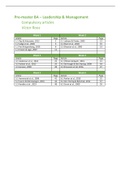
Week 1 Week 2
Article Page Article Page
1.1 Day & Antonakis, 2012 2 2.1 Latham & Pinder, 2005 13
1.2 Judge et al., 2004 5 2.2 Stam et al., 2018 15
1.3 Van Knippenberg, 2020 8 2.3 Sheeran et al., 2005 19
1.4 Vroom & Jago, 2007 11
Week 3 Week 4
Article Page Article Page
3.1 Anderson et al., 2014 22 4.1 O’Brien & Beehr, 2019 31
3.2 Volmer et al., 2012 25 4.2 De Hoogh & Den Hartog, 2009 34
3.3 Janssen, 2000 28 4.3 Kinnunen et all, 2016 37
Week 5 Week 6
Article Page Article Page
5.1 Hammond et al., 1998 41 6.1 Parker et al., 2010 52
5.2 Cascio & Montealegre, 2016 44 6.2 Den Hartog & Belschak, 2012 57
5.3 Handke et al., 2019 48 6.3 Grant et al., 2009 59
,Leadership & Management – Pre-master BA – Compulsory articles
1.1 – Day & Antonakis, 2012; Leadership: past, present, and future
Author: David V. Day & John Antonakis
Year: 2012
1. What is the main idea of the article?
→ Abstract – Introduction – Conclusion– 3/4 sentences
The main idea is that leadership is complex, diverse and difficult to make a cohesive view of, even
though a clearer picture is beginning to emerge. This study uses the accumulated knowledge to
describe the nature of leadership, its antecedents and its consequences. They conclude by defining
leadership as a requirement to direct and guide organizational and human resources toward the
strategic objectives of the organization and ensure that organizational functions are aligned with the
external environment.
2. Why was the research conducted (research gap)?
→ Introduction - Conclusion
Leadership is a complex and diverse field of knowledge and it is still difficult to define precisely. As it is
so complex, a specific and widely accepted definition of leadership does not exist and might never be
found. However, most leadership researchers agree about the following: leadership can be defined as
the nature of the influencing process that occurs between a leader and followers. A definition of
leadership requires it to be differentiated from power and management.
This research summarizes scientific studies that studied the theoretical foundations of leadership
research: how did we get to this point? What are the major theoretical paradigms of leadership?
Where is leadership research heading. The intention is to provide general understanding of how
leadership theory evolved into the major paradigms presented in this book/article.
3. How are the authors trying to convince you?
→ Main part of the article – Methodology
3.1 Hypotheses + reasoning behind hypotheses
-
3.2 Type of research (including type of measurements)
Case study, content analysis
2
Victor Roos
,Leadership & Management – Pre-master BA – Compulsory articles
4. Outcomes
→ Main part of the article – Conclusions
4.1 Results
The researchers divide leadership into nine major schools:
- Trait school of leadership: this school of thought suggested that certain characteristics
differentiated leaders from non-leaders. The focused on identifying robust individual
differences in personality traits that were thought to be associated with effective leadership.
It also often positively related with the big-five personality factors with leader emergence and
effectiveness.
- Behavioral school of leadership: this is mostly associated with the Ohio State University Studies
(OSU studies) and the University of Michigan research (UoM research). They identified two
overarching leadership factors: consideration (supportive, person-oriented leadership) and
initiating structure (directive, task-oriented leadership). Others extended this research to
organization-level effects (e.g. Blake & Mouton, Managerial Grid Model). As there was no
consistent evidence of a universally preferred leadership style across tasks or situations, the
focus shifted towards leadership contingencies.
- Contingency school of leadership: this is mostly associated with Fiedler (who stated that
leader-member relations, task structure, and the position power of the leader determine the
effectiveness of the type of leadership exercised) and House & Dressler (who focused on the
leader’s role in clarifying paths to follower goals). It is not very active anymore as parts of this
literature have led to the development of broader contextual approaches to leadership.
- Contextual school of leadership: -
- Skeptics-of-leadership school: the validity of questionnaire ratings of leadership was criticized
as likely biased by the leadership theories of those providing the ratings.
- Relational school of leadership: following the contingency theory, this movement became
popular. It focuses on the relationships between leaders and followers. High-quality relations
between a leader and the followers are based on trust and mutual respect, while low-quality
relations are based on the fulfillment of contractual obligations.
- New leadership (neo-charismatic/transformational/visionary) school: Bass built on the work
of Burns, House and others that argued that leadership was mainly transaction; that is, they
were focused on the mutual satisfaction of transactional (social exchange) obligations. Bass
however, believed that a different form of leadership was required to account for follower
3
Victor Roos
, Leadership & Management – Pre-master BA – Compulsory articles
outcomes centered on a sense of purpose and an idealized mission, called transformational
leadership. Idealized and inspiring leader behaviors induce followers to transcend their
interests to the greater good. This is the top spot in research the last decade.
- Information processing: this is mostly associated with the work of Lord et al. The focus is on
how and why a leader is legitimized through the process of matching his or her personal
characteristics with the prototypical expectations that followers have of a leader.
- Biological/evolutionary: this is a new research stream, which is somewhat related to the trait
perspective of leadership in terms of measuring individual differences. However, this is harder
science in measuring individual differences, such as biological variables or processes. It also
looks at behavioral genetics of leadership emergence, leadership role occupancy (both men
and women) or the effect of hormones on leadership.
4.2 Implications (practical + theoretical
Leadership is a requirement to direct and guide organizational and human resources toward the
strategic objectives of the organization and ensure that organizational functions are aligned with the
external environment.
4.3 Limitations
-
5. Key constructs
Power: power refers to the means that leaders have to potentially influence others to obtain a certain
goal. There are different types of power: referent power (influence people because they identify with
you), expertise power (influence people because they see you as an expert) and coercive power
(influence people because you are able to punish or reward them).
Management: management is objectives driven, resulting in stability grounded in rationality,
bureaucratic means, and the fulfillment of contractual obligations (i.e., transactions).
4
Victor Roos
Compulsory articles
Victor Roos
Week 1 Week 2
Article Page Article Page
1.1 Day & Antonakis, 2012 2 2.1 Latham & Pinder, 2005 13
1.2 Judge et al., 2004 5 2.2 Stam et al., 2018 15
1.3 Van Knippenberg, 2020 8 2.3 Sheeran et al., 2005 19
1.4 Vroom & Jago, 2007 11
Week 3 Week 4
Article Page Article Page
3.1 Anderson et al., 2014 22 4.1 O’Brien & Beehr, 2019 31
3.2 Volmer et al., 2012 25 4.2 De Hoogh & Den Hartog, 2009 34
3.3 Janssen, 2000 28 4.3 Kinnunen et all, 2016 37
Week 5 Week 6
Article Page Article Page
5.1 Hammond et al., 1998 41 6.1 Parker et al., 2010 52
5.2 Cascio & Montealegre, 2016 44 6.2 Den Hartog & Belschak, 2012 57
5.3 Handke et al., 2019 48 6.3 Grant et al., 2009 59
,Leadership & Management – Pre-master BA – Compulsory articles
1.1 – Day & Antonakis, 2012; Leadership: past, present, and future
Author: David V. Day & John Antonakis
Year: 2012
1. What is the main idea of the article?
→ Abstract – Introduction – Conclusion– 3/4 sentences
The main idea is that leadership is complex, diverse and difficult to make a cohesive view of, even
though a clearer picture is beginning to emerge. This study uses the accumulated knowledge to
describe the nature of leadership, its antecedents and its consequences. They conclude by defining
leadership as a requirement to direct and guide organizational and human resources toward the
strategic objectives of the organization and ensure that organizational functions are aligned with the
external environment.
2. Why was the research conducted (research gap)?
→ Introduction - Conclusion
Leadership is a complex and diverse field of knowledge and it is still difficult to define precisely. As it is
so complex, a specific and widely accepted definition of leadership does not exist and might never be
found. However, most leadership researchers agree about the following: leadership can be defined as
the nature of the influencing process that occurs between a leader and followers. A definition of
leadership requires it to be differentiated from power and management.
This research summarizes scientific studies that studied the theoretical foundations of leadership
research: how did we get to this point? What are the major theoretical paradigms of leadership?
Where is leadership research heading. The intention is to provide general understanding of how
leadership theory evolved into the major paradigms presented in this book/article.
3. How are the authors trying to convince you?
→ Main part of the article – Methodology
3.1 Hypotheses + reasoning behind hypotheses
-
3.2 Type of research (including type of measurements)
Case study, content analysis
2
Victor Roos
,Leadership & Management – Pre-master BA – Compulsory articles
4. Outcomes
→ Main part of the article – Conclusions
4.1 Results
The researchers divide leadership into nine major schools:
- Trait school of leadership: this school of thought suggested that certain characteristics
differentiated leaders from non-leaders. The focused on identifying robust individual
differences in personality traits that were thought to be associated with effective leadership.
It also often positively related with the big-five personality factors with leader emergence and
effectiveness.
- Behavioral school of leadership: this is mostly associated with the Ohio State University Studies
(OSU studies) and the University of Michigan research (UoM research). They identified two
overarching leadership factors: consideration (supportive, person-oriented leadership) and
initiating structure (directive, task-oriented leadership). Others extended this research to
organization-level effects (e.g. Blake & Mouton, Managerial Grid Model). As there was no
consistent evidence of a universally preferred leadership style across tasks or situations, the
focus shifted towards leadership contingencies.
- Contingency school of leadership: this is mostly associated with Fiedler (who stated that
leader-member relations, task structure, and the position power of the leader determine the
effectiveness of the type of leadership exercised) and House & Dressler (who focused on the
leader’s role in clarifying paths to follower goals). It is not very active anymore as parts of this
literature have led to the development of broader contextual approaches to leadership.
- Contextual school of leadership: -
- Skeptics-of-leadership school: the validity of questionnaire ratings of leadership was criticized
as likely biased by the leadership theories of those providing the ratings.
- Relational school of leadership: following the contingency theory, this movement became
popular. It focuses on the relationships between leaders and followers. High-quality relations
between a leader and the followers are based on trust and mutual respect, while low-quality
relations are based on the fulfillment of contractual obligations.
- New leadership (neo-charismatic/transformational/visionary) school: Bass built on the work
of Burns, House and others that argued that leadership was mainly transaction; that is, they
were focused on the mutual satisfaction of transactional (social exchange) obligations. Bass
however, believed that a different form of leadership was required to account for follower
3
Victor Roos
, Leadership & Management – Pre-master BA – Compulsory articles
outcomes centered on a sense of purpose and an idealized mission, called transformational
leadership. Idealized and inspiring leader behaviors induce followers to transcend their
interests to the greater good. This is the top spot in research the last decade.
- Information processing: this is mostly associated with the work of Lord et al. The focus is on
how and why a leader is legitimized through the process of matching his or her personal
characteristics with the prototypical expectations that followers have of a leader.
- Biological/evolutionary: this is a new research stream, which is somewhat related to the trait
perspective of leadership in terms of measuring individual differences. However, this is harder
science in measuring individual differences, such as biological variables or processes. It also
looks at behavioral genetics of leadership emergence, leadership role occupancy (both men
and women) or the effect of hormones on leadership.
4.2 Implications (practical + theoretical
Leadership is a requirement to direct and guide organizational and human resources toward the
strategic objectives of the organization and ensure that organizational functions are aligned with the
external environment.
4.3 Limitations
-
5. Key constructs
Power: power refers to the means that leaders have to potentially influence others to obtain a certain
goal. There are different types of power: referent power (influence people because they identify with
you), expertise power (influence people because they see you as an expert) and coercive power
(influence people because you are able to punish or reward them).
Management: management is objectives driven, resulting in stability grounded in rationality,
bureaucratic means, and the fulfillment of contractual obligations (i.e., transactions).
4
Victor Roos