

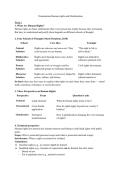
Transnational human rights and Globalisation
Week 1
1. What Are Human Rights?
Human rights are basic entitlements that every person has simply because they are human.
But how we understand and justify them depends on different schools of thought.
2. Four Schools of Thought (Marie Dembour, 2010)
School Core Idea Example
Natural Rights are inherent and universal. They “The right to life is
Scholars exist because we are human. self-evident.”
Deliberative Rights arise through democratic debate Rights are defined by
Scholars and agreement. collective political will.
Protest Rights are tools of struggle used by Civil rights movements.
Scholars oppressed groups to challenge injustice.
Discourse Rights are socially constructed, shaped by Rights reflect dominant
Scholars power, culture, and history. cultural narratives.
In short: these are four ways to explain what rights are and where they come from — moral
truth, consensus, resistance, or social discourse.
3. Three Perspectives on Human Rights
Perspective Focus Question it asks
Technical Legal structure What do human rights mean in law?
Transnational Cross-border How do rights apply beyond one country’s
application borders?
Globalisation Normative How is globalisation changing the very meaning
transformation of rights?
4. Technical perspective
Human rights law protects key human interests and balances individual rights with public
goals.
Scope: Who is protected (personal scope) and what is protected (material scope).
Interference: When a right is restricted or violated.
Limitations:
● Absolute rights (e.g., no torture) can’t be limited.
● Qualified rights (e.g., freedom of expression) can be limited, but only when:
- Based on law
- For a legitimate aim (e.g., national security)
, - Proportionate (least intrusive way possible)
Obligations of States:
- Respect – don’t violate rights directly.
- Protect – prevent third parties from violating rights.
- Fulfil – take steps (laws, resources) to realise rights.
Generations of Rights:
1. First: Civil and political (liberty, expression).
2. Second: Socio-economic (education, health).
3. Third: Collective/solidarity (environment, peace, development).
5. Transnational perspective
Human rights challenges increasingly cross national lines.
Key issues:
- Jurisdiction: Can a state be responsible for harm beyond its borders?
- Interference: Often involves multiple actors (states, companies, organizations).
- Attribution: How do we assign responsibility — especially to non-state actors?
Examples:
- Cross-border pollution: Factories in one country harm people in another.
- Passenger Name Record (PNR) data exchange: Privacy concerns when states and
airlines share personal data.
- Private security firms: Non-state actors may commit human rights abuses abroad —
who is responsible?
6. Globalisation perspective
Globalisation blurs borders (through digital networks, trade, finance, migration) making it
harder to say where responsibility lies.
● Law beyond borders: Global governance includes corporations, NGOs, and
international bodies.
● Changing role of territory: Rights issues are no longer purely national.
● New actors: Non-state actors now shape norms and accountability.
New questions of justice:
- Is sovereignty outdated?
- Can we achieve global justice through human rights?
- Do we need cosmopolitan (borderless) justice, or a stronger nation-state to enforce
rights?
7. Integrating It All
When applying these perspectives to a case or essay:
- Use the technical lens to explain the law.
- Use the transnational lens to examine cross-border implications.
- Use the globalisation lens to question deeper changes in justice and authority.
, Transnational human rights and Globalisation
Week 2
Milieudefensie et al v Royal Dutch Shell ECLI:NL:RBDHA:2021:5337
Background
In 2019, Milieudefensie (Friends of the Earth Netherlands), together with several NGOs
(Greenpeace NL, Fossielvrij NL, Waddenvereniging, Both ENDS, Jongeren Milieu Actief,
ActionAid) and over 17,000 individuals, sued Royal Dutch Shell (RDS) before the District
Court of The Hague.They argued that Shell’s global activities contributed significantly to
climate change, threatening human rights and violating an unwritten duty of care under
Dutch tort law (Article 6:162 BW). They demanded that Shell reduce its CO₂ emissions
(Scopes 1–3) by at least 45% by 2030 compared to 2019, consistent with the Paris
Agreement and IPCC pathways.
Legal Question
Was RDS, as the policy-setting parent company of the Shell group, legally obliged under
Dutch tort law to reduce global CO₂ emissions from its own operations, its subsidiaries,
suppliers, and customers, in order to prevent dangerous climate change?
Court’s Reasoning
The Hague District Court held that:
- Dutch law applies (via Article 7 Rome II), since RDS determines Shell’s overall
policy from its headquarters in the Netherlands.
The unwritten duty of care in Article 6:162 BW must be interpreted in light of:
- Human rights (Articles 2 and 8 ECHR; Articles 6 and 17 ICCPR — right to life and
family life);
- The UN Guiding Principles on Business and Human Rights (UNGPs);
- Scientific consensus and international standards like the Paris Agreement and
IPCC reports.
● The court recognized that climate change poses serious, foreseeable, and irreversible
risks to people in the Netherlands (including the Wadden Sea region).
● As a major global emitter, Shell has a significant role and an individual responsibility to
reduce emissions.
● RDS has a result-based duty for emissions from the Shell group’s own operations
(Scopes 1 and 2) and a strong best-efforts duty for emissions from its suppliers and
customers (Scope 3).
Ruling
The court ordered RDS to:
- Reduce the total CO₂ emissions of the Shell group (Scopes 1–3) by a net 45% by the
end of 2030, relative to 2019 levels.
- Implement this through group policy.
- The judgment is provisionally enforceable (uitvoerbaar bij voorraad).
- Other claims (such as declaratory judgments and global enforcement) were rejected.
, - ActionAid and individual claimants were declared inadmissible (no direct standing).
- RDS was ordered to pay the plaintiffs’ legal costs.
Significance
● This was the first court decision in the world to impose a legally binding emission
reduction obligation on a private company based on human rights and tort law.
● It extended corporate accountability for climate change beyond national regulations.
● The case inspired similar actions worldwide (against TotalEnergies, Exxon, etc.).
● The ruling emphasized that private corporations share responsibility in preventing
dangerous climate change, not just states.
● It also confirmed that Dutch courts can apply national tort law extraterritorially when
harm affects Dutch residents.
Questions:
1. Scope of application: how does each case/communication consider jurisdiction and
extra-territoriality?
Jurisdiction (territorial link):
The District Court of The Hague held that Dutch law was applicable and that it had
jurisdiction because Royal Dutch Shell (RDS) — the parent company of the global Shell
group — is located in the Netherlands and determines the group’s global policy from its
headquarters in The Hague.
→ Therefore, the court’s jurisdiction was based on the seat of the company, not on where
the emissions occurred.
Extraterritorial reach:
The ruling had global implications, since it required RDS to reduce worldwide CO₂
emissions (Scopes 1–3).
- These emissions mostly arise outside the Netherlands, but the court reasoned that
climate change has global effects, including in the Netherlands (affecting its residents
and the Wadden Sea region).
- Hence, Dutch law could be applied extraterritorially to RDS’s global corporate
policy because of the foreseeable domestic effects and RDS’s policy control over the
entire group.
The court explicitly invoked Article 7 of the Rome II Regulation, which allows claimants in
environmental harm cases to choose the law of the country where the damage occurs or
where the harmful event originated. Here, the “harmful event” was the policy-setting in the
Netherlands, which contributed to climate harm globally but with domestic consequences.
Conclusion:
The case expands jurisdiction and extraterritoriality in private law: a Dutch parent
company can be held responsible for global emissions if these contribute to domestic human
rights risks.
2. Personal scope: who are the victims?
The court limited standing and “victim” status as follows:
1. Admissible claimants:
Week 1
1. What Are Human Rights?
Human rights are basic entitlements that every person has simply because they are human.
But how we understand and justify them depends on different schools of thought.
2. Four Schools of Thought (Marie Dembour, 2010)
School Core Idea Example
Natural Rights are inherent and universal. They “The right to life is
Scholars exist because we are human. self-evident.”
Deliberative Rights arise through democratic debate Rights are defined by
Scholars and agreement. collective political will.
Protest Rights are tools of struggle used by Civil rights movements.
Scholars oppressed groups to challenge injustice.
Discourse Rights are socially constructed, shaped by Rights reflect dominant
Scholars power, culture, and history. cultural narratives.
In short: these are four ways to explain what rights are and where they come from — moral
truth, consensus, resistance, or social discourse.
3. Three Perspectives on Human Rights
Perspective Focus Question it asks
Technical Legal structure What do human rights mean in law?
Transnational Cross-border How do rights apply beyond one country’s
application borders?
Globalisation Normative How is globalisation changing the very meaning
transformation of rights?
4. Technical perspective
Human rights law protects key human interests and balances individual rights with public
goals.
Scope: Who is protected (personal scope) and what is protected (material scope).
Interference: When a right is restricted or violated.
Limitations:
● Absolute rights (e.g., no torture) can’t be limited.
● Qualified rights (e.g., freedom of expression) can be limited, but only when:
- Based on law
- For a legitimate aim (e.g., national security)
, - Proportionate (least intrusive way possible)
Obligations of States:
- Respect – don’t violate rights directly.
- Protect – prevent third parties from violating rights.
- Fulfil – take steps (laws, resources) to realise rights.
Generations of Rights:
1. First: Civil and political (liberty, expression).
2. Second: Socio-economic (education, health).
3. Third: Collective/solidarity (environment, peace, development).
5. Transnational perspective
Human rights challenges increasingly cross national lines.
Key issues:
- Jurisdiction: Can a state be responsible for harm beyond its borders?
- Interference: Often involves multiple actors (states, companies, organizations).
- Attribution: How do we assign responsibility — especially to non-state actors?
Examples:
- Cross-border pollution: Factories in one country harm people in another.
- Passenger Name Record (PNR) data exchange: Privacy concerns when states and
airlines share personal data.
- Private security firms: Non-state actors may commit human rights abuses abroad —
who is responsible?
6. Globalisation perspective
Globalisation blurs borders (through digital networks, trade, finance, migration) making it
harder to say where responsibility lies.
● Law beyond borders: Global governance includes corporations, NGOs, and
international bodies.
● Changing role of territory: Rights issues are no longer purely national.
● New actors: Non-state actors now shape norms and accountability.
New questions of justice:
- Is sovereignty outdated?
- Can we achieve global justice through human rights?
- Do we need cosmopolitan (borderless) justice, or a stronger nation-state to enforce
rights?
7. Integrating It All
When applying these perspectives to a case or essay:
- Use the technical lens to explain the law.
- Use the transnational lens to examine cross-border implications.
- Use the globalisation lens to question deeper changes in justice and authority.
, Transnational human rights and Globalisation
Week 2
Milieudefensie et al v Royal Dutch Shell ECLI:NL:RBDHA:2021:5337
Background
In 2019, Milieudefensie (Friends of the Earth Netherlands), together with several NGOs
(Greenpeace NL, Fossielvrij NL, Waddenvereniging, Both ENDS, Jongeren Milieu Actief,
ActionAid) and over 17,000 individuals, sued Royal Dutch Shell (RDS) before the District
Court of The Hague.They argued that Shell’s global activities contributed significantly to
climate change, threatening human rights and violating an unwritten duty of care under
Dutch tort law (Article 6:162 BW). They demanded that Shell reduce its CO₂ emissions
(Scopes 1–3) by at least 45% by 2030 compared to 2019, consistent with the Paris
Agreement and IPCC pathways.
Legal Question
Was RDS, as the policy-setting parent company of the Shell group, legally obliged under
Dutch tort law to reduce global CO₂ emissions from its own operations, its subsidiaries,
suppliers, and customers, in order to prevent dangerous climate change?
Court’s Reasoning
The Hague District Court held that:
- Dutch law applies (via Article 7 Rome II), since RDS determines Shell’s overall
policy from its headquarters in the Netherlands.
The unwritten duty of care in Article 6:162 BW must be interpreted in light of:
- Human rights (Articles 2 and 8 ECHR; Articles 6 and 17 ICCPR — right to life and
family life);
- The UN Guiding Principles on Business and Human Rights (UNGPs);
- Scientific consensus and international standards like the Paris Agreement and
IPCC reports.
● The court recognized that climate change poses serious, foreseeable, and irreversible
risks to people in the Netherlands (including the Wadden Sea region).
● As a major global emitter, Shell has a significant role and an individual responsibility to
reduce emissions.
● RDS has a result-based duty for emissions from the Shell group’s own operations
(Scopes 1 and 2) and a strong best-efforts duty for emissions from its suppliers and
customers (Scope 3).
Ruling
The court ordered RDS to:
- Reduce the total CO₂ emissions of the Shell group (Scopes 1–3) by a net 45% by the
end of 2030, relative to 2019 levels.
- Implement this through group policy.
- The judgment is provisionally enforceable (uitvoerbaar bij voorraad).
- Other claims (such as declaratory judgments and global enforcement) were rejected.
, - ActionAid and individual claimants were declared inadmissible (no direct standing).
- RDS was ordered to pay the plaintiffs’ legal costs.
Significance
● This was the first court decision in the world to impose a legally binding emission
reduction obligation on a private company based on human rights and tort law.
● It extended corporate accountability for climate change beyond national regulations.
● The case inspired similar actions worldwide (against TotalEnergies, Exxon, etc.).
● The ruling emphasized that private corporations share responsibility in preventing
dangerous climate change, not just states.
● It also confirmed that Dutch courts can apply national tort law extraterritorially when
harm affects Dutch residents.
Questions:
1. Scope of application: how does each case/communication consider jurisdiction and
extra-territoriality?
Jurisdiction (territorial link):
The District Court of The Hague held that Dutch law was applicable and that it had
jurisdiction because Royal Dutch Shell (RDS) — the parent company of the global Shell
group — is located in the Netherlands and determines the group’s global policy from its
headquarters in The Hague.
→ Therefore, the court’s jurisdiction was based on the seat of the company, not on where
the emissions occurred.
Extraterritorial reach:
The ruling had global implications, since it required RDS to reduce worldwide CO₂
emissions (Scopes 1–3).
- These emissions mostly arise outside the Netherlands, but the court reasoned that
climate change has global effects, including in the Netherlands (affecting its residents
and the Wadden Sea region).
- Hence, Dutch law could be applied extraterritorially to RDS’s global corporate
policy because of the foreseeable domestic effects and RDS’s policy control over the
entire group.
The court explicitly invoked Article 7 of the Rome II Regulation, which allows claimants in
environmental harm cases to choose the law of the country where the damage occurs or
where the harmful event originated. Here, the “harmful event” was the policy-setting in the
Netherlands, which contributed to climate harm globally but with domestic consequences.
Conclusion:
The case expands jurisdiction and extraterritoriality in private law: a Dutch parent
company can be held responsible for global emissions if these contribute to domestic human
rights risks.
2. Personal scope: who are the victims?
The court limited standing and “victim” status as follows:
1. Admissible claimants:



