
Samenvatting SL semester 5
Week 1: Introduction 3 main themes
Learning outcomes:
Understand the WHO Sustainable Development Goals (SDG’s) and it’s relevance for nutrition
and dietetics.
Identify the relationship between sustainability, climate change, sustainable eating and health
promotion.
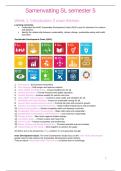
Sustainable Development Goals (SDG):
1. No Poverty – End poverty everywhere.
2. Zero Hunger – End hunger and improve nutrition.
3. Good Health and Well-being – Ensure healthy lives for all.
4. Quality Education – Provide inclusive and quality education.
5. Gender Equality – Achieve equality for women and men.
6. Clean Water and Sanitation – Access to clean water and sanitation for all.
7. Affordable and Clean Energy – Access to sustainable energy for all.
8. Decent Work and Economic Growth – Promote fair jobs and economic growth.
9. Industry, Innovation and Infrastructure – Build resilient infrastructure and innovation.
10. Reduced Inequalities – Reduce inequality within and between countries.
11. Sustainable Cities and Communities – Make cities safe and sustainable.
12. Responsible Consumption and Production – Use resources responsibly.
13. Climate Action – Take action against climate change.
14. Life Below Water – Protect oceans and marine life.
15. Life on Land – Protect ecosystems and biodiversity.
16. Peace, Justice and Strong Institutions – Promote peaceful and just societies.
17. Partnerships for the Goals – Work together to achieve the goals.
All SDG’s aim to be achieved by 2030, problem: it’s not going fast enough.
Inner Development Goals: The Inner Development Goals focus on the inner skills and mindset
people need to help achieve the Sustainable Development Goals (SDGs).
They are about how people think, feel and act, not about laws or technology.
1
,1. Being – Developing self-awareness, values and emotional balance.
2. Thinking – Learning to think critically, creatively and long-term.
3. Relating – Building empathy, respect and care for others and nature.
4. Collaborating – Working together through communication and trust.
5. Acting – Taking responsibility and turning ideas into action.
What is malnutrition: Malnutrition refers to deficiencies, excesses or imbalances in a person's intake
of energy and/or nutrients.
Types of malnutrition:
Malnutrition means the body is not properly nourished, even if
someone eats enough food.
Undernutrition
o Underweight (low weight for age)
o Stunting (low height for age)
o Wasting (low weight for height)
o Micronutrient deficiencies
Over nutrition
o Overweight
o Obesity
Protein-energy malnutrition:
Underweight low weight-for-age
Wasting low weight-for-height (acute malnutrition)
Stunting low height-for-age (chronic malnutrition)
The most important deficiencies (micronutrient deficiencies):
Lodine
Vitamin A
Iron
Lodine, vitamin A and iron are the most important in global public health terms; their deficiency
represents a major threat to the health and development of populations worldwide, particularly children
and pregnant women in low-income countries.
Malnutrition and infections complex:
Undernutrition has an effect on someone’s
immune system risk of disease
infectious disease increased energy
needs. This is a hard cycle to break!
2
,SDG goal 2 - Zero Hunger:
End hunger, achieve food security and improved nutrition and promote sustainable agriculture
All forms of hunger
By 2030
What can you do as a dietitian-nutritionist:
Target individuals - clinically
Target populations/groups - public health intervention
Non-communicable diseases (NCD’s): Non-communicable diseases (NCD’s) are chronic diseases
that are not directly caused by infections (so they are not transmissible from person to person).
They usually develop due to a combination of genetic, physiological, environmental, and
behavioral factors.
The four main groups of NCD’s are:
1. Cardiovascular diseases – such as heart attacks, strokes, and high blood pressure. More
than 18 million people dies.
2. Cancer – various types, for example lung cancer or breast cancer.
3. Chronic respiratory diseases – such as COPD and asthma.
4. Diabetes – mainly type 2 diabetes.
NCD’s account for 71% of all deaths globally 41 million people a year.
Each year, 15 million people die from a NCD between the ages of 3 and 69 years; over 85% of these
“premature” deaths occur in low- and middle-income countries.
Non communicable diseases (NCD’s) are major preventable. If the major risk factors for non-
communicable diseases were eliminated, at around three-quarters of cardiovascular diseases and
type 2 diabetes would be prevented and 40% of cancer would be prevented. It’s not only a health
problem but a developmental challenge as well.
Risk
factors for NCD’s:
High blood pressure
Physical inactivity
Obesity
Raised cholesterol
Decreased vegetable & fruit intake
3
, Raised blood glucose
Alcohol
Tobacco use
The Sustainable Development Goal 3.4, which aims to reduce premature mortality from NCD’s by a
third between 2015 and 2030.
Dietitians are the health professionals who could deliver reliable nutritional advice.
Priority areas that are within the roles of dietitians:
1. Create healthy food and drink environments and encourage physical activity for all population
groups.
2. Promote the health gains of a healthy diet throughout the life-course, especially for the most
vulnerable.
3. Reinforce health systems to promote health and to provide services for NCD’s.
4. Support surveillance, monitoring, evaluation and research of the population’s nutritional status
and behaviors.
5. Strengthen governance, alliances and networks and empower communities to engage in
health promotion and prevention efforts.
Introduction of sustainable diets:
We exceed the safe operating space of the earth for 6 of 9 planetary
boundaries:
Climate change
Disruption of nitrogen and phospheres cycles
Water use
Biodiversity loss
Changes in land use
Novel entities
Food represents 21-37% of our
carbon-footprint
Protein sources – large variation in impact:
4
Week 1: Introduction 3 main themes
Learning outcomes:
Understand the WHO Sustainable Development Goals (SDG’s) and it’s relevance for nutrition
and dietetics.
Identify the relationship between sustainability, climate change, sustainable eating and health
promotion.
Sustainable Development Goals (SDG):
1. No Poverty – End poverty everywhere.
2. Zero Hunger – End hunger and improve nutrition.
3. Good Health and Well-being – Ensure healthy lives for all.
4. Quality Education – Provide inclusive and quality education.
5. Gender Equality – Achieve equality for women and men.
6. Clean Water and Sanitation – Access to clean water and sanitation for all.
7. Affordable and Clean Energy – Access to sustainable energy for all.
8. Decent Work and Economic Growth – Promote fair jobs and economic growth.
9. Industry, Innovation and Infrastructure – Build resilient infrastructure and innovation.
10. Reduced Inequalities – Reduce inequality within and between countries.
11. Sustainable Cities and Communities – Make cities safe and sustainable.
12. Responsible Consumption and Production – Use resources responsibly.
13. Climate Action – Take action against climate change.
14. Life Below Water – Protect oceans and marine life.
15. Life on Land – Protect ecosystems and biodiversity.
16. Peace, Justice and Strong Institutions – Promote peaceful and just societies.
17. Partnerships for the Goals – Work together to achieve the goals.
All SDG’s aim to be achieved by 2030, problem: it’s not going fast enough.
Inner Development Goals: The Inner Development Goals focus on the inner skills and mindset
people need to help achieve the Sustainable Development Goals (SDGs).
They are about how people think, feel and act, not about laws or technology.
1
,1. Being – Developing self-awareness, values and emotional balance.
2. Thinking – Learning to think critically, creatively and long-term.
3. Relating – Building empathy, respect and care for others and nature.
4. Collaborating – Working together through communication and trust.
5. Acting – Taking responsibility and turning ideas into action.
What is malnutrition: Malnutrition refers to deficiencies, excesses or imbalances in a person's intake
of energy and/or nutrients.
Types of malnutrition:
Malnutrition means the body is not properly nourished, even if
someone eats enough food.
Undernutrition
o Underweight (low weight for age)
o Stunting (low height for age)
o Wasting (low weight for height)
o Micronutrient deficiencies
Over nutrition
o Overweight
o Obesity
Protein-energy malnutrition:
Underweight low weight-for-age
Wasting low weight-for-height (acute malnutrition)
Stunting low height-for-age (chronic malnutrition)
The most important deficiencies (micronutrient deficiencies):
Lodine
Vitamin A
Iron
Lodine, vitamin A and iron are the most important in global public health terms; their deficiency
represents a major threat to the health and development of populations worldwide, particularly children
and pregnant women in low-income countries.
Malnutrition and infections complex:
Undernutrition has an effect on someone’s
immune system risk of disease
infectious disease increased energy
needs. This is a hard cycle to break!
2
,SDG goal 2 - Zero Hunger:
End hunger, achieve food security and improved nutrition and promote sustainable agriculture
All forms of hunger
By 2030
What can you do as a dietitian-nutritionist:
Target individuals - clinically
Target populations/groups - public health intervention
Non-communicable diseases (NCD’s): Non-communicable diseases (NCD’s) are chronic diseases
that are not directly caused by infections (so they are not transmissible from person to person).
They usually develop due to a combination of genetic, physiological, environmental, and
behavioral factors.
The four main groups of NCD’s are:
1. Cardiovascular diseases – such as heart attacks, strokes, and high blood pressure. More
than 18 million people dies.
2. Cancer – various types, for example lung cancer or breast cancer.
3. Chronic respiratory diseases – such as COPD and asthma.
4. Diabetes – mainly type 2 diabetes.
NCD’s account for 71% of all deaths globally 41 million people a year.
Each year, 15 million people die from a NCD between the ages of 3 and 69 years; over 85% of these
“premature” deaths occur in low- and middle-income countries.
Non communicable diseases (NCD’s) are major preventable. If the major risk factors for non-
communicable diseases were eliminated, at around three-quarters of cardiovascular diseases and
type 2 diabetes would be prevented and 40% of cancer would be prevented. It’s not only a health
problem but a developmental challenge as well.
Risk
factors for NCD’s:
High blood pressure
Physical inactivity
Obesity
Raised cholesterol
Decreased vegetable & fruit intake
3
, Raised blood glucose
Alcohol
Tobacco use
The Sustainable Development Goal 3.4, which aims to reduce premature mortality from NCD’s by a
third between 2015 and 2030.
Dietitians are the health professionals who could deliver reliable nutritional advice.
Priority areas that are within the roles of dietitians:
1. Create healthy food and drink environments and encourage physical activity for all population
groups.
2. Promote the health gains of a healthy diet throughout the life-course, especially for the most
vulnerable.
3. Reinforce health systems to promote health and to provide services for NCD’s.
4. Support surveillance, monitoring, evaluation and research of the population’s nutritional status
and behaviors.
5. Strengthen governance, alliances and networks and empower communities to engage in
health promotion and prevention efforts.
Introduction of sustainable diets:
We exceed the safe operating space of the earth for 6 of 9 planetary
boundaries:
Climate change
Disruption of nitrogen and phospheres cycles
Water use
Biodiversity loss
Changes in land use
Novel entities
Food represents 21-37% of our
carbon-footprint
Protein sources – large variation in impact:
4



