

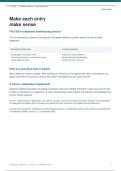
FAC1502 / TRANSACTIONS TO TRIAL BALANCE
START HERE
Make each entry
make sense
FAC1502 foundational bookkeeping practice
From a transaction in words to the accounts, the ledger balances and the checks that tell you what
happened.
28 original practice tasks 5 worked examples
12 standalone transaction drills Credit sale versus collection
12 linked transactions in one business case Compound entry and drawings
4 error-diagnosis tasks A balanced bank T-account
What you should be able to explain
Why a debit can reduce a liability. Why collecting an invoice is not a second sale. Why a trial balance can
agree even when an account is wrong. Why cash in the bank is not the same as profit.
A narrow, independent supplement
Supports selected transaction-recording foundations relevant to UNISA FAC1502. It does not cover the full
module or reproduce any assignment or exam. All businesses and amounts are fictional. Use alongside your
current official materials.
No VAT, trading inventory, depreciation, tax, interest accruals or end-of-period adjustments are modelled. The case produces
an unadjusted trial balance and an illustrative pre-adjustment profit; these are not complete financial statements.
Created with AI assistance. Calculations checked programmatically; no independent expert review claimed. Not affiliated with
or endorsed by UNISA. Version 1.0, 12 September 2026.
Independent supplement | Version 1.0 - September 2026 1
,FAC1502 / TRANSACTIONS TO TRIAL BALANCE
METHOD
Choose the account, then the side
Use the business perspective. Bank means the business bank ledger, not the bank statement.
Debit (Dr) means left; credit (Cr) means right. Neither word means increase for every kind of account.
Account family Increase Decrease Example
Asset Dr Cr Bank; equipment; receivables
Liability Cr Dr Payables; loan; customer advances
Owner capital Cr Dr Owner contributions
Revenue Cr Dr Completed service income
Expense Dr Cr Current rent; wages
Drawings Dr Cr Owner withdrawals
Four decisions before you post
1. Identify what the business received, used, earned or now owes.
2. Name each affected account and its family.
3. Decide whether that account increases or decreases.
4. Use the table, then check that total Dr equals total Cr.
Assets = liabilities + owner's equity
In this simple sole-trader model, profit increases equity and drawings reduce it. Revenue and expenses
collect the period's performance separately before closing. Keep contributions and withdrawals out of profit.
These are normal directions, not a claim that unusual or contra-account balances cannot exist. This workbook excludes those
complexities. Accounts must describe the event; a balanced entry alone is not proof that it is correct. References [2]-[5].
Independent supplement | Version 1.0 - September 2026 2
, FAC1502 / TRANSACTIONS TO TRIAL BALANCE
WORKED 1-2
Earned once, collected later
E1 A business completes a service for R2,700 and issues an invoice. Payment will come
later.
Dr Trade receivables: R2,700
Cr Service revenue: R2,700
Receivables increase with a debit; earned revenue increases with a credit. Bank does not change.
E2 Later, the customer pays R1,900 of the E1 invoice.
Dr Bank: R1,900
Cr Trade receivables: R1,900
The claim falls while bank rises. R2,700 - R1,900 = R800 remains receivable. Revenue stays R2,700.
After the two events Change
Bank + R1,900
Trade receivables + R800
Service revenue + R2,700
Combined asset increase R1,900 + R800 = R2,700
Why record both events?
The invoice creates a claim. The collection exchanges some of that claim for money. Total assets do not
increase again on collection, but their composition changes. That is useful information: you can now see
both available cash and the customer balance.
A credit to receivables is a decrease in an asset. It is not income merely because it is a credit. The account name supplies the
meaning.
Independent supplement | Version 1.0 - September 2026 3
START HERE
Make each entry
make sense
FAC1502 foundational bookkeeping practice
From a transaction in words to the accounts, the ledger balances and the checks that tell you what
happened.
28 original practice tasks 5 worked examples
12 standalone transaction drills Credit sale versus collection
12 linked transactions in one business case Compound entry and drawings
4 error-diagnosis tasks A balanced bank T-account
What you should be able to explain
Why a debit can reduce a liability. Why collecting an invoice is not a second sale. Why a trial balance can
agree even when an account is wrong. Why cash in the bank is not the same as profit.
A narrow, independent supplement
Supports selected transaction-recording foundations relevant to UNISA FAC1502. It does not cover the full
module or reproduce any assignment or exam. All businesses and amounts are fictional. Use alongside your
current official materials.
No VAT, trading inventory, depreciation, tax, interest accruals or end-of-period adjustments are modelled. The case produces
an unadjusted trial balance and an illustrative pre-adjustment profit; these are not complete financial statements.
Created with AI assistance. Calculations checked programmatically; no independent expert review claimed. Not affiliated with
or endorsed by UNISA. Version 1.0, 12 September 2026.
Independent supplement | Version 1.0 - September 2026 1
,FAC1502 / TRANSACTIONS TO TRIAL BALANCE
METHOD
Choose the account, then the side
Use the business perspective. Bank means the business bank ledger, not the bank statement.
Debit (Dr) means left; credit (Cr) means right. Neither word means increase for every kind of account.
Account family Increase Decrease Example
Asset Dr Cr Bank; equipment; receivables
Liability Cr Dr Payables; loan; customer advances
Owner capital Cr Dr Owner contributions
Revenue Cr Dr Completed service income
Expense Dr Cr Current rent; wages
Drawings Dr Cr Owner withdrawals
Four decisions before you post
1. Identify what the business received, used, earned or now owes.
2. Name each affected account and its family.
3. Decide whether that account increases or decreases.
4. Use the table, then check that total Dr equals total Cr.
Assets = liabilities + owner's equity
In this simple sole-trader model, profit increases equity and drawings reduce it. Revenue and expenses
collect the period's performance separately before closing. Keep contributions and withdrawals out of profit.
These are normal directions, not a claim that unusual or contra-account balances cannot exist. This workbook excludes those
complexities. Accounts must describe the event; a balanced entry alone is not proof that it is correct. References [2]-[5].
Independent supplement | Version 1.0 - September 2026 2
, FAC1502 / TRANSACTIONS TO TRIAL BALANCE
WORKED 1-2
Earned once, collected later
E1 A business completes a service for R2,700 and issues an invoice. Payment will come
later.
Dr Trade receivables: R2,700
Cr Service revenue: R2,700
Receivables increase with a debit; earned revenue increases with a credit. Bank does not change.
E2 Later, the customer pays R1,900 of the E1 invoice.
Dr Bank: R1,900
Cr Trade receivables: R1,900
The claim falls while bank rises. R2,700 - R1,900 = R800 remains receivable. Revenue stays R2,700.
After the two events Change
Bank + R1,900
Trade receivables + R800
Service revenue + R2,700
Combined asset increase R1,900 + R800 = R2,700
Why record both events?
The invoice creates a claim. The collection exchanges some of that claim for money. Total assets do not
increase again on collection, but their composition changes. That is useful information: you can now see
both available cash and the customer balance.
A credit to receivables is a decrease in an asset. It is not income merely because it is a credit. The account name supplies the
meaning.
Independent supplement | Version 1.0 - September 2026 3



