
• Verkeerd document? Gratis ruilen
  • Geschreven door studenten die geslaagd zijn
  • Direct beschikbaar na je betaling
  • Online lezen of als PDF
Verkopen
Kies je studieland
Kies je taal
Document preview thumbnail
Voorbeeld 1 van de 1 pagina's
Samenvatting

Grade 11 Physical Sciences: Electrostatics Summary

Document preview thumbnail
Voorbeeld 1 van de 1 pagina's

Need clear and concise Grade 11 Electrostatics notes for your Physical Sciences test or exam? This summary covers the key concepts and calculations you need to revise the Electrostatics section of Grade 11 Physics. These notes are designed to make Electrostatics easier to understand and revise, with important concepts, definitions, equations and relationships brought together in one convenient resource. Topics covered include: Electric charge Electrostatic forces Coulomb’s Law Electric fields Electric field strength Forces between charged particles Point charges Important definitions and concepts Key equations and relationships Electrostatics calculations and revision Perfect for Grade 11 Physical Sciences students preparing for tests, exams, assessments or general revision.

Voorbeeld van de inhoud

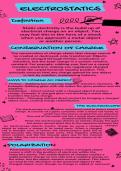
ELECTROSTATICS
Definition
Static electricity is the build up of
electrical charge on an object. You
may feel this in the form of a shock
when you approach a metal object
or another person.

CONSERVATION OF CHARGE
The conservation of charge states that charge cannot
be created or destroyed, only transferred. Objects
become charged through friction, conduction, or
induction, but the total charge in a system remains
constant. For example, rubbing your feet on a carpet
transfers electrons, making you negatively charged
while the carpet becomes equally positive. This
principle ensures that any charge gained by one object
is lost by another, maintaining balance.

WAYS TO CHARGE AN OBJECT
1. Friction – Rubbing two materials together transfers electrons.
Example: Rubbing glass with silk makes the glass positive and silk
negative.
2.Conduction – Direct contact with a charged object transfers
charge. Example: A charged glass rod touching a metal object
transfers the same charge.
3.Induction – Charging without direct contact by bringing a charged
object close, causing charge redistribution.

THE ELECTROSCOPE
The electroscope is a sensitive instrument used to detect electric
charge. It consists of a glass container with a metal rod inside, to
which two thin pieces of gold foil are attached.
One end of the metal rod has a metal plate attached to it,
located outside the glass container.
When the electroscope detects an electric charge, the gold
foil pieces spread apart due to the repulsion between like
An electroscope detects electric charge by using a charged charges.
object to induce a charge in its metal parts. When a charged
rod is brought near, it causes the electroscope's gold foil to
repel because like charges push away. This happens without
direct contact, and the foil spreads apart due to the induced
charge. After the rod is removed, the electroscope returns to its
neutral state.


POLARIZATION
Polarization occurs in insulators when a charged object
causes a shift in the position of electrons within the
material's atoms. This redistribution of charges creates a
slight positive charge on one side and a negative charge on
the other, but the object remains overall neutral. This effect
can lead to the attraction of the polarized object to the
charged object, even though no charge is added or removed.


Documentinformatie

Schooljaar
200
Geüpload op
12 september 2026
Aantal pagina's
1
Geschreven in
2026/2027
Type
Samenvatting
€5,40

Verkeerd document? Gratis ruilen Binnen 14 dagen na aankoop en voor het downloaden kun je een ander document kiezen. Je kunt het bedrag gewoon opnieuw besteden.
Geschreven door studenten die geslaagd zijn
Direct beschikbaar na je betaling
Online lezen of als PDF

Verkocht
0
Volgers
0
Items
7
Laatst verkocht
-


Echte notities, van echte studenten
Elk document op Stuvia is geschreven door een medestudent die hetzelfde vak deed. Zo leer je van iemand die het al heeft gehaald.


Waarom studenten kiezen voor Stuvia

Gemaakt door medestudenten, geverifieerd door reviews

Kwaliteit die je kunt vertrouwen: geschreven door studenten die slaagden en beoordeeld door anderen die dit document gebruikten.

Niet tevreden? Kies een ander document

Geen zorgen! Je kunt voor hetzelfde geld direct een ander document kiezen dat beter past bij wat je zoekt.

Betaal zoals je wilt, start meteen met leren

Geen abonnement, geen verplichtingen. Betaal zoals je gewend bent via iDeal of creditcard en download je PDF-document meteen.

Student with book image

“Gekocht, gedownload en geslaagd. Zo makkelijk kan het dus zijn.”

Alisha Student

Bezig met je bronvermelding?

Maak nauwkeurige citaten in APA, MLA en Harvard met onze gratis bronnengenerator.

Bezig met je bronvermelding?

Veelgestelde vragen

