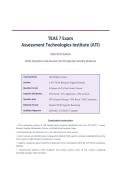
TEAS 7 Exam
Assessment Technologies Institute (ATI)
2026/2027 Edition
Study Questions and Answers for Prospective Nursing Students
Total Questions 200 Multiple Choice
Sections 4 ATI TEAS Blueprint-Aligned Domains
Question Format 4 Options (A-D), One Correct Answer
Cognitive Distribution 25% Recall / 55% Application / 20% Analysis
Question Style 50% Scenario/Passage / 30% Recall / 20% Calculation
Rationale Format Detailed TEAS-Specific Reasoning
Guideline Alignment 2026/2027 ATI TEAS 7 Updates
Examination Instructions
• This examination consists of 200 multiple-choice questions distributed across four ATI TEAS 7 content
domains: Reading, Mathematics, Science, and English and Language Usage.
• Each question has four options (A, B, C, D) with exactly one correct answer.
• Correct answers are identified and accompanied by detailed TEAS-specific rationales explaining both why the
correct option is right and why the distractors are wrong.
• Cognitive complexity spans recall (25%), application (55%), and analysis (20%) per ATI TEAS examination
blueprint.
• Scenario-based questions reflect healthcare and nursing contexts across all four sections, integrating
test-taking strategies within rationales.
,TEAS 7 Exam | 2026/2027 Edition ATI Study Questions and Answers
• Content aligns with current 2026/2027 ATI TEAS 7 test specifications and blueprint revisions.
Prepared for Prospective Nursing Students
2026/2027 Examination Cycle
Page 2 | 200-Question Comprehensive Exam
,TEAS 7 Exam | 2026/2027 Edition ATI Study Questions and Answers
SECTION 1: READING
Key Ideas and Details, Craft and Structure, Integration of Knowledge and Ideas (Q1-Q50)
Q1: Read the following passage and answer the question. Passage: 'Regular hand hygiene remains the single
most effective measure to prevent healthcare-associated infections. Despite decades of evidence supporting its
efficacy, healthcare worker compliance with hand hygiene protocols averages only 40% globally. Common
barriers include skin irritation from frequent washing, understaffing, and lack of accessible dispensers.
Multiple interventions—education, audit and feedback, and electronic monitoring—have shown modest
improvements, but sustained behavior change remains elusive.' What is the main idea of this passage?
A. Healthcare workers should use electronic monitoring systems to track hand hygiene compliance.
B. Despite proven effectiveness, hand hygiene compliance among healthcare workers remains low and is
difficult to improve sustainably. [CORRECT]
C. Skin irritation is the primary reason healthcare workers fail to perform hand hygiene.
D. Education and audit feedback are the most effective interventions for improving hand hygiene compliance.
Correct Answer: B
Rationale:
The main idea must capture the passage's central claim. The passage opens with the effectiveness of hand hygiene,
then states the central problem (40% compliance), lists barriers, and concludes that sustained change is elusive.
Option B captures this overarching theme. Option A overstates a minor detail (electronic monitoring is listed as one
intervention, not the recommended solution). Option C is one barrier among several, not the main idea. Option D
overstates the effectiveness of specific interventions when the passage says they produce 'modest improvements.'
Always choose the answer that encompasses the whole passage, not a single detail.
Q2: Read the following passage. Passage: 'The influenza virus undergoes frequent genetic changes through
two mechanisms: antigenic drift and antigenic shift. Antigenic drift involves small, gradual mutations in the
hemagglutinin and neuraminidase genes, accounting for seasonal flu outbreaks. Antigenic shift, by contrast, is
an abrupt, major change resulting from the reassortment of gene segments when two different strains infect
the same host cell. While drift allows the virus to evade existing immunity gradually, shift can produce a novel
subtype against which the human population has little to no immunity, potentially sparking pandemics.'
Which organizational pattern does the author primarily use in this passage?
A. Chronological order
B. Cause and effect
C. Compare and contrast [CORRECT]
D. Problem and solution
Correct Answer: C
Rationale:
The passage is structured around comparing and contrasting antigenic drift and antigenic shift. The author uses 'by
contrast' and juxtaposes gradual mutations with abrupt reassortment. Cause-effect (B) is partially present (drift allows
gradual evasion), but it is not the dominant structure. Chronological (A) requires time sequence, which is absent.
Problem-solution (D) requires stating a problem then a remedy; this passage describes mechanisms, not solutions.
Recognizing signal words like 'by contrast' and 'while' is a high-yield TEAS strategy.
Page 3 | 200-Question Comprehensive Exam
, TEAS 7 Exam | 2026/2027 Edition ATI Study Questions and Answers
Q3: Read the following passage. Passage: 'Telehealth expanded rapidly during the COVID-19 pandemic,
offering patients remote access to care. Proponents argue that telehealth increases access for rural populations
and reduces exposure risks. Critics counter that telehealth exacerbates disparities for patients lacking reliable
internet or digital literacy. Additionally, the absence of physical examination may lead to missed diagnoses.
Whether telehealth's benefits outweigh its limitations remains a subject of ongoing debate among healthcare
policymakers.' What is the author's primary purpose in this passage?
A. To persuade readers that telehealth should be permanently expanded
B. To inform readers about the arguments on both sides of the telehealth debate [CORRECT]
C. To entertain readers with a story about telehealth technology
D. To instruct readers on how to use telehealth services
Correct Answer: B
Rationale:
The author presents arguments for telehealth ('proponents argue') and against it ('critics counter') without endorsing
either side, ending with a neutral statement that the debate continues. This balanced presentation indicates an
informative purpose. Option A is wrong because the author does not advocate expansion. Option C is wrong because
the tone is factual, not narrative or entertaining. Option D is wrong because no procedural instructions are given.
Identifying author's purpose requires looking at tone, balance, and the absence of persuasive language.
Q4: Read the following passage. Passage: 'Patients with chronic kidney disease must carefully monitor their
phosphorus intake. Elevated phosphorus levels cause the body to pull calcium from bones, weakening the
skeletal system and promoting vascular calcification. Dietitians recommend that these patients limit
high-phosphorus foods such as dairy products, nuts, seeds, and dark colas. When dietary restriction is
insufficient, phosphate binders taken with meals can help reduce phosphorus absorption.' Which sentence
from the passage best states a supporting detail for the recommendation to limit phosphorus intake?
A. Patients with chronic kidney disease must carefully monitor their phosphorus intake.
B. Elevated phosphorus levels cause the body to pull calcium from bones, weakening the skeletal system
and promoting vascular calcification. [CORRECT]
C. Dietitians recommend that these patients limit high-phosphorus foods such as dairy products, nuts, seeds,
and dark colas.
D. When dietary restriction is insufficient, phosphate binders taken with meals can help reduce phosphorus
absorption.
Correct Answer: B
Rationale:
A supporting detail provides evidence or reasoning for a claim. The topic sentence (A) introduces the main idea. The
supporting detail (B) explains why monitoring phosphorus matters—the physiologic consequence of elevated
phosphorus. Option C is the recommendation itself, not the supporting rationale. Option D discusses an alternative
intervention, not the evidence for dietary restriction. Distinguishing claims from supporting evidence is a TEAS
essential skill.
Page 4 | 200-Question Comprehensive Exam
Assessment Technologies Institute (ATI)
2026/2027 Edition
Study Questions and Answers for Prospective Nursing Students
Total Questions 200 Multiple Choice
Sections 4 ATI TEAS Blueprint-Aligned Domains
Question Format 4 Options (A-D), One Correct Answer
Cognitive Distribution 25% Recall / 55% Application / 20% Analysis
Question Style 50% Scenario/Passage / 30% Recall / 20% Calculation
Rationale Format Detailed TEAS-Specific Reasoning
Guideline Alignment 2026/2027 ATI TEAS 7 Updates
Examination Instructions
• This examination consists of 200 multiple-choice questions distributed across four ATI TEAS 7 content
domains: Reading, Mathematics, Science, and English and Language Usage.
• Each question has four options (A, B, C, D) with exactly one correct answer.
• Correct answers are identified and accompanied by detailed TEAS-specific rationales explaining both why the
correct option is right and why the distractors are wrong.
• Cognitive complexity spans recall (25%), application (55%), and analysis (20%) per ATI TEAS examination
blueprint.
• Scenario-based questions reflect healthcare and nursing contexts across all four sections, integrating
test-taking strategies within rationales.
,TEAS 7 Exam | 2026/2027 Edition ATI Study Questions and Answers
• Content aligns with current 2026/2027 ATI TEAS 7 test specifications and blueprint revisions.
Prepared for Prospective Nursing Students
2026/2027 Examination Cycle
Page 2 | 200-Question Comprehensive Exam
,TEAS 7 Exam | 2026/2027 Edition ATI Study Questions and Answers
SECTION 1: READING
Key Ideas and Details, Craft and Structure, Integration of Knowledge and Ideas (Q1-Q50)
Q1: Read the following passage and answer the question. Passage: 'Regular hand hygiene remains the single
most effective measure to prevent healthcare-associated infections. Despite decades of evidence supporting its
efficacy, healthcare worker compliance with hand hygiene protocols averages only 40% globally. Common
barriers include skin irritation from frequent washing, understaffing, and lack of accessible dispensers.
Multiple interventions—education, audit and feedback, and electronic monitoring—have shown modest
improvements, but sustained behavior change remains elusive.' What is the main idea of this passage?
A. Healthcare workers should use electronic monitoring systems to track hand hygiene compliance.
B. Despite proven effectiveness, hand hygiene compliance among healthcare workers remains low and is
difficult to improve sustainably. [CORRECT]
C. Skin irritation is the primary reason healthcare workers fail to perform hand hygiene.
D. Education and audit feedback are the most effective interventions for improving hand hygiene compliance.
Correct Answer: B
Rationale:
The main idea must capture the passage's central claim. The passage opens with the effectiveness of hand hygiene,
then states the central problem (40% compliance), lists barriers, and concludes that sustained change is elusive.
Option B captures this overarching theme. Option A overstates a minor detail (electronic monitoring is listed as one
intervention, not the recommended solution). Option C is one barrier among several, not the main idea. Option D
overstates the effectiveness of specific interventions when the passage says they produce 'modest improvements.'
Always choose the answer that encompasses the whole passage, not a single detail.
Q2: Read the following passage. Passage: 'The influenza virus undergoes frequent genetic changes through
two mechanisms: antigenic drift and antigenic shift. Antigenic drift involves small, gradual mutations in the
hemagglutinin and neuraminidase genes, accounting for seasonal flu outbreaks. Antigenic shift, by contrast, is
an abrupt, major change resulting from the reassortment of gene segments when two different strains infect
the same host cell. While drift allows the virus to evade existing immunity gradually, shift can produce a novel
subtype against which the human population has little to no immunity, potentially sparking pandemics.'
Which organizational pattern does the author primarily use in this passage?
A. Chronological order
B. Cause and effect
C. Compare and contrast [CORRECT]
D. Problem and solution
Correct Answer: C
Rationale:
The passage is structured around comparing and contrasting antigenic drift and antigenic shift. The author uses 'by
contrast' and juxtaposes gradual mutations with abrupt reassortment. Cause-effect (B) is partially present (drift allows
gradual evasion), but it is not the dominant structure. Chronological (A) requires time sequence, which is absent.
Problem-solution (D) requires stating a problem then a remedy; this passage describes mechanisms, not solutions.
Recognizing signal words like 'by contrast' and 'while' is a high-yield TEAS strategy.
Page 3 | 200-Question Comprehensive Exam
, TEAS 7 Exam | 2026/2027 Edition ATI Study Questions and Answers
Q3: Read the following passage. Passage: 'Telehealth expanded rapidly during the COVID-19 pandemic,
offering patients remote access to care. Proponents argue that telehealth increases access for rural populations
and reduces exposure risks. Critics counter that telehealth exacerbates disparities for patients lacking reliable
internet or digital literacy. Additionally, the absence of physical examination may lead to missed diagnoses.
Whether telehealth's benefits outweigh its limitations remains a subject of ongoing debate among healthcare
policymakers.' What is the author's primary purpose in this passage?
A. To persuade readers that telehealth should be permanently expanded
B. To inform readers about the arguments on both sides of the telehealth debate [CORRECT]
C. To entertain readers with a story about telehealth technology
D. To instruct readers on how to use telehealth services
Correct Answer: B
Rationale:
The author presents arguments for telehealth ('proponents argue') and against it ('critics counter') without endorsing
either side, ending with a neutral statement that the debate continues. This balanced presentation indicates an
informative purpose. Option A is wrong because the author does not advocate expansion. Option C is wrong because
the tone is factual, not narrative or entertaining. Option D is wrong because no procedural instructions are given.
Identifying author's purpose requires looking at tone, balance, and the absence of persuasive language.
Q4: Read the following passage. Passage: 'Patients with chronic kidney disease must carefully monitor their
phosphorus intake. Elevated phosphorus levels cause the body to pull calcium from bones, weakening the
skeletal system and promoting vascular calcification. Dietitians recommend that these patients limit
high-phosphorus foods such as dairy products, nuts, seeds, and dark colas. When dietary restriction is
insufficient, phosphate binders taken with meals can help reduce phosphorus absorption.' Which sentence
from the passage best states a supporting detail for the recommendation to limit phosphorus intake?
A. Patients with chronic kidney disease must carefully monitor their phosphorus intake.
B. Elevated phosphorus levels cause the body to pull calcium from bones, weakening the skeletal system
and promoting vascular calcification. [CORRECT]
C. Dietitians recommend that these patients limit high-phosphorus foods such as dairy products, nuts, seeds,
and dark colas.
D. When dietary restriction is insufficient, phosphate binders taken with meals can help reduce phosphorus
absorption.
Correct Answer: B
Rationale:
A supporting detail provides evidence or reasoning for a claim. The topic sentence (A) introduces the main idea. The
supporting detail (B) explains why monitoring phosphorus matters—the physiologic consequence of elevated
phosphorus. Option C is the recommendation itself, not the supporting rationale. Option D discusses an alternative
intervention, not the evidence for dietary restriction. Distinguishing claims from supporting evidence is a TEAS
essential skill.
Page 4 | 200-Question Comprehensive Exam