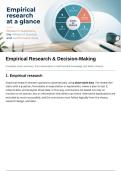
Empirical 1
OBSERVATION
research 6
CONCLUSION
2
RESEARCH
at a glance
QUESTION
WHEEL
OF
SCIENCE
5 3
ANALYSIS HYPOTHESIS
Research questions,
4
the Wheel of Science STUDY
and confirmation bias
Empirical Research & Decision-Making
Complete exam summary: from observation to well-founded knowledge and better choices.
1. Empirical research
Empirical research answers questions systematically using observable data. The researcher
starts with a question, formulates an expectation or explanation, makes a plan to test it,
collects data, and analyzes those data. In this way, conclusions are based not only on
intuition or an opinion, but on information that others can check. Alternative explanations are
excluded as much as possible, and the conclusion must follow logically from the theory,
research design, and data.
, Step Translation What happens?
Thinking Theory An expectation or
explanation for what
happens and why.
Planning Research design The plan for testing the
theory: who or what is
studied, how, and under
what circumstances?
Observing Data collection Collecting data about the
units and variables relevant
to the question.
Analyzing Data analysis and Organizing and analyzing
conclusion the data, assessing the
expectation, and drawing a
conclusion.
Example: does studying more lead to higher grades?
, Theory Students who study more hours achieve
higher grades on average.
Research design Compare students with different amounts
of study time and establish in advance how
study time and grades will be measured.
Data collection Collect data for each student on the
number of study hours and the grades
achieved.
Data analysis Examine whether more study time is
associated with higher grades and check
whether other explanations may play a
role.
Conclusion Assess whether the data support the
theory. An association is not automatically
evidence that studying causes the higher
grades.
2. Types of research questions
, Type Explanation Example
Normative Concerns what should Should schools make more
happen. The answer time available for healthy
contains a value judgment behavior?
or recommendation and
does not follow from
observations alone.
Conceptual Concerns the meaning or What does social inequality
delineation of a concept. mean, or when do we call
behavior “healthy”?
Empirical Concerns what happens, Does studying more lead to
how much, how often, or higher grades?
why something happens.
The answer can be
investigated using
observable data.
3. Empirical questions
Predictive questions
Besides descriptive and explanatory questions, empirical research can also include predictive
questions. Predictive questions focus on forecasting an outcome. They are not necessarily
causal, but they are also more than purely descriptive.
Example: Can we predict which students are most likely to drop out of university?
Remember:
Descriptive = what happens?
Explanatory = why does it happen?
Predictive = what is likely to happen?
Descriptive — what happens? Describes what occurs, how much, how often, or among
whom something occurs. For example: how many hours do students study on average,
and how often do teenagers smoke?
Explanatory/causal — why does it happen? Investigates why something happens or
whether X affects Y. For example: does studying more affect grades, or why do some
teenagers start smoking?
OBSERVATION
research 6
CONCLUSION
2
RESEARCH
at a glance
QUESTION
WHEEL
OF
SCIENCE
5 3
ANALYSIS HYPOTHESIS
Research questions,
4
the Wheel of Science STUDY
and confirmation bias
Empirical Research & Decision-Making
Complete exam summary: from observation to well-founded knowledge and better choices.
1. Empirical research
Empirical research answers questions systematically using observable data. The researcher
starts with a question, formulates an expectation or explanation, makes a plan to test it,
collects data, and analyzes those data. In this way, conclusions are based not only on
intuition or an opinion, but on information that others can check. Alternative explanations are
excluded as much as possible, and the conclusion must follow logically from the theory,
research design, and data.
, Step Translation What happens?
Thinking Theory An expectation or
explanation for what
happens and why.
Planning Research design The plan for testing the
theory: who or what is
studied, how, and under
what circumstances?
Observing Data collection Collecting data about the
units and variables relevant
to the question.
Analyzing Data analysis and Organizing and analyzing
conclusion the data, assessing the
expectation, and drawing a
conclusion.
Example: does studying more lead to higher grades?
, Theory Students who study more hours achieve
higher grades on average.
Research design Compare students with different amounts
of study time and establish in advance how
study time and grades will be measured.
Data collection Collect data for each student on the
number of study hours and the grades
achieved.
Data analysis Examine whether more study time is
associated with higher grades and check
whether other explanations may play a
role.
Conclusion Assess whether the data support the
theory. An association is not automatically
evidence that studying causes the higher
grades.
2. Types of research questions
, Type Explanation Example
Normative Concerns what should Should schools make more
happen. The answer time available for healthy
contains a value judgment behavior?
or recommendation and
does not follow from
observations alone.
Conceptual Concerns the meaning or What does social inequality
delineation of a concept. mean, or when do we call
behavior “healthy”?
Empirical Concerns what happens, Does studying more lead to
how much, how often, or higher grades?
why something happens.
The answer can be
investigated using
observable data.
3. Empirical questions
Predictive questions
Besides descriptive and explanatory questions, empirical research can also include predictive
questions. Predictive questions focus on forecasting an outcome. They are not necessarily
causal, but they are also more than purely descriptive.
Example: Can we predict which students are most likely to drop out of university?
Remember:
Descriptive = what happens?
Explanatory = why does it happen?
Predictive = what is likely to happen?
Descriptive — what happens? Describes what occurs, how much, how often, or among
whom something occurs. For example: how many hours do students study on average,
and how often do teenagers smoke?
Explanatory/causal — why does it happen? Investigates why something happens or
whether X affects Y. For example: does studying more affect grades, or why do some
teenagers start smoking?