

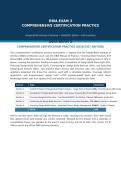
DBIA EXAM 3
COMPREHENSIVE CERTIFICATION PRACTICE
Design-Build Institute of America • 2026/2027 Edition • 100 Questions
DBIA EXAM 3
COMPREHENSIVE CERTIFICATION PRACTICE (2026/2027 EDITION)
This comprehensive certification practice examination is aligned with the Design-Build Institute of
America (DBIA) certification exam and the DBIA Manual of Practice / Universal Best Practices. The
official DBIA certification exam is a 100-question computer-based test with a passing score of 72% or
above, covering five domains: Guiding Principles (8%), Foundations of Design-Build Done Right (8%),
Procuring Design-Build Services (30%), Contracting for Design-Build Services (24%), and Executing
Design-Build Projects (30%). This practice exam mirrors that structure with 100 multiple-choice
questions organized into those five sections, each with a complete rationale. Coverage reflects
application- and analysis-heavy design (with ≈75% scenario-based items and ≈25% direct
knowledge items), with four options (A–D) and exactly one correct response per item.
Section Topic Questions
Section 1 Guiding Principles of Design-Build Project Delivery – Single Point of Responsibility,
8 Risk Allocation, DBIA Crede
Section 2 Foundations of Design-Build Done Right – Best Value, Universal Best Practices,8 Progressive Design-Build
Section 3 Procuring Design-Build Services – Two-Phase RFQ/RFP, Shortlisting, Stipends, 30
Evaluation & Selection
Section 4 Contracting for Design-Build Services – Contract Forms, Risk Allocation, GMP, 24
Bonds, Insurance, Changes
Section 5 Executing Design-Build Projects – Integrated Teams, Design Management, BIM/VDC,
30 Quality, Closeout
TOTAL 100
How to use this exam: Work through the sections in order, marking your answers. Each item shows
four options (A–D) with exactly one correct response, followed by the answer and a rationale. A
consolidated answer key appears at the end for quick scoring. Aim for at least 72% correct (72 of
100) to mirror the official DBIA passing standard.
,DBIA EXAM Comprehensive Certification Practice (2026/2027)
Section 1: Guiding Principles of Design-Build Project Delivery – Single Point of
Responsibility, Risk Allocation, DBIA Credential
Q1: DBIA is the acronym for which organization?
A. Design-Build Institute of America [CORRECT]
B. Design-Bid-Build Industry Association
C. Department of Building and Infrastructure Administration
D. Design-Build Institute of Architects
Correct Answer: A
Rationale: DBIA stands for the Design-Build Institute of America, the organization defining and promoting
design-build best practices.
Q2: Under design-build project delivery, the owner typically enters into how many prime contract(s) for
design and construction?
A. One contract with a single design-build entity [CORRECT]
B. Two separate contracts (designer and constructor)
C. Three contracts (designer, constructor, and CM)
D. No formal contract
Correct Answer: A
Rationale: Design-build is characterized by single point of responsibility: one contract for both design and
construction.
Q3: The 'single point of responsibility' in design-build means the:
A. design-builder is responsible to the owner for both design and construction [CORRECT]
B. owner directly manages every subcontractor
C. architect alone bears all risk
D. construction manager answers to no one
Correct Answer: A
Rationale: The owner looks to one entity, the design-builder, for both design and construction performance.
Q4: Which is a PRIMARY advantage of design-build project delivery?
A. Faster delivery and a single point of responsibility [CORRECT]
B. Guaranteed lowest first cost on every project
C. Elimination of all project risk
D. Owner micromanagement of each trade
Correct Answer: A
Rationale: Design-build enables schedule compression through overlapping design and construction and
consolidates accountability.
Q5: Under traditional design-bid-build delivery, the owner typically holds:
A. separate contracts with the designer and the constructor [CORRECT]
B. a single contract with a design-builder
C. no direct contracts
D. one contract with a construction manager only
Correct Answer: A
Rationale: In DBB the owner contracts separately with a designer and a constructor and coordinates between
them.
Page 2 of 20
, DBIA EXAM Comprehensive Certification Practice (2026/2027)
Q6: A core DBIA guiding principle for project risk is to:
A. allocate each risk to the party best able to manage it [CORRECT]
B. transfer all risk to the owner
C. transfer all risk to the lowest-tier subcontractor
D. ignore risk until it occurs
Correct Answer: A
Rationale: Design-Build Done Right allocates risk to the party best positioned to control and price it.
Q7: The professional credential awarded by DBIA is the:
A. Designated Design-Build Professional (DBIA®) [CORRECT]
B. Certified General Contractor
C. Registered Design Professional
D. Project Management Professional
Correct Answer: A
Rationale: DBIA's credential is the Designated Design-Build Professional (DBIA®).
Q8: DBIA's position on Diversity, Equity and Inclusion (DEI) holds that:
A. DEI is integral to building high-performing teams and is a core principle of best practices [CORRECT]
B. DEI is discouraged in design-build
C. DEI applies only to public owners
D. DEI is unrelated to design-build
Correct Answer: A
Rationale: DBIA formally recognizes DEI as integral to design-build excellence and team performance.
Section 2: Foundations of Design-Build Done Right – Best Value, Universal Best
Practices, Progressive Design-Build
Q9: 'Design-Build Done Right' emphasizes selecting the design-build team based primarily on:
A. qualifications and best value, not low bid [CORRECT]
B. the lowest price only
C. the largest firm size
D. the most aggressive schedule promise
Correct Answer: A
Rationale: Best-value selection weighs qualifications, technical approach, and price rather than price alone.
Q10: DBIA's Universal Best Practices are organized into which three categories?
A. Procurement, Contracting, and Execution [CORRECT]
B. Design, Bid, and Build
C. Initiate, Plan, and Close
D. Estimate, Schedule, and Report
Correct Answer: A
Rationale: DBIA organizes Universal Best Practices into Procurement, Contracting, and Execution practices.
Q11: Early involvement of key trade partners (e.g., MEP, structural, steel) in design-build is encouraged
because it:
A. improves constructability, cost certainty, and schedule reliability [CORRECT]
B. slows the project down
C. reduces team collaboration
D. is prohibited by best practices
Correct Answer: A
Rationale: Early trade partner input surfaces constructability issues when changes are least costly.
Page 3 of 20
COMPREHENSIVE CERTIFICATION PRACTICE
Design-Build Institute of America • 2026/2027 Edition • 100 Questions
DBIA EXAM 3
COMPREHENSIVE CERTIFICATION PRACTICE (2026/2027 EDITION)
This comprehensive certification practice examination is aligned with the Design-Build Institute of
America (DBIA) certification exam and the DBIA Manual of Practice / Universal Best Practices. The
official DBIA certification exam is a 100-question computer-based test with a passing score of 72% or
above, covering five domains: Guiding Principles (8%), Foundations of Design-Build Done Right (8%),
Procuring Design-Build Services (30%), Contracting for Design-Build Services (24%), and Executing
Design-Build Projects (30%). This practice exam mirrors that structure with 100 multiple-choice
questions organized into those five sections, each with a complete rationale. Coverage reflects
application- and analysis-heavy design (with ≈75% scenario-based items and ≈25% direct
knowledge items), with four options (A–D) and exactly one correct response per item.
Section Topic Questions
Section 1 Guiding Principles of Design-Build Project Delivery – Single Point of Responsibility,
8 Risk Allocation, DBIA Crede
Section 2 Foundations of Design-Build Done Right – Best Value, Universal Best Practices,8 Progressive Design-Build
Section 3 Procuring Design-Build Services – Two-Phase RFQ/RFP, Shortlisting, Stipends, 30
Evaluation & Selection
Section 4 Contracting for Design-Build Services – Contract Forms, Risk Allocation, GMP, 24
Bonds, Insurance, Changes
Section 5 Executing Design-Build Projects – Integrated Teams, Design Management, BIM/VDC,
30 Quality, Closeout
TOTAL 100
How to use this exam: Work through the sections in order, marking your answers. Each item shows
four options (A–D) with exactly one correct response, followed by the answer and a rationale. A
consolidated answer key appears at the end for quick scoring. Aim for at least 72% correct (72 of
100) to mirror the official DBIA passing standard.
,DBIA EXAM Comprehensive Certification Practice (2026/2027)
Section 1: Guiding Principles of Design-Build Project Delivery – Single Point of
Responsibility, Risk Allocation, DBIA Credential
Q1: DBIA is the acronym for which organization?
A. Design-Build Institute of America [CORRECT]
B. Design-Bid-Build Industry Association
C. Department of Building and Infrastructure Administration
D. Design-Build Institute of Architects
Correct Answer: A
Rationale: DBIA stands for the Design-Build Institute of America, the organization defining and promoting
design-build best practices.
Q2: Under design-build project delivery, the owner typically enters into how many prime contract(s) for
design and construction?
A. One contract with a single design-build entity [CORRECT]
B. Two separate contracts (designer and constructor)
C. Three contracts (designer, constructor, and CM)
D. No formal contract
Correct Answer: A
Rationale: Design-build is characterized by single point of responsibility: one contract for both design and
construction.
Q3: The 'single point of responsibility' in design-build means the:
A. design-builder is responsible to the owner for both design and construction [CORRECT]
B. owner directly manages every subcontractor
C. architect alone bears all risk
D. construction manager answers to no one
Correct Answer: A
Rationale: The owner looks to one entity, the design-builder, for both design and construction performance.
Q4: Which is a PRIMARY advantage of design-build project delivery?
A. Faster delivery and a single point of responsibility [CORRECT]
B. Guaranteed lowest first cost on every project
C. Elimination of all project risk
D. Owner micromanagement of each trade
Correct Answer: A
Rationale: Design-build enables schedule compression through overlapping design and construction and
consolidates accountability.
Q5: Under traditional design-bid-build delivery, the owner typically holds:
A. separate contracts with the designer and the constructor [CORRECT]
B. a single contract with a design-builder
C. no direct contracts
D. one contract with a construction manager only
Correct Answer: A
Rationale: In DBB the owner contracts separately with a designer and a constructor and coordinates between
them.
Page 2 of 20
, DBIA EXAM Comprehensive Certification Practice (2026/2027)
Q6: A core DBIA guiding principle for project risk is to:
A. allocate each risk to the party best able to manage it [CORRECT]
B. transfer all risk to the owner
C. transfer all risk to the lowest-tier subcontractor
D. ignore risk until it occurs
Correct Answer: A
Rationale: Design-Build Done Right allocates risk to the party best positioned to control and price it.
Q7: The professional credential awarded by DBIA is the:
A. Designated Design-Build Professional (DBIA®) [CORRECT]
B. Certified General Contractor
C. Registered Design Professional
D. Project Management Professional
Correct Answer: A
Rationale: DBIA's credential is the Designated Design-Build Professional (DBIA®).
Q8: DBIA's position on Diversity, Equity and Inclusion (DEI) holds that:
A. DEI is integral to building high-performing teams and is a core principle of best practices [CORRECT]
B. DEI is discouraged in design-build
C. DEI applies only to public owners
D. DEI is unrelated to design-build
Correct Answer: A
Rationale: DBIA formally recognizes DEI as integral to design-build excellence and team performance.
Section 2: Foundations of Design-Build Done Right – Best Value, Universal Best
Practices, Progressive Design-Build
Q9: 'Design-Build Done Right' emphasizes selecting the design-build team based primarily on:
A. qualifications and best value, not low bid [CORRECT]
B. the lowest price only
C. the largest firm size
D. the most aggressive schedule promise
Correct Answer: A
Rationale: Best-value selection weighs qualifications, technical approach, and price rather than price alone.
Q10: DBIA's Universal Best Practices are organized into which three categories?
A. Procurement, Contracting, and Execution [CORRECT]
B. Design, Bid, and Build
C. Initiate, Plan, and Close
D. Estimate, Schedule, and Report
Correct Answer: A
Rationale: DBIA organizes Universal Best Practices into Procurement, Contracting, and Execution practices.
Q11: Early involvement of key trade partners (e.g., MEP, structural, steel) in design-build is encouraged
because it:
A. improves constructability, cost certainty, and schedule reliability [CORRECT]
B. slows the project down
C. reduces team collaboration
D. is prohibited by best practices
Correct Answer: A
Rationale: Early trade partner input surfaces constructability issues when changes are least costly.
Page 3 of 20



