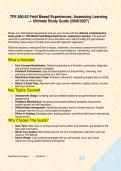
TFE 800.63 Field Based Experiences: Assessing Learning
— Ultimate Study Guide (2026/2027)
Master your field-based assessments and ace your course with the ultimate comprehensive
study guide for TFE 800.63 Field Based Experiences: Assessing Learning. This premium
resource is specifically engineered for future educators who need to bridge the gap between
theoretical measurement concepts and real-world classroom application.
Effective educators understand how to design, implement, and analyze assessments that truly
reflect student progress. This guide provides the exact blueprints, frameworks, and insights you
need to demonstrate that mastery in your coursework and clinical experiences.
What is Included
• Core Concept Breakdowns: Detailed explanations of formative, summative, diagnostic,
and authentic assessment strategies.
• Fieldwork Frameworks: Step-by-step templates for documenting, observing, and
analyzing student learning during your field hours.
• Data-Driven Instruction Tools: Practical methods for interpreting student data to modify
and improve lesson plans.
• Rubric & Exam Prep: Alignment with major course milestones, grading rubrics, and key
learning outcomes.
Key Topics Covered
• Assessment Design: Creating valid and reliable traditional and performance-based
assessments.
• Feedback Mechanisms: Developing actionable feedback strategies that promote
student growth and self-regulation.
• Differentiated Assessment: Modifying evaluation tools for diverse learners, English
Language Learners (ELLs), and exceptional students.
• Ethics in Grading: Navigating bias, grading policies, and ethical dilemmas in educational
measurement.
Why Choose This Guide?
• Save Time: Skip hours of sorting through lecture slides and textbooks; get straight to the
high-yield information.
• Boost Your Grades: Built directly around the core competencies required to earn top
marks in TFE 800.63.
• Career Ready: Learn practical strategies that you will actually use in your future
classroom during student teaching and beyond.
1
Questions & Answers Literature
, Question
Answered step-by-step
Asked by MagistrateBarracudaMaster1144
TFE 800.63 Field Based Experiences: Assessing Learning
Effective educators understand how to collect, analyze, and use assessment data to plan instruction
that meets student needs. This field-based experience (FBE) course draws on previous courses such
as TCR 405 Questioning Strategies and Feedback, TCR 406 Formal Assessment, and TTL 409 Using
Data to Inform Instruction.
As you spend time observing teachers and students in these five classrooms, watch for both
formative and summative assessment strategies. Pay close attention to the techniques the teacher
uses to gauge understanding and what they do with this information. Does the teacher reteach a
portion of the lesson, pause independent work to clarify a concept, or pull a small group aside to give
extra time for mastery? In your reflection, refer to previous coursework to connect what you saw in
the classroom with how assessment is used to guide instruction.
Reflection Questions:
1. In video 1 where you observed the classrooms of Ms. Christensen and Ms. Dunlap, what type(s)
of formative assessment did you see in the classes observed? How was it administered and used
to impact future instruction?
2. The classrooms of Ms. Lassiter and Ms. Manske in video 2 are very hands-on environments.
How did each of these teachers employ formative assessments in their classrooms? Provide
specific examples of each.
Q+A
3. You observed the classrooms of Mr. Reed and Ms. Perez in video 3. What type of
feedback did the teacher(s) give students? Refer back to the characteristics of effective feedback in
Lesson 6 of TCR 405 Questioning Strategies and Feedback. Did the feedback attain the desired
results?
4. Formative assessment is used to assist teachers in planning their next instructional steps. How
was data used in both Ms. Stewart and Aguirre's classes to impact instruction? Cite specific
examples from the video.
— Ultimate Study Guide (2026/2027)
Master your field-based assessments and ace your course with the ultimate comprehensive
study guide for TFE 800.63 Field Based Experiences: Assessing Learning. This premium
resource is specifically engineered for future educators who need to bridge the gap between
theoretical measurement concepts and real-world classroom application.
Effective educators understand how to design, implement, and analyze assessments that truly
reflect student progress. This guide provides the exact blueprints, frameworks, and insights you
need to demonstrate that mastery in your coursework and clinical experiences.
What is Included
• Core Concept Breakdowns: Detailed explanations of formative, summative, diagnostic,
and authentic assessment strategies.
• Fieldwork Frameworks: Step-by-step templates for documenting, observing, and
analyzing student learning during your field hours.
• Data-Driven Instruction Tools: Practical methods for interpreting student data to modify
and improve lesson plans.
• Rubric & Exam Prep: Alignment with major course milestones, grading rubrics, and key
learning outcomes.
Key Topics Covered
• Assessment Design: Creating valid and reliable traditional and performance-based
assessments.
• Feedback Mechanisms: Developing actionable feedback strategies that promote
student growth and self-regulation.
• Differentiated Assessment: Modifying evaluation tools for diverse learners, English
Language Learners (ELLs), and exceptional students.
• Ethics in Grading: Navigating bias, grading policies, and ethical dilemmas in educational
measurement.
Why Choose This Guide?
• Save Time: Skip hours of sorting through lecture slides and textbooks; get straight to the
high-yield information.
• Boost Your Grades: Built directly around the core competencies required to earn top
marks in TFE 800.63.
• Career Ready: Learn practical strategies that you will actually use in your future
classroom during student teaching and beyond.
1
Questions & Answers Literature
, Question
Answered step-by-step
Asked by MagistrateBarracudaMaster1144
TFE 800.63 Field Based Experiences: Assessing Learning
Effective educators understand how to collect, analyze, and use assessment data to plan instruction
that meets student needs. This field-based experience (FBE) course draws on previous courses such
as TCR 405 Questioning Strategies and Feedback, TCR 406 Formal Assessment, and TTL 409 Using
Data to Inform Instruction.
As you spend time observing teachers and students in these five classrooms, watch for both
formative and summative assessment strategies. Pay close attention to the techniques the teacher
uses to gauge understanding and what they do with this information. Does the teacher reteach a
portion of the lesson, pause independent work to clarify a concept, or pull a small group aside to give
extra time for mastery? In your reflection, refer to previous coursework to connect what you saw in
the classroom with how assessment is used to guide instruction.
Reflection Questions:
1. In video 1 where you observed the classrooms of Ms. Christensen and Ms. Dunlap, what type(s)
of formative assessment did you see in the classes observed? How was it administered and used
to impact future instruction?
2. The classrooms of Ms. Lassiter and Ms. Manske in video 2 are very hands-on environments.
How did each of these teachers employ formative assessments in their classrooms? Provide
specific examples of each.
Q+A
3. You observed the classrooms of Mr. Reed and Ms. Perez in video 3. What type of
feedback did the teacher(s) give students? Refer back to the characteristics of effective feedback in
Lesson 6 of TCR 405 Questioning Strategies and Feedback. Did the feedback attain the desired
results?
4. Formative assessment is used to assist teachers in planning their next instructional steps. How
was data used in both Ms. Stewart and Aguirre's classes to impact instruction? Cite specific
examples from the video.