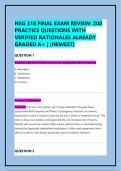
NSG 318 FINAL EXAM REVIEW: 200
PRACTICE QUESTIONS WITH
VERIFIED RATIONALES ALREADY
GRADED A+ | (NEWEST)
QUESTION 1
A patient with liver cirrhosis is at risk for drug toxicity due to impaired:
A. Absorption
B. Distribution
C. Metabolism
D. Excretion
Answer: C. Metabolism
Rationale: The liver is the primary site of drug metabolism through Phase I
(cytochrome P450 enzymes) and Phase II (conjugation) reactions. In cirrhosis,
hepatocyte function is impaired, reducing the liver's ability to metabolize drugs. This
leads to drug accumulation, prolonged half-life, and increased risk of toxicity.
Patients with severe liver disease often require reduced doses or extended dosing
intervals for hepatically metabolized medications. Unlike renal impairment (which
affects excretion), liver disease specifically impairs metabolic clearance.
QUESTION 2
,A drug that is highly protein-bound is displaced by a second drug. The likely
result is:
A. Decreased free drug concentration
B. Increased drug toxicity
C. Reduced drug half-life
D. No change in effect
Answer: B. Increased drug toxicity
Rationale: Protein binding limits the amount of free (active, unbound) drug in
circulation. When a highly protein-bound drug (e.g., warfarin, 98-99% bound) is
displaced by another protein-bound drug (e.g., sulfonamides), the concentration of
free drug increases significantly. This enhances both therapeutic and adverse effects,
potentially leading to toxicity. The classic example is warfarin displacement by
sulfonamides, which can cause severe bleeding. The displaced drug remains active
until it is metabolized or excreted.
QUESTION 3
A patient taking warfarin starts taking rifampin. The INR decreases. This
interaction is due to:
A. CYP450 enzyme induction
B. CYP450 enzyme inhibition
C. Increased protein binding
D. Reduced absorption
,Answer: A. CYP450 enzyme induction
Rationale: Rifampin is a potent inducer of hepatic CYP450 enzymes (particularly
CYP3A4). Enzyme induction accelerates the metabolism of warfarin, reducing its
plasma concentration and anticoagulant effect, resulting in a lower INR. This is the
opposite of enzyme inhibition (e.g., grapefruit juice, cimetidine), which would
increase drug levels and toxicity. Patients on warfarin starting rifampin may require
increased warfarin doses, and monitoring should be intensified.
QUESTION 4
A drug given IV has 100% bioavailability because:
A. It bypasses absorption barriers
B. It is metabolized in the liver
C. It is protein bound
D. It has a long half-life
Answer: A. It bypasses absorption barriers
Rationale: Bioavailability is the fraction of administered drug that reaches systemic
circulation unchanged. Intravenous administration delivers the drug directly into the
bloodstream, completely bypassing the gastrointestinal absorption process and the
first-pass hepatic metabolism. Oral drugs must be absorbed through the GI tract and
pass through the liver before reaching systemic circulation, reducing bioavailability
due to incomplete absorption and first-pass metabolism.
, QUESTION 5
Which organ is the primary site of drug excretion?
A. Liver
B. Lung
C. Kidney
D. Skin
Answer: C. Kidney
Rationale: The kidneys are the primary organs of drug excretion, eliminating drugs
and their metabolites via glomerular filtration, tubular secretion, and tubular
reabsorption. Renal impairment requires dose adjustment for renally eliminated
drugs (e.g., aminoglycosides, lithium, digoxin). Liver function tests assess metabolic
capacity; BUN and creatinine are used to evaluate renal function. The liver
metabolizes drugs (not primarily excretes them), and the lungs eliminate volatile
anesthetics and alcohol.
QUESTION 6
A patient with bradycardia is given atropine. This drug is a:
A. Beta-1 agonist
B. Muscarinic antagonist
C. Nicotinic agonist
D. Alpha-1 antagonist
PRACTICE QUESTIONS WITH
VERIFIED RATIONALES ALREADY
GRADED A+ | (NEWEST)
QUESTION 1
A patient with liver cirrhosis is at risk for drug toxicity due to impaired:
A. Absorption
B. Distribution
C. Metabolism
D. Excretion
Answer: C. Metabolism
Rationale: The liver is the primary site of drug metabolism through Phase I
(cytochrome P450 enzymes) and Phase II (conjugation) reactions. In cirrhosis,
hepatocyte function is impaired, reducing the liver's ability to metabolize drugs. This
leads to drug accumulation, prolonged half-life, and increased risk of toxicity.
Patients with severe liver disease often require reduced doses or extended dosing
intervals for hepatically metabolized medications. Unlike renal impairment (which
affects excretion), liver disease specifically impairs metabolic clearance.
QUESTION 2
,A drug that is highly protein-bound is displaced by a second drug. The likely
result is:
A. Decreased free drug concentration
B. Increased drug toxicity
C. Reduced drug half-life
D. No change in effect
Answer: B. Increased drug toxicity
Rationale: Protein binding limits the amount of free (active, unbound) drug in
circulation. When a highly protein-bound drug (e.g., warfarin, 98-99% bound) is
displaced by another protein-bound drug (e.g., sulfonamides), the concentration of
free drug increases significantly. This enhances both therapeutic and adverse effects,
potentially leading to toxicity. The classic example is warfarin displacement by
sulfonamides, which can cause severe bleeding. The displaced drug remains active
until it is metabolized or excreted.
QUESTION 3
A patient taking warfarin starts taking rifampin. The INR decreases. This
interaction is due to:
A. CYP450 enzyme induction
B. CYP450 enzyme inhibition
C. Increased protein binding
D. Reduced absorption
,Answer: A. CYP450 enzyme induction
Rationale: Rifampin is a potent inducer of hepatic CYP450 enzymes (particularly
CYP3A4). Enzyme induction accelerates the metabolism of warfarin, reducing its
plasma concentration and anticoagulant effect, resulting in a lower INR. This is the
opposite of enzyme inhibition (e.g., grapefruit juice, cimetidine), which would
increase drug levels and toxicity. Patients on warfarin starting rifampin may require
increased warfarin doses, and monitoring should be intensified.
QUESTION 4
A drug given IV has 100% bioavailability because:
A. It bypasses absorption barriers
B. It is metabolized in the liver
C. It is protein bound
D. It has a long half-life
Answer: A. It bypasses absorption barriers
Rationale: Bioavailability is the fraction of administered drug that reaches systemic
circulation unchanged. Intravenous administration delivers the drug directly into the
bloodstream, completely bypassing the gastrointestinal absorption process and the
first-pass hepatic metabolism. Oral drugs must be absorbed through the GI tract and
pass through the liver before reaching systemic circulation, reducing bioavailability
due to incomplete absorption and first-pass metabolism.
, QUESTION 5
Which organ is the primary site of drug excretion?
A. Liver
B. Lung
C. Kidney
D. Skin
Answer: C. Kidney
Rationale: The kidneys are the primary organs of drug excretion, eliminating drugs
and their metabolites via glomerular filtration, tubular secretion, and tubular
reabsorption. Renal impairment requires dose adjustment for renally eliminated
drugs (e.g., aminoglycosides, lithium, digoxin). Liver function tests assess metabolic
capacity; BUN and creatinine are used to evaluate renal function. The liver
metabolizes drugs (not primarily excretes them), and the lungs eliminate volatile
anesthetics and alcohol.
QUESTION 6
A patient with bradycardia is given atropine. This drug is a:
A. Beta-1 agonist
B. Muscarinic antagonist
C. Nicotinic agonist
D. Alpha-1 antagonist