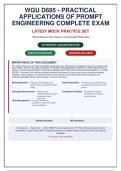
WGU D685 - PRACTICAL
APPLICATIONS OF PROMPT
ENGINEERING COMPLETE EXAM
LATEST MOCK PRACTICE SET
189 Questions with Answers and Detailed Rationales
100 PERCENT GUARANTEED PASS
INSTANT DOWNLOAD ANSWERS INCLUDED
IMPORTANCE OF THIS DOCUMENT
This comprehensive examination preparation guide has been meticulously developed to help you succeed in the
WGU D685 - PRACTICAL APPLICATIONS OF PROMPT ENGINEERING COMPLETE EXAM PREPARATION
GUIDE - QUESTIONS CORRECT VERIFIED ANSWERS WITH DETAILED RATIONALES GRADED A+ LATEST
UPDATE. It contains 189 carefully selected questions that reflect the most current exam content and testing
strategies. Each question is accompanied by a correct answer and a detailed rationale that explains the
underlying pathophysiology, pharmacology, or clinical reasoning.
Self-Assessment – Test your knowledge and Exam Preparation – Familiarize yourself with the
identify areas requiring further question format and content
study areas
Concept Reinforcement – Deepen your Confidence Building – Develop test-taking
understanding through strategies and reduce
evidence-based exam anxiety
rationales
Time Management – Practice answering
questions under simulated
exam conditions
Review Summary 189 Questions
Foundations - Application - WGU D685 Practical Applications OF Prompt Engineering Complete
Preparation Guide Correct WITH Detailed Rationales A Update Prompt Engineering AND AI Systems
Graduate
All answers with rationales
,Table of Contents
Content Area Questions Key Topics
WGU D685 Practical 1-32 Prompt, Model, Effective, Engineer, Generate
Applications OF Prompt
Engineering Complete
Preparation Guide Correct
WITH Detailed Rationales A
Update Prompt Engineering
AND AI Systems Graduate
Model 33-64 Prompt, Engineer, System, Effective, Likely
Engineer 65-96 Prompt, Effective, Model, Engineering, System
Effective 97-128 Prompt, Engineer, Model, System, Designing
System 129-160 Prompt, Engineer, Model, Effective, Technique
Designing 161-189 Prompt, Model, Engineer, Likely, Language
TOTAL 189 All questions include answers and detailed rationales
,Section A - WGU D685 Practical Applications OF Prompt
Engineering Complete Preparation Guide Correct WITH
Detailed Rationales A Update Prompt Engineering AND AI
Systems Graduate
Q1.
In the context of few-shot prompting, what is the primary effect of providing examples
with high variability in the output space?
A. It increases the model's tendency to B. It improves generalization by better
overfit to the specific examples. defining the task boundary.
C. It reduces the need for clear instructions. D. It causes the model to ignore the
examples and rely on prior knowledge.
Correct: B - It improves generalization by better defining the task boundary.
Rationale:High variability in few-shot examples helps the model infer the underlying task
pattern rather than memorizing specific input-output pairs, thus improving generalization.
Overfitting (A) occurs with low variability. Clear instructions (C) are still necessary. (D) is
incorrect as examples are always used.
Q2.
When using chain-of-thought prompting for arithmetic reasoning, what is the most
significant benefit of explicitly requesting 'Let's think step by step'?
A. It forces the model to use a specific B. It increases the model's confidence in its
algorithm. final answer.
C. It elicits intermediate reasoning steps that D. It allows the model to bypass token
reduce arithmetic errors. limitations.
Correct: C - It elicits intermediate reasoning steps that reduce arithmetic errors.
Rationale:Chain-of-thought prompting encourages the model to produce intermediate
reasoning steps, which decompose complex problems and reduce errors. It does not force a
specific algorithm (A), nor does it necessarily increase confidence (B). It does not affect token
limits (D).
Q3.
Which of the following best describes the role of temperature in LLM generation for a task
requiring high factual accuracy?
A. Set temperature to 1.5 to increase B. Set temperature to 0.0 to make the output
creativity. deterministic.
Page 3
, Section A - WGU D685 Practical Applications OF Prompt Engineering Complete Preparation Guide Correct WITH Detailed Rationales A Update
Prompt Engineering AND AI Systems Graduate
C. Set temperature to 0.7 to balance D. Set temperature to 0.2 to reduce
randomness and coherence. hallucination risk.
Correct: D - Set temperature to 0.2 to reduce hallucination risk.
Rationale:Lower temperatures (e.g., 0.2) produce more focused and deterministic outputs,
reducing the likelihood of hallucination. Temperature 0.0 (B) is deterministic but may lead to
repetitive outputs. Higher temperatures (A, C) increase randomness, which is not ideal for
factual accuracy.
Q4.
In building a prompt for a code generation task, which of the following is most effective
for eliciting efficient code?
A. Ask for 'the most elegant solution'. B. Provide a detailed specification and ask
for 'production-ready code'.
C. Request 'multiple solutions and explain D. Use a few-shot example with a naive
the trade-offs'. solution.
Correct: B - Provide a detailed specification and ask for 'production-ready code'.
Rationale:Providing a detailed specification and asking for 'production-ready code' sets clear
expectations for quality and completeness. 'Elegant' (A) is subjective, 'multiple solutions' (C)
may be overkill, and a naive example (D) may bias towards inefficiency.
Q5.
What is a primary concern when using user-generated examples in few-shot prompts for a
public-facing chatbot?
A. The examples may contain biases that B. The examples are likely to be too short.
get amplified.
C. The examples will make the model too D. The examples will slow down inference.
creative.
Correct: A - The examples may contain biases that get amplified.
Rationale:User-generated content can embed societal biases, which the model may learn
and amplify. Length (B) is not a primary concern, creativity (C) is not directly related, and
inference speed (D) is not significantly affected by example content.
Q6.
When designing a prompt for a multi-step tool-use task, what is the primary advantage of
using a 'scratchpad' or 'working memory'?
Page 4
APPLICATIONS OF PROMPT
ENGINEERING COMPLETE EXAM
LATEST MOCK PRACTICE SET
189 Questions with Answers and Detailed Rationales
100 PERCENT GUARANTEED PASS
INSTANT DOWNLOAD ANSWERS INCLUDED
IMPORTANCE OF THIS DOCUMENT
This comprehensive examination preparation guide has been meticulously developed to help you succeed in the
WGU D685 - PRACTICAL APPLICATIONS OF PROMPT ENGINEERING COMPLETE EXAM PREPARATION
GUIDE - QUESTIONS CORRECT VERIFIED ANSWERS WITH DETAILED RATIONALES GRADED A+ LATEST
UPDATE. It contains 189 carefully selected questions that reflect the most current exam content and testing
strategies. Each question is accompanied by a correct answer and a detailed rationale that explains the
underlying pathophysiology, pharmacology, or clinical reasoning.
Self-Assessment – Test your knowledge and Exam Preparation – Familiarize yourself with the
identify areas requiring further question format and content
study areas
Concept Reinforcement – Deepen your Confidence Building – Develop test-taking
understanding through strategies and reduce
evidence-based exam anxiety
rationales
Time Management – Practice answering
questions under simulated
exam conditions
Review Summary 189 Questions
Foundations - Application - WGU D685 Practical Applications OF Prompt Engineering Complete
Preparation Guide Correct WITH Detailed Rationales A Update Prompt Engineering AND AI Systems
Graduate
All answers with rationales
,Table of Contents
Content Area Questions Key Topics
WGU D685 Practical 1-32 Prompt, Model, Effective, Engineer, Generate
Applications OF Prompt
Engineering Complete
Preparation Guide Correct
WITH Detailed Rationales A
Update Prompt Engineering
AND AI Systems Graduate
Model 33-64 Prompt, Engineer, System, Effective, Likely
Engineer 65-96 Prompt, Effective, Model, Engineering, System
Effective 97-128 Prompt, Engineer, Model, System, Designing
System 129-160 Prompt, Engineer, Model, Effective, Technique
Designing 161-189 Prompt, Model, Engineer, Likely, Language
TOTAL 189 All questions include answers and detailed rationales
,Section A - WGU D685 Practical Applications OF Prompt
Engineering Complete Preparation Guide Correct WITH
Detailed Rationales A Update Prompt Engineering AND AI
Systems Graduate
Q1.
In the context of few-shot prompting, what is the primary effect of providing examples
with high variability in the output space?
A. It increases the model's tendency to B. It improves generalization by better
overfit to the specific examples. defining the task boundary.
C. It reduces the need for clear instructions. D. It causes the model to ignore the
examples and rely on prior knowledge.
Correct: B - It improves generalization by better defining the task boundary.
Rationale:High variability in few-shot examples helps the model infer the underlying task
pattern rather than memorizing specific input-output pairs, thus improving generalization.
Overfitting (A) occurs with low variability. Clear instructions (C) are still necessary. (D) is
incorrect as examples are always used.
Q2.
When using chain-of-thought prompting for arithmetic reasoning, what is the most
significant benefit of explicitly requesting 'Let's think step by step'?
A. It forces the model to use a specific B. It increases the model's confidence in its
algorithm. final answer.
C. It elicits intermediate reasoning steps that D. It allows the model to bypass token
reduce arithmetic errors. limitations.
Correct: C - It elicits intermediate reasoning steps that reduce arithmetic errors.
Rationale:Chain-of-thought prompting encourages the model to produce intermediate
reasoning steps, which decompose complex problems and reduce errors. It does not force a
specific algorithm (A), nor does it necessarily increase confidence (B). It does not affect token
limits (D).
Q3.
Which of the following best describes the role of temperature in LLM generation for a task
requiring high factual accuracy?
A. Set temperature to 1.5 to increase B. Set temperature to 0.0 to make the output
creativity. deterministic.
Page 3
, Section A - WGU D685 Practical Applications OF Prompt Engineering Complete Preparation Guide Correct WITH Detailed Rationales A Update
Prompt Engineering AND AI Systems Graduate
C. Set temperature to 0.7 to balance D. Set temperature to 0.2 to reduce
randomness and coherence. hallucination risk.
Correct: D - Set temperature to 0.2 to reduce hallucination risk.
Rationale:Lower temperatures (e.g., 0.2) produce more focused and deterministic outputs,
reducing the likelihood of hallucination. Temperature 0.0 (B) is deterministic but may lead to
repetitive outputs. Higher temperatures (A, C) increase randomness, which is not ideal for
factual accuracy.
Q4.
In building a prompt for a code generation task, which of the following is most effective
for eliciting efficient code?
A. Ask for 'the most elegant solution'. B. Provide a detailed specification and ask
for 'production-ready code'.
C. Request 'multiple solutions and explain D. Use a few-shot example with a naive
the trade-offs'. solution.
Correct: B - Provide a detailed specification and ask for 'production-ready code'.
Rationale:Providing a detailed specification and asking for 'production-ready code' sets clear
expectations for quality and completeness. 'Elegant' (A) is subjective, 'multiple solutions' (C)
may be overkill, and a naive example (D) may bias towards inefficiency.
Q5.
What is a primary concern when using user-generated examples in few-shot prompts for a
public-facing chatbot?
A. The examples may contain biases that B. The examples are likely to be too short.
get amplified.
C. The examples will make the model too D. The examples will slow down inference.
creative.
Correct: A - The examples may contain biases that get amplified.
Rationale:User-generated content can embed societal biases, which the model may learn
and amplify. Length (B) is not a primary concern, creativity (C) is not directly related, and
inference speed (D) is not significantly affected by example content.
Q6.
When designing a prompt for a multi-step tool-use task, what is the primary advantage of
using a 'scratchpad' or 'working memory'?
Page 4