

SDI DIVEMASTER EXAM
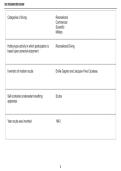
Categories of diving Recreational
Commercial
Scientific
Military
Hobby-type activity in which participation is Recreational Diving
based upon personal enjoyment
Inventors of modern scuba Emile Gagnan and Jacques-Yves Cousteau
Self-contained underwater breathing Scuba
apparatus
Year scuba was invented 1943
1
,SDI DIVEMASTER EXAM
First civilian diver training in the USA Los Angeles County
Dives greater than the recreational limit of Technical Diving
130 FSW that require special training and
equipment. This may also include
decompression diving, alternating breathing
gasses, or penetration into wrecks/caves.
Nitrogen and oxygen mixture with higher Nitrox
percentage of oxygen than air. Reduces the
effects of nitrogen at depth.
Dives less than 130 FSW on an open circuit Sport Diving
scuba with a single cylinder. Divers do not
dive in overhead environments or past their
no-decompression limits.
Parent organization for Scuba Diving International Training (ITI)
International (SDI), Technical Diving
International (TDI), and Emergency
Response Diving International (ERDI).
2
, SDI DIVEMASTER EXAM
Formed in 1994 by the early nitrox pioneers Technical Diving International (TDI)
to provide recreational divers with the most
accurate and up to date information on diving
tools and techniques.
Formed in 1998 from requests from TDI Scuba Diving International (SDI)
instructors and TDI dive centers who were
anxious to see the same type of clear,
practical, and no-nonsense approach
introduced to the sport diving arena. It was
the first agency to mandate the use of
personal dive computers during all confined
water and open water training. It was the first
agency to offer a certification program for 10
year old divers. It was the first agency to offer
on-line academics for the Open Water Diver
course. And it was the first agency to offer a
Solo Diver certification.
Formed in 2000 to provide highly specialized Emergency Response Diving International (ERDI)
training for police, fire service, and other
public safety personnel, addressing search
and rescue techniques in various and
sometimes hazardous underwater
environments, for both divers and dive
tenders.
3
Categories of diving Recreational
Commercial
Scientific
Military
Hobby-type activity in which participation is Recreational Diving
based upon personal enjoyment
Inventors of modern scuba Emile Gagnan and Jacques-Yves Cousteau
Self-contained underwater breathing Scuba
apparatus
Year scuba was invented 1943
1
,SDI DIVEMASTER EXAM
First civilian diver training in the USA Los Angeles County
Dives greater than the recreational limit of Technical Diving
130 FSW that require special training and
equipment. This may also include
decompression diving, alternating breathing
gasses, or penetration into wrecks/caves.
Nitrogen and oxygen mixture with higher Nitrox
percentage of oxygen than air. Reduces the
effects of nitrogen at depth.
Dives less than 130 FSW on an open circuit Sport Diving
scuba with a single cylinder. Divers do not
dive in overhead environments or past their
no-decompression limits.
Parent organization for Scuba Diving International Training (ITI)
International (SDI), Technical Diving
International (TDI), and Emergency
Response Diving International (ERDI).
2
, SDI DIVEMASTER EXAM
Formed in 1994 by the early nitrox pioneers Technical Diving International (TDI)
to provide recreational divers with the most
accurate and up to date information on diving
tools and techniques.
Formed in 1998 from requests from TDI Scuba Diving International (SDI)
instructors and TDI dive centers who were
anxious to see the same type of clear,
practical, and no-nonsense approach
introduced to the sport diving arena. It was
the first agency to mandate the use of
personal dive computers during all confined
water and open water training. It was the first
agency to offer a certification program for 10
year old divers. It was the first agency to offer
on-line academics for the Open Water Diver
course. And it was the first agency to offer a
Solo Diver certification.
Formed in 2000 to provide highly specialized Emergency Response Diving International (ERDI)
training for police, fire service, and other
public safety personnel, addressing search
and rescue techniques in various and
sometimes hazardous underwater
environments, for both divers and dive
tenders.
3



