

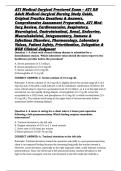
ATI Medical-Surgical Proctored Exam – ATI RN
Adult Medical-Surgical Nursing Study Guide,
Original Practice Questions & Answers,
Comprehensive Assessment Preparation, ATI Med-
Surg Review, Cardiovascular, Respiratory,
Neurological, Gastrointestinal, Renal, Endocrine,
Musculoskeletal, Integumentary, Immune &
Infectious Disorders, Pharmacology, Laboratory
Values, Patient Safety, Prioritization, Delegation &
NGN Clinical Judgment
Question 1: A client with chronic kidney disease is scheduled for a
hemodialysis session. Which laboratory value should the nurse report to the
healthcare provider before the procedure?
A. Serum potassium of 5.5 mEq/L
B. Serum phosphorus of 4.5 mg/dL
C. Serum calcium of 10.2 mg/dL
D. Hemoglobin of 11.5 g/dL
CORRECT ANSWER: C. Serum calcium of 10.2 mg/dL
Rationale: A serum calcium of 10.2 mg/dL is slightly above the normal range (8.5-10.2
mg/dL) and, if elevated, could indicate a risk for metastatic calcification. However, the
more critical value to report is a potassium level of 5.5 mEq/L, as it is at the high end of
normal but can rise rapidly during dialysis. A hemoglobin of 11.5 g/dL is low but
acceptable for a CKD client, and phosphorus of 4.5 mg/dL is within normal limits (2.5-
4.5 mg/dL). The calcium level being at the upper limit of normal warrants further
assessment before initiating dialysis.
Question 2: A nurse is caring for a client who is 2 hours post-operative
following a left pneumonectomy. Which finding requires immediate
intervention?
A. Tracheal deviation to the left side
B. Oxygen saturation of 91% on 2 L nasal cannula
C. Heart rate of 102 beats per minute
D. Blood pressure of 100/70 mm Hg
CORRECT ANSWER: A. Tracheal deviation to the left side
Rationale: Tracheal deviation toward the operative side (left) in a post-pneumonectomy
client is an expected finding because the remaining lung pulls the trachea toward it.
However, acute deviation, especially to the right (opposite side), could indicate a tension
pneumothorax. Since the client had a left pneumonectomy, tracheal deviation to the
right is the more emergent concern, but deviation to the left could also indicate a
,mediastinal shift if it is sudden. The most immediate concern is a tension pneumothorax
on the non-operative side, which would cause deviation to the left. A saturation of 91%
is acceptable for a post-pneumonectomy client, as the goal is typically >90%. The heart
rate and blood pressure are slightly elevated and low, respectively, but not immediately
life-threatening.
Question 3: A client with heart failure has a new prescription for carvedilol.
Which assessment finding would indicate that the medication is having the
desired therapeutic effect?
A. Heart rate decreases from 88 to 72 beats per minute
B. Blood pressure increases from 110/70 to 130/80 mm Hg
C. Ejection fraction decreases from 35% to 30%
D. Weight increases by 2 kg in 24 hours
CORRECT ANSWER: A. Heart rate decreases from 88 to 72 beats per minute
Rationale: Carvedilol is a non-selective beta-blocker used in heart failure to reduce the
workload on the heart. A decrease in heart rate indicates effective beta-blockade,
reducing myocardial oxygen demand and improving cardiac output over time. An
increase in blood pressure is not the primary goal, as carvedilol can lower blood
pressure. A decreasing ejection fraction is not desired. Weight gain is a sign of fluid
retention, indicating worsening heart failure.
Question 4: A nurse is assessing a client with acute pancreatitis. Which finding
is most concerning?
A. Epigastric pain radiating to the back
B. Serum amylase of 250 U/L
C. Tachycardia and hypotension
D. Nausea and vomiting
CORRECT ANSWER: C. Tachycardia and hypotension
Rationale: Tachycardia and hypotension are signs of hypovolemic shock, a severe
complication of acute pancreatitis caused by third-space fluid shifting and massive fluid
losses. This is a life-threatening finding that requires immediate fluid resuscitation.
Epigastric pain radiating to the back, elevated serum amylase, and nausea/vomiting are
all classic manifestations of acute pancreatitis but are not as immediately life-threatening
as hemodynamic instability.
Question 5: A client with chronic obstructive pulmonary disease (COPD) has a
prescription for home oxygen therapy. The nurse should instruct the client to
use oxygen at which flow rate?
,A. 1-2 L/min via nasal cannula
B. 4-6 L/min via nasal cannula
C. 8-10 L/min via simple mask
D. 10-15 L/min via non-rebreather mask
CORRECT ANSWER: A. 1-2 L/min via nasal cannula
Rationale: Clients with COPD often have a hypoxic drive to breathe. High-flow oxygen
can suppress this drive, leading to respiratory depression and carbon dioxide narcosis.
The standard prescription for home oxygen in COPD is 1-2 L/min via nasal cannula to
maintain oxygen saturation at or above 90% without causing hypercapnia. Higher flow
rates are generally reserved for acute care settings and non-COPD clients.
Question 6: The nurse is caring for a client with a chest tube that is attached to
a closed drainage system. The tube becomes dislodged from the chest. What is
the nurse's priority action?
A. Clamp the chest tube near the insertion site
B. Apply an occlusive dressing over the insertion site
C. Reinsert the chest tube immediately
D. Notify the healthcare provider
CORRECT ANSWER: B. Apply an occlusive dressing over the insertion site
Rationale: If a chest tube is accidentally dislodged, the priority is to prevent a tension
pneumothorax by covering the insertion site with an occlusive dressing. The dressing
should be taped on three sides to allow air to escape and prevent air from entering.
Clamping the tube is not appropriate if it is dislodged. Reinsertion is not within the
nurse's scope of practice and should only be done by a provider. Notifying the provider
is important but not the priority action.
Question 7: A client has been diagnosed with cirrhosis of the liver. Which
assessment finding is most indicative of hepatic encephalopathy?
A. Asterixis
B. Jaundice
C. Ascites
D. Spider angiomas
CORRECT ANSWER: A. Asterixis
Rationale: Asterixis (liver flap) is a motor disturbance characterized by intermittent loss
of postural tone, and it is a classic sign of hepatic encephalopathy. It indicates an
accumulation of ammonia and other toxins in the bloodstream affecting the central
nervous system. Jaundice, ascites, and spider angiomas are also manifestations of
, cirrhosis but are related to portal hypertension and liver dysfunction, not specifically to
encephalopathy.
Question 8: A client with diabetes mellitus type 1 is experiencing nausea,
vomiting, and abdominal pain. The client's blood glucose is 450 mg/dL, and
arterial blood gases show pH 7.20, PaCO2 28 mm Hg, and HCO3 12 mEq/L.
What is the priority nursing intervention?
A. Administer insulin subcutaneously
B. Start an IV infusion of 0.9% normal saline
C. Administer sodium bicarbonate intravenously
D. Insert a nasogastric tube
CORRECT ANSWER: B. Start an IV infusion of 0.9% normal saline
Rationale: The client is in diabetic ketoacidosis (DKA) as evidenced by hyperglycemia,
metabolic acidosis, and classic symptoms. The priority intervention is fluid resuscitation
with 0.9% normal saline to correct hypovolemia and improve tissue perfusion. Insulin
therapy should be initiated after fluid resuscitation has begun, typically via continuous
IV infusion, not subcutaneously. Sodium bicarbonate is only given in severe acidosis (pH
<6.9) and is not a first-line treatment. A nasogastric tube may be needed if the client has
ileus or severe vomiting, but fluid resuscitation is the priority.
Question 9: The nurse is assessing a client who is 24 hours post-
thyroidectomy. The client complains of tingling around the mouth and fingers.
What is the nurse's priority action?
A. Administer calcium gluconate IV
B. Assess for Chvostek's and Trousseau's signs
C. Increase the rate of the IV infusion
D. Notify the healthcare provider for a thyroid hormone level
CORRECT ANSWER: B. Assess for Chvostek's and Trousseau's signs
Rationale: After thyroidectomy, the client is at risk for hypocalcemia due to accidental
removal of or damage to the parathyroid glands. Tingling around the mouth and fingers
(circumoral paresthesia) is an early sign of hypocalcemia. The nurse's priority is to
assess for Chvostek's sign (facial twitching upon tapping the facial nerve) and
Trousseau's sign (carpopedal spasm upon inflation of a blood pressure cuff). While
administering IV calcium gluconate may be necessary, it should not be given without
confirming the diagnosis through assessment. Notifying the provider is important after
assessment.
Adult Medical-Surgical Nursing Study Guide,
Original Practice Questions & Answers,
Comprehensive Assessment Preparation, ATI Med-
Surg Review, Cardiovascular, Respiratory,
Neurological, Gastrointestinal, Renal, Endocrine,
Musculoskeletal, Integumentary, Immune &
Infectious Disorders, Pharmacology, Laboratory
Values, Patient Safety, Prioritization, Delegation &
NGN Clinical Judgment
Question 1: A client with chronic kidney disease is scheduled for a
hemodialysis session. Which laboratory value should the nurse report to the
healthcare provider before the procedure?
A. Serum potassium of 5.5 mEq/L
B. Serum phosphorus of 4.5 mg/dL
C. Serum calcium of 10.2 mg/dL
D. Hemoglobin of 11.5 g/dL
CORRECT ANSWER: C. Serum calcium of 10.2 mg/dL
Rationale: A serum calcium of 10.2 mg/dL is slightly above the normal range (8.5-10.2
mg/dL) and, if elevated, could indicate a risk for metastatic calcification. However, the
more critical value to report is a potassium level of 5.5 mEq/L, as it is at the high end of
normal but can rise rapidly during dialysis. A hemoglobin of 11.5 g/dL is low but
acceptable for a CKD client, and phosphorus of 4.5 mg/dL is within normal limits (2.5-
4.5 mg/dL). The calcium level being at the upper limit of normal warrants further
assessment before initiating dialysis.
Question 2: A nurse is caring for a client who is 2 hours post-operative
following a left pneumonectomy. Which finding requires immediate
intervention?
A. Tracheal deviation to the left side
B. Oxygen saturation of 91% on 2 L nasal cannula
C. Heart rate of 102 beats per minute
D. Blood pressure of 100/70 mm Hg
CORRECT ANSWER: A. Tracheal deviation to the left side
Rationale: Tracheal deviation toward the operative side (left) in a post-pneumonectomy
client is an expected finding because the remaining lung pulls the trachea toward it.
However, acute deviation, especially to the right (opposite side), could indicate a tension
pneumothorax. Since the client had a left pneumonectomy, tracheal deviation to the
right is the more emergent concern, but deviation to the left could also indicate a
,mediastinal shift if it is sudden. The most immediate concern is a tension pneumothorax
on the non-operative side, which would cause deviation to the left. A saturation of 91%
is acceptable for a post-pneumonectomy client, as the goal is typically >90%. The heart
rate and blood pressure are slightly elevated and low, respectively, but not immediately
life-threatening.
Question 3: A client with heart failure has a new prescription for carvedilol.
Which assessment finding would indicate that the medication is having the
desired therapeutic effect?
A. Heart rate decreases from 88 to 72 beats per minute
B. Blood pressure increases from 110/70 to 130/80 mm Hg
C. Ejection fraction decreases from 35% to 30%
D. Weight increases by 2 kg in 24 hours
CORRECT ANSWER: A. Heart rate decreases from 88 to 72 beats per minute
Rationale: Carvedilol is a non-selective beta-blocker used in heart failure to reduce the
workload on the heart. A decrease in heart rate indicates effective beta-blockade,
reducing myocardial oxygen demand and improving cardiac output over time. An
increase in blood pressure is not the primary goal, as carvedilol can lower blood
pressure. A decreasing ejection fraction is not desired. Weight gain is a sign of fluid
retention, indicating worsening heart failure.
Question 4: A nurse is assessing a client with acute pancreatitis. Which finding
is most concerning?
A. Epigastric pain radiating to the back
B. Serum amylase of 250 U/L
C. Tachycardia and hypotension
D. Nausea and vomiting
CORRECT ANSWER: C. Tachycardia and hypotension
Rationale: Tachycardia and hypotension are signs of hypovolemic shock, a severe
complication of acute pancreatitis caused by third-space fluid shifting and massive fluid
losses. This is a life-threatening finding that requires immediate fluid resuscitation.
Epigastric pain radiating to the back, elevated serum amylase, and nausea/vomiting are
all classic manifestations of acute pancreatitis but are not as immediately life-threatening
as hemodynamic instability.
Question 5: A client with chronic obstructive pulmonary disease (COPD) has a
prescription for home oxygen therapy. The nurse should instruct the client to
use oxygen at which flow rate?
,A. 1-2 L/min via nasal cannula
B. 4-6 L/min via nasal cannula
C. 8-10 L/min via simple mask
D. 10-15 L/min via non-rebreather mask
CORRECT ANSWER: A. 1-2 L/min via nasal cannula
Rationale: Clients with COPD often have a hypoxic drive to breathe. High-flow oxygen
can suppress this drive, leading to respiratory depression and carbon dioxide narcosis.
The standard prescription for home oxygen in COPD is 1-2 L/min via nasal cannula to
maintain oxygen saturation at or above 90% without causing hypercapnia. Higher flow
rates are generally reserved for acute care settings and non-COPD clients.
Question 6: The nurse is caring for a client with a chest tube that is attached to
a closed drainage system. The tube becomes dislodged from the chest. What is
the nurse's priority action?
A. Clamp the chest tube near the insertion site
B. Apply an occlusive dressing over the insertion site
C. Reinsert the chest tube immediately
D. Notify the healthcare provider
CORRECT ANSWER: B. Apply an occlusive dressing over the insertion site
Rationale: If a chest tube is accidentally dislodged, the priority is to prevent a tension
pneumothorax by covering the insertion site with an occlusive dressing. The dressing
should be taped on three sides to allow air to escape and prevent air from entering.
Clamping the tube is not appropriate if it is dislodged. Reinsertion is not within the
nurse's scope of practice and should only be done by a provider. Notifying the provider
is important but not the priority action.
Question 7: A client has been diagnosed with cirrhosis of the liver. Which
assessment finding is most indicative of hepatic encephalopathy?
A. Asterixis
B. Jaundice
C. Ascites
D. Spider angiomas
CORRECT ANSWER: A. Asterixis
Rationale: Asterixis (liver flap) is a motor disturbance characterized by intermittent loss
of postural tone, and it is a classic sign of hepatic encephalopathy. It indicates an
accumulation of ammonia and other toxins in the bloodstream affecting the central
nervous system. Jaundice, ascites, and spider angiomas are also manifestations of
, cirrhosis but are related to portal hypertension and liver dysfunction, not specifically to
encephalopathy.
Question 8: A client with diabetes mellitus type 1 is experiencing nausea,
vomiting, and abdominal pain. The client's blood glucose is 450 mg/dL, and
arterial blood gases show pH 7.20, PaCO2 28 mm Hg, and HCO3 12 mEq/L.
What is the priority nursing intervention?
A. Administer insulin subcutaneously
B. Start an IV infusion of 0.9% normal saline
C. Administer sodium bicarbonate intravenously
D. Insert a nasogastric tube
CORRECT ANSWER: B. Start an IV infusion of 0.9% normal saline
Rationale: The client is in diabetic ketoacidosis (DKA) as evidenced by hyperglycemia,
metabolic acidosis, and classic symptoms. The priority intervention is fluid resuscitation
with 0.9% normal saline to correct hypovolemia and improve tissue perfusion. Insulin
therapy should be initiated after fluid resuscitation has begun, typically via continuous
IV infusion, not subcutaneously. Sodium bicarbonate is only given in severe acidosis (pH
<6.9) and is not a first-line treatment. A nasogastric tube may be needed if the client has
ileus or severe vomiting, but fluid resuscitation is the priority.
Question 9: The nurse is assessing a client who is 24 hours post-
thyroidectomy. The client complains of tingling around the mouth and fingers.
What is the nurse's priority action?
A. Administer calcium gluconate IV
B. Assess for Chvostek's and Trousseau's signs
C. Increase the rate of the IV infusion
D. Notify the healthcare provider for a thyroid hormone level
CORRECT ANSWER: B. Assess for Chvostek's and Trousseau's signs
Rationale: After thyroidectomy, the client is at risk for hypocalcemia due to accidental
removal of or damage to the parathyroid glands. Tingling around the mouth and fingers
(circumoral paresthesia) is an early sign of hypocalcemia. The nurse's priority is to
assess for Chvostek's sign (facial twitching upon tapping the facial nerve) and
Trousseau's sign (carpopedal spasm upon inflation of a blood pressure cuff). While
administering IV calcium gluconate may be necessary, it should not be given without
confirming the diagnosis through assessment. Notifying the provider is important after
assessment.



