Geschreven door studenten die geslaagd zijn Direct beschikbaar na je betaling Online lezen of als PDF Verkeerd document? Gratis ruilen 4,6 TrustPilot
logo-home
Document preview thumbnail
Voorbeeld 3 van de 21 pagina's
Tentamen (uitwerkingen)

Mental & Behavioral Health Nursing (NUR 2459): NUR2459 Final Exam: Complete Review Guide | Questions & Answers, Summer 2026 - Rasmussen.

Document preview thumbnail
Voorbeeld 3 van de 21 pagina's

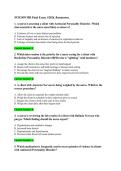
Mental & Behavioral Health Nursing (NUR 2459): NUR2459 Final Exam: Complete Review Guide | Questions & Answers, Summer 2026 - Rasmussen. NUR2459 MH Final Exam_S2026_Rasmussen. 1. A nurse is assessing a client with Antisocial Personality Disorder. Which characteristic is the nurse most likely to observe? A. Existence of two or more distinct personalities B. Extreme shyness and intense fear of rejection C. Lack of empathy and an absence of remorse for exploitative behavior D. Feelings of intense discomfort when being alone for brief periods 2. Which intervention is the priority for a nurse caring for a client with Borderline Personality Disorder (BPD) who is "splitting" staff members? A. Assign the client to the nurse they prefer to build rapport B. Ensure staff consistency and hold meetings to discuss limit-setting C. Encourage the client to use "magical thinking" to reduce anxiety D. Provide the client with any special favors they request to prevent self-harm 3. A client with Anorexia Nervosa is being weighed by the nurse. Which is the correct procedure? A. Allow the client to negotiate the weight schedule daily B. Weigh the client on schedule in their underwear prior to a meal C. Require the client to look at the scale to face reality D. Weigh the client daily after their largest meal 4. A nurse is reviewing the lab results of a client with Bulimia Nervosa who purges. Which finding should the nurse expect? A. Hypokalemia and metabolic changes B. Increased bone density C. Hypernatremia and hypertension D. Elevated white blood cell count (leukocytosis) 5. Which medication is frequently used to treat episodes of violence in clients with Antisocial Personality Disorder?A. Lithium carbonate and propranolol B. Sertraline and Fluoxetine C. Risperidone and Aripiprazole D. Alprazolam and Diazepam 6. What is a primary characteristic of a client with Histrionic Personality Disorder? A. Profound defect in the ability to form personal relationships B. Pervasive and persistent mistrust of others C. Seductive, flirtatious behavior and a requirement for constant affirmation D. Magical thinking and ideas of reference 7. A client with Anorexia Nervosa has the nursing diagnosis of "Imbalanced Nutrition: Less than body requirements." What is the most appropriate outcome? A. The client will identify three healthy coping skills B. The client will express satisfaction with their body image C. The client will achieve a weight gain of 15% above expected range D. The client will participate in solitary exercise daily 8. Which personality disorder is characterized by a "narrowed perceptual field" and extreme reliance on others? A. Dependent Personality Disorder B. Schizoid Personality Disorder C. Paranoid Personality Disorder D. Narcissistic Personality Disorder 9. The nurse observes calluses on the knuckles of a client with Bulimia Nervosa. This is known as: A. La Belle Indifference B. Amenorrhea C. Russell’s sign D. Lanugo 10. A nurse is caring for a client with BPD who has superficial self-injuries. How should the nurse respond? A. Provide extra attention to the client to show care B. Respond in a matter-of-fact manner to the injuries C. Encourage the client to keep the injury a secret D. Discuss the client's past trauma immediately after treatment 11. Which medication is the first-line choice for treating impulsivity and selfdestructive acts in BPD? A. SSRIs B. Benzodiazepines C. Typical antipsychotics D. Tricyclic antidepressants 12. A client with Schizotypal Personality Disorder exhibits "magical thinking." This is best described as: A. The belief that one's thoughts are being removed B. Feeling strange sensations from an object C. The belief that one's thoughts or behaviors can affect the environment D. Making up stories to fill in gaps of memory 13. What is the focus of Dialectical Behavior Therapy (DBT)? A. Modifying the environment to be more relaxing B. Treating chronic, self-injurious behavior in clients with BPD C. Restoring normal thought processes through solitary work D. Reducing physical symptoms of GAD through rapid-acting meds 14. In Anorexia Nervosa, what physical finding is a result of the body trying to conserve heat?A. Lanugo B. Hypertension C. Tachycardia D. Hyperthermia 15. A client with Paranoid Personality Disorder is suspicious of the hospital food. What is the best nursing intervention? A. Eat the food in front of the client to prove it is safe B. Provide food in sealed containers or wrappers C. Explain the hospital's food safety standards in detail D. Offer to taste every item on the client's tray 16. Which behavior is expected from a client with Narcissistic Personality Disorder? A. Grandiosity and a sense of entitlement B. Self-mutilation and suicide-prone behaviors C. Excessive shyness and fear of being evaluated negatively D. Inability to be alone for even brief periods 17. Which finding is typical of Binge Eating Disorder? A. Ingestion of large quantities of food without purging B. Weight loss of more than 15% of expected weight C. Dental erosion and parotid swelling D. Amenorrhea 18. Avoidant Personality Disorder is characterized by: A. Being aloof and emotionally cold B. Extreme sensitivity to rejection and a socially withdrawn life C. Constant testing of the honesty of others D. Failure to conform to the law Correct Answer: B19. What is the primary rule for the milieu therapy of a client with Anorexia? A. The client chooses their own meal times B. The client must be left alone in the bathroom after meals C. Observation during meals and for a period afterward is required D. Exercise should be used as a reward for eating 20. A client with Schizoid Personality Disorder is likely to prefer which activity? A. Working alone on a project B. Participating in a large group party C. Leading a team building session D. Engaging in seductive behavior 21. Which level of anxiety is characterized by a "narrowed perceptual field" where the client hears and sees less? A. Mild B. Moderate C. Severe D. Panic 22. What is the first-line pharmacological treatment for Generalized Anxiety Disorder (GAD)? A. Benzodiazepines B. SSRIs and SNRIs C. Tricyclic antidepressants D. MAOIs 23. A client with OCD performs a hand-washing ritual 30 times a day. What is the purpose of this compulsion? A. To gain attention from the staff B. To prevent or reduce distress or a dreaded event C. To improve skin hygiene D. To manipulate the nurse into providing extra care 24. Which characteristic is found in Conversion Disorder? A. Loss of body function that cannot be explained medically B. Conscious feigning of symptoms to receive emotional care C. Chronic worry about having a serious undiagnosed illness D. Sudden, unexpected travel away from home 25. "La Belle Indifference" is a clinical feature of which disorder? A. Generalized Anxiety Disorder B. Panic Disorder C. Conversion Disorder D. OCD 26. Which medication for anxiety takes 2 to 4 weeks to reach full effect and has no risk of physical dependence? A. Alprazolam B. Diazepam C. Buspirone D. Chlordiazepoxide 27. A client is experiencing a panic attack. What is the nurse's priority intervention? A. Encourage the client to join a group therapy session B. Give a long, detailed explanation of why the attack is happening C. Stay with the client and use short, firm sentences D. Leave the client alone in a quiet room until they calm down 28. In "Implosion Therapy" (flooding) for phobias, the client: A. Participates in a real-life situation that is extremely frightening B. Is gradually exposed to the phobic stimulusC. Learns to avoid the phobic stimulus entirely D. Takes high doses of benzodiazepines before exposure 29. Which type of amnesia involves the inability to recall one's entire identity and life history? A. Localized amnesia B. Selective amnesia C. Generalized amnesia D. Dissociative fugue 30. What is a common complication of Somatic Symptom Disorder? A. Drug abuse and dependence B. Rapid weight gain C. Enhanced concentration D. High self-esteem 31. Which level of anxiety is considered a "survival mechanism" that alerts the body to meet a threat? A. Mild B. Moderate C. Panic D. Alarm/Fight or Flight 32. What is the goal of "Systematic Desensitization" for phobias? A. Gradual exposure to the phobic stimulus B. Immediate exposure to the most frightening stimulus C. Use of negative feedback to stop a behavior D. Substituting a constructive behavior for an inadequate one 33. A client with GAD should be encouraged to:A. Avoid all stressful situations B. Discuss their feelings with a calm nurse C. Take benzodiazepines for long-term maintenance D. Only communicate through non-verbal methods 34. Factitious Disorder, also known as Munchausen syndrome, involves: A. Conscious, intentional feigning of symptoms to receive emotional care B. Unconscious conversion of stress into physical symptoms C. Morbid fear of obesity resulting in weight loss D. Repetitive ritualistic behaviors to reduce distress 35. Agoraphobia is the fear of: A. Evaluation negatively by others B. Specific objects like snakes or spiders C. Being in places where escape might be difficult D. Contracting a germ-related illness 36. Which theory suggests that GAD is caused by "faulty, distorted, or counterproductive thinking"? A. Psychodynamic theory B. Biological theory C. Cognitive theory D. Learning theory 37. A nurse caring for a client in "Panic" level anxiety should: A. Use a high-pitched, fast voice to get their attention B. Ask the client "Why" they are feeling this way C. Remain with the patient and speak slowly in a low-pitched voice D. Place the client in a room with many other patients 38. Which side effect is common in clients taking benzodiazepines for anxiety?A. Sedation and decreased cognitive function B. Coarse hand tremors and seizures C. Hypertension and hyperthermia D. Rapid weight gain 39. A client with OCD spends hours cleaning. Initially, the nurse should: A. Forbid the client from cleaning B. Give the client more cleaning supplies C. Allow the ritual while slowly setting future limits D. Tell the client their cleaning is unnecessary 40. "Dissociative Fugue" is characterized by: A. Sudden, unexpected travel and an inability to recall the past B. A pattern of anger and defiant behavior C. Morbid preoccupation with food D. Pervasive mistrust and suspiciousness of others 41. Which neurodevelopmental disorder occurs more often in boys than girls? A. Autism Spectrum Disorder B. Anorexia Nervosa C. Separation Anxiety Disorder D. Histrionic Personality Disorder 42. A child with Autism is observed "rocking" and "handclapping." These are: A. Deliberate self-harming behaviors B. Stereotyped body movements C. Signs of high self-esteem D. Symptoms of separation anxiety 43. What are the two FDA-approved medications for treating aggression and self-injury in Autism?A. Methylphenidate and Amphetamine B. Risperidone and Aripiprazole C. Sertraline and Fluoxetine D. Lithium and Propranolol 44. Which behavior is the "essential pattern" of ADHD? A. Inattention, hyperactivity, and impulsivity B. Withdrawal into a fantasy world C. Cruelty to animals and using weapons D. Crying and screaming when separated from the mother 45. Stimulants used for ADHD are approved for children of what age? A. 2 years and up B. 4 years and up C. 6 years and up D. 18 years and up 46. A child with Separation Anxiety Disorder often exhibits which of the following? A. Reluctance or refusal to attend school B. Cruelty to animals or pets C. Mastery of age-appropriate social skills D. Lack of interest in others 47. Conduct Disorder is characterized by which of the following? A. Pattern of irritability and compromise B. Aggression towards people and animals and bullying C. Magical thinking and superstitiousness D. Excessive fear of being alone 48. Oppositional Defiant Disorder (ODD) typically begins at what age?A. Age 2 B. Age 5 C. Age 8 D. Age 15 49. What is a key nursing intervention for a child with Conduct Disorder? A. Provide immediate, non-threatening feedback for negative behavior B. Encourage the child to play alone in a quiet room C. Let the child lead group activities to build power D. Avoid using role-play as it increases anxiety 50. Which medication is used to reduce aggression and irritability in ODD? A. Buspirone B. Divalproex (Depakote) C. Lithium carbonate D. Alprazolam 51. A child with Autism withdrawal into a fantasy world likely has which nursing diagnosis? A. Risk for Loneliness B. Impaired social interaction related to inability to trust C. Ineffective health maintenance D. Chronic low self-esteem 52. A child who is truant, sets fires, and runs away from home most likely has: A. ADHD B. Autism C. Conduct Disorder D. Separation Anxiety Disorder 53. What is a "perinatal influence" that may increase the risk of ADHD?A. Maternal high salt diet B. Low birth weight or trauma C. High socioeconomic status D. Early childhood vaccines 54. In younger children, Separation Anxiety may manifest as: A. "Shadowing" the attachment figure B. Bullying and intimidating others C. Stealing from parents D. Mastery of school skills 55. Which therapy involves the entire family because the child should not be separated from parents? A. Individual therapy B. Family therapy C. Milieu therapy D. Aversion therapy 56. A child with ODD typically directs their attitude first toward: A. Parents or caregivers B. Peers at school C. Animals and pets D. Strangers in the community 57. The goal for a client with ADHD is to: A. Complete assigned tasks independently B. Withdraw into a fantasy world C. Shadow the parent throughout the day D. Increase body weight by 15% 58. Which anatomical influence is linked to ADHD?A. Increased volume in the prefrontal cortex B. Decreased activity in the thalamus and cerebellum C. Lesions in the appetite center of the hypothalamus D. Excessive electrical signals at the synapse 59. Which behavior indicates a child has begun the "separation/individuation" process? A. Crying when the mother leaves B. Demonstrating awareness of self as separate from others C. Repetitive handclapping D. Following the nurse around the unit 60. What is a priority nursing diagnosis for a child with Autism who hits their head against the wall? A. Risk for self-mutilation B. Impaired verbal communication C. Disturbed personal identity D. Ineffective coping 61. In the "Cycle of Battering," what happens during Phase 1? A. Tension builds with minor incidents like pushing and verbal abuse B. The victim provokes an incident to end the tension C. The abuser makes promises to change D. An external event triggers the acute battering 62. Why do victims of intimate partner violence often stay in the relationship? A. They have high self-esteem and want to help the abuser B. They lack financial resources and a support network C. They are legally required to stay by the court D. They view the relationship as egalitarian Correct Answer: B63. A rape survivor who is calm, composed, and has a subdued affect is showing which pattern? A. Expressed response pattern B. Controlled response pattern C. Rape trauma syndrome D. Anticipatory grieving 64. What is the priority intervention for a nurse when a patient has been raped? A. Ask the patient why they were in that location B. Ensure the patient is safe and assess the extent of injuries C. Call the patient’s family immediately D. Conduct a long-term psychotherapy session 65. Which is a sign of suspected physical abuse in a child? A. A parent who describes their child as "evil" B. A child who is frequently absent from school C. A child who is consistently dirty and has body odor D. A parent who is overly protective of the child 66. Elder abuse is most often perpetrated by: A. A stranger in the community B. A relative who lives with the older adult C. A professional financial advisor D. A child under age 18 67. A nurse teaching a coping class for families suffering from stressors is performing: A. Primary prevention B. Secondary prevention C. Tertiary prevention D. Crisis intervention 68. Which stage of grief involves the individual attempting to strike a deal with God? A. Denial B. Anger C. Bargaining D. Depression 69. "Bereavement Overload" in older adults can lead to: A. Increased self-actualization B. Depression and jeopardized mental health C. Faster adaptation to loss D. Development of Antisocial Personality Disorder 70. What is an "Advance Directive"? A. A living will or durable power of attorney for health care B. A set of rules for staff consistency C. A medication schedule for alcohol maintenance D. A plan to ensure safety during a panic attack 71. Which task of Worden’s bereavement involves letting go of past attachments? A. Task I B. Task II C. Task III D. Task IV 72. How do children aged 3 to 5 years perceive death? A. As reversible and often confused with fantasy B. As final and universal C. As inevitable for themselves D. Unable to understand any feelings of loss 73. "Disenfranchised Grief" is grief that: A. Cannot be openly acknowledged or is not recognized by others B. Lasts for less than 6 weeks C. Occurs before the actual loss happens D. Is characterized by intense anger and aggression 74. In the "Honeymoon Phase" of battering, the abuser: A. Pushes and shoves the victim B. Is kind, loving, and promises to change C. Triggers the acute battering incident D. Threatens to leave the relationship 75. What is the goal of "Crisis Intervention"? A. To reconstruct the client's entire personality B. To help the survivor return to their previous lifestyle quickly C. To provide long-term pharmacological support D. To move the patient to a foster care facility 76. Adolescents (ages 13-18) perceive death as: A. Reversible and contagious B. A temporary sleep C. Universal and inevitable, but difficult to tolerate intense feelings D. Something that only affects older adults 77. A nurse is caring for an adult survivor of incest. What characteristic is common? A. Excessive trust in strangers B. Absence of pleasure with sexual activity and low self-esteem C. High sense of identity and self-worth D. Mastery of Task I of bereavement 78. What is the first step in a safety plan for a victim of domestic violence? A. Confront the abuser during the tension-building phase B. Be prepared for the next violent incident C. Taper off all anti-anxiety medications D. Discuss the abuser's childhood trauma with them 79. Which emotional pattern involves a survivor crying and sobbing after a rape? A. Expressed response pattern B. Controlled response pattern C. Disenfranchised grief D. Bargaining stage 80. Delayed (inhibited) grief is potentially pathological because: A. The person remains fixed in the denial stage B. The person moves through the stages too quickly C. It leads to immediate and severe somatic symptoms D. It only occurs in young children 81. Which lobe of the brain is responsible for "Thought Processes and Voluntary Movement"? A. Temporal Lobe B. Occipital Lobe C. Frontal Lobe D. Parietal Lobe 82. What is the therapeutic range for Lithium? A. 0.1 – 0.5 B. 0.8 – 1.4C. 1.5 and over D. 2.0 – 3.5 83. A client taking Lithium should be taught to: A. Maintain a regular salt diet and stay hydrated B. Restrict salt intake and avoid all exercise C. Take the medication only on an empty stomach D. Avoid all climates with temperatures over 70 degrees 84. Which medication can cause "Serotonin Syndrome" if combined with an MAOI too soon? A. Alprazolam B. SSRIs (e.g., Sertraline) C. Haldol D. Cogentin 85. Tardive Dyskinesia is characterized by: A. Muscle stiffness in the neck and head B. Facial tics, lip smacking, and tongue protrusion C. Severe muscle rigidity and a fever of 103+ D. Restlessness, pacing, and shifting weight 86. What is the priority assessment for a patient in a crisis? A. The patient's perception of the event B. Physical safety and risk for self-harm/suicide C. The patient's situational supports D. The patient's previous coping skills 87. Which medication is the first choice for acute alcohol withdrawal?A. Chlordiazepoxide (Librium) B. Disulfiram (Antabuse) C. Naltrexone (Revia) D. Lithium carbonate 88. What characterizes "Neuroleptic Malignant Syndrome" (NMS)? A. Severe muscle rigidity, high fever, and tachycardia B. Slurred speech, coarse tremors, and severe N/V C. Facial tics and involuntary eye blinks D. Narrowed perceptual field and pacing 89. When a client is experiencing auditory hallucinations, the first question should be: A. "When did the voices start?" B. "What are the voices saying to do?" C. "Do you like the voices?" D. "Who do the voices sound like?" 90. Which ethical principle refers to the client’s right to make their own decisions? A. Beneficence B. Justice C. Autonomy D. Fidelity 91. "Confabulation" is used by clients with Alzheimer's to: A. Fill in gaps of memory to maintain self-esteem B. Repeat phrases or behaviors over and over C. Recognize objects they can no longer name D. Communicate with staff in a loud voice Correct Answer: A92. Which neurotransmitters are implicated in Alzheimer’s Disease? A. Dopamine and Norepinephrine B. Serotonin and GABA C. Acetylcholine and Glutamate D. Epinephrine and Histamine 93. A nurse stays with a client who is talking to his mother for the first time in a year, as promised. This is: A. Fidelity B. Autonomy C. Justice D. Veracity 94. In "Milieu Therapy," which element is essential to healing? A. A high-salt diet B. A safe, structured, and relaxed environment C. Using the most restrictive methods possible D. Avoiding all interactions with other patients 95. "Agnosia" is the inability to: A. Recognize common objects B. Speak or use language C. Perform motor tasks D. Recall personal identity 96. Which medication is used for the maintenance of alcohol sobriety by making the person sick if they drink? A. Librium B. Antabuse C. Revia D. Xanax 97. Which defense mechanism involves "blaming another person for your own issues"? A. Sublimation B. Suppression C. Projection D. Displacement 98. When does alcohol withdrawal typically peak? A. 1–2 hours B. 24–48 hours C. 7–10 days D. 3 weeks 99. Which lobe of the brain interprets visual images? A. Frontal Lobe B. Temporal Lobe C. Occipital Lobe D. Parietal Lobe 100. A nurse repeats the same key words a patient has just spoken to echo their feelings. This is: A. Exploring B. Reflecting C. Restating D. Clarifying

Voorbeeld van de inhoud

NUR2459 MH Final Exam_S2026_Rasmussen.

1. A nurse is assessing a client with Antisocial Personality Disorder. Which
characteristic is the nurse most likely to observe?

A. Existence of two or more distinct personalities
B. Extreme shyness and intense fear of rejection
C. Lack of empathy and an absence of remorse for exploitative behavior
D. Feelings of intense discomfort when being alone for brief periods

Correct Answer: C

2. Which intervention is the priority for a nurse caring for a client with
Borderline Personality Disorder (BPD) who is "splitting" staff members?

A. Assign the client to the nurse they prefer to build rapport
B. Ensure staff consistency and hold meetings to discuss limit-setting
C. Encourage the client to use "magical thinking" to reduce anxiety
D. Provide the client with any special favors they request to prevent self-harm

Correct Answer: B

3. A client with Anorexia Nervosa is being weighed by the nurse. Which is the
correct procedure?

A. Allow the client to negotiate the weight schedule daily
B. Weigh the client on schedule in their underwear prior to a meal
C. Require the client to look at the scale to face reality
D. Weigh the client daily after their largest meal

Correct Answer: B

4. A nurse is reviewing the lab results of a client with Bulimia Nervosa who
purges. Which finding should the nurse expect?

A. Hypokalemia and metabolic changes
B. Increased bone density
C. Hypernatremia and hypertension
D. Elevated white blood cell count (leukocytosis)

Correct Answer: A

5. Which medication is frequently used to treat episodes of violence in clients
with Antisocial Personality Disorder?

,A. Lithium carbonate and propranolol
B. Sertraline and Fluoxetine
C. Risperidone and Aripiprazole
D. Alprazolam and Diazepam

Correct Answer: A

6. What is a primary characteristic of a client with Histrionic Personality
Disorder?

A. Profound defect in the ability to form personal relationships
B. Pervasive and persistent mistrust of others
C. Seductive, flirtatious behavior and a requirement for constant affirmation
D. Magical thinking and ideas of reference

Correct Answer: C

7. A client with Anorexia Nervosa has the nursing diagnosis of "Imbalanced
Nutrition: Less than body requirements." What is the most appropriate
outcome?

A. The client will identify three healthy coping skills
B. The client will express satisfaction with their body image
C. The client will achieve a weight gain of 15% above expected range
D. The client will participate in solitary exercise daily

Correct Answer: C

8. Which personality disorder is characterized by a "narrowed perceptual field"
and extreme reliance on others?

A. Dependent Personality Disorder
B. Schizoid Personality Disorder
C. Paranoid Personality Disorder
D. Narcissistic Personality Disorder

Correct Answer: A

9. The nurse observes calluses on the knuckles of a client with Bulimia Nervosa.
This is known as:

A. La Belle Indifference
B. Amenorrhea
C. Russell’s sign
D. Lanugo

, Correct Answer: C

10. A nurse is caring for a client with BPD who has superficial self-injuries. How
should the nurse respond?

A. Provide extra attention to the client to show care
B. Respond in a matter-of-fact manner to the injuries
C. Encourage the client to keep the injury a secret
D. Discuss the client's past trauma immediately after treatment

Correct Answer: B

11. Which medication is the first-line choice for treating impulsivity and self-
destructive acts in BPD?

A. SSRIs
B. Benzodiazepines
C. Typical antipsychotics
D. Tricyclic antidepressants

Correct Answer: A

12. A client with Schizotypal Personality Disorder exhibits "magical thinking."
This is best described as:

A. The belief that one's thoughts are being removed
B. Feeling strange sensations from an object
C. The belief that one's thoughts or behaviors can affect the environment
D. Making up stories to fill in gaps of memory

Correct Answer: C

13. What is the focus of Dialectical Behavior Therapy (DBT)?

A. Modifying the environment to be more relaxing
B. Treating chronic, self-injurious behavior in clients with BPD
C. Restoring normal thought processes through solitary work
D. Reducing physical symptoms of GAD through rapid-acting meds

Correct Answer: B

14. In Anorexia Nervosa, what physical finding is a result of the body trying to
conserve heat?

Documentinformatie

Geüpload op
16 augustus 2026
Aantal pagina's
21
Geschreven in
2025/2026
Type
Tentamen (uitwerkingen)
Bevat
Vragen en antwoorden
€18,51

Verkeerd document? Gratis ruilen Binnen 14 dagen na aankoop en voor het downloaden kun je een ander document kiezen. Je kunt het bedrag gewoon opnieuw besteden.
Geschreven door studenten die geslaagd zijn
Direct beschikbaar na je betaling
Online lezen of als PDF

Seller avatar
De reputatie van een verkoper is gebaseerd op het aantal documenten dat iemand tegen betaling verkocht heeft en de beoordelingen die voor die items ontvangen zijn. Er zijn drie niveau’s te onderscheiden: brons, zilver en goud. Hoe beter de reputatie, hoe meer de kwaliteit van zijn of haar werk te vertrouwen is.
MindCraft
3,8
(50)
Verkocht
403
Volgers
10
Items
2870
Laatst verkocht
1 dag geleden

Echte notities, van echte studenten
Elk document op Stuvia is geschreven door een medestudent die hetzelfde vak deed. Zo leer je van iemand die het al heeft gehaald.


Waarom studenten kiezen voor Stuvia

Gemaakt door medestudenten, geverifieerd door reviews

Kwaliteit die je kunt vertrouwen: geschreven door studenten die slaagden en beoordeeld door anderen die dit document gebruikten.

Niet tevreden? Kies een ander document

Geen zorgen! Je kunt voor hetzelfde geld direct een ander document kiezen dat beter past bij wat je zoekt.

Betaal zoals je wilt, start meteen met leren

Geen abonnement, geen verplichtingen. Betaal zoals je gewend bent via iDeal of creditcard en download je PDF-document meteen.

Student with book image

“Gekocht, gedownload en geslaagd. Zo makkelijk kan het dus zijn.”

Alisha Student

Bezig met je bronvermelding?

Maak nauwkeurige citaten in APA, MLA en Harvard met onze gratis bronnengenerator.

Bezig met je bronvermelding?

Veelgestelde vragen