NHA Practice Exam: Key Questions
and Answers for ECG Technicians
Questions And Answers Rated A+ New
Update Assured Satisfaction
1 2 3 4 5
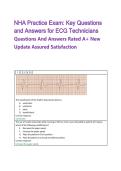
The classification of the rhythm strip shown above is
A. ventricular.
B. junctional.
C. atrial.
D. bundle block.
Correct response:
ventricular.
The use of smaller electrodes while running an ECG on a four-year-old pediatric patient will require
which of the following modifications?
E. Decrease the paper speed.
F. Increase the paper speed.
G. Place the patient in Sim’s position.
H. Place the patient in a dorsal recumbent position.
Correct response:
Increase the paper speed.
,In the event an ECG technician recognizes idioventricular rhythm on an ECG printout, how should the
ECG technician respond?
I. Ask the patient to take several deep breaths.
J. Notify the physician.
K. Administer oxygen.
L. Reposition the patient and run the test again.
Correct response:
Notify the physician.
Proper electrode placement for continuous ECG monitoring is identified by the use of
M. 3 leads placed on the patient’s torso.
N. 5 electrodes placed on the patient’s extremities and torso.
O. 10 electrodes placed on the patient’s torso.
P. 12 electrodes placed on the patient’s extremities and torso.
Correct response:
3 leads placed on the patient’s torso.
The ECG technician should enter the medications that the patient is taking into the
Q. system review.
R. discharge summary report.
S. electrocardiogram.
T. nurse’s notes.
Correct response:
electrocardiogram.
Before entering a private room with monitored negative air the ECG technician should prepare by
following
U. standard and contact precautions.
V. airborne and droplet precautions.
W. standard and airborne precautions.
X. airborne and contact precautions.
Correct response:
standard and airborne precautions.
An ECG technician is preparing to perform an ECG on a patient with a total left arm amputation. How
should the ECG technician place the arm electrodes?
Y. Place both the right and left on the upper outer shoulder area.
Z. Omit the left electrode and put the right on the upper outer arm.
AA. Put the right on the upper outer arm and the left on the torso below the clavicle.
BB. Put both the right and left on the torso, below the clavicle.
Correct response:
Put both the right and left on the torso, below the clavicle.
, In electrocardiography, the degrees of variation (horizontally and vertically) are known as the
CC. isoelectric line and baseline.
DD. deflection and baseline.
EE. amplitude and voltage.
FF. time and amplitude.
Correct response:
time and amplitude.
Which of the following is characterized by rapid incomplete contractions of the atria?
GG. Ventricular fibrillation
HH. Atrial fibrillation
II. Premature atrial contractions
JJ. Paroxysmal atrial tachycardia
Your response:
Premature atrial contractions
Correct response:
Atrial fibrillation
Which of the following actions should the ECG technician take if a 3 second period of sinus arrest is
observed on an asymptomatic patient?
KK. Call a code.
LL. Check the patient for a pulse.
MM. Ask the patient to remain still.
NN. Inform the physician about the pause.
Correct response:
Inform the physician about the pause.
The time from ventricular depolarization through repolarization is represented by the
OO.QRS complex.
PP. PR interval.
QQ.QT interval.
RR. PR segment.
Correct response:
QT interval.
The physician orders an ECG on a patient with severe burns on his left arm. Which of the following
alternate placements should the ECG technician use?
SS. All upper limb leads symmetrically placed as close to the original site as possible
TT. All upper limb leads placed substernally at the acromion process
UU. Left upper limb lead placed as close to the original site as possible
VV. Left upper limb lead placed substernally at the acromion process
Correct response:
All upper limb leads symmetrically placed as close to the original site as possible
and Answers for ECG Technicians
Questions And Answers Rated A+ New
Update Assured Satisfaction
1 2 3 4 5
The classification of the rhythm strip shown above is
A. ventricular.
B. junctional.
C. atrial.
D. bundle block.
Correct response:
ventricular.
The use of smaller electrodes while running an ECG on a four-year-old pediatric patient will require
which of the following modifications?
E. Decrease the paper speed.
F. Increase the paper speed.
G. Place the patient in Sim’s position.
H. Place the patient in a dorsal recumbent position.
Correct response:
Increase the paper speed.
,In the event an ECG technician recognizes idioventricular rhythm on an ECG printout, how should the
ECG technician respond?
I. Ask the patient to take several deep breaths.
J. Notify the physician.
K. Administer oxygen.
L. Reposition the patient and run the test again.
Correct response:
Notify the physician.
Proper electrode placement for continuous ECG monitoring is identified by the use of
M. 3 leads placed on the patient’s torso.
N. 5 electrodes placed on the patient’s extremities and torso.
O. 10 electrodes placed on the patient’s torso.
P. 12 electrodes placed on the patient’s extremities and torso.
Correct response:
3 leads placed on the patient’s torso.
The ECG technician should enter the medications that the patient is taking into the
Q. system review.
R. discharge summary report.
S. electrocardiogram.
T. nurse’s notes.
Correct response:
electrocardiogram.
Before entering a private room with monitored negative air the ECG technician should prepare by
following
U. standard and contact precautions.
V. airborne and droplet precautions.
W. standard and airborne precautions.
X. airborne and contact precautions.
Correct response:
standard and airborne precautions.
An ECG technician is preparing to perform an ECG on a patient with a total left arm amputation. How
should the ECG technician place the arm electrodes?
Y. Place both the right and left on the upper outer shoulder area.
Z. Omit the left electrode and put the right on the upper outer arm.
AA. Put the right on the upper outer arm and the left on the torso below the clavicle.
BB. Put both the right and left on the torso, below the clavicle.
Correct response:
Put both the right and left on the torso, below the clavicle.
, In electrocardiography, the degrees of variation (horizontally and vertically) are known as the
CC. isoelectric line and baseline.
DD. deflection and baseline.
EE. amplitude and voltage.
FF. time and amplitude.
Correct response:
time and amplitude.
Which of the following is characterized by rapid incomplete contractions of the atria?
GG. Ventricular fibrillation
HH. Atrial fibrillation
II. Premature atrial contractions
JJ. Paroxysmal atrial tachycardia
Your response:
Premature atrial contractions
Correct response:
Atrial fibrillation
Which of the following actions should the ECG technician take if a 3 second period of sinus arrest is
observed on an asymptomatic patient?
KK. Call a code.
LL. Check the patient for a pulse.
MM. Ask the patient to remain still.
NN. Inform the physician about the pause.
Correct response:
Inform the physician about the pause.
The time from ventricular depolarization through repolarization is represented by the
OO.QRS complex.
PP. PR interval.
QQ.QT interval.
RR. PR segment.
Correct response:
QT interval.
The physician orders an ECG on a patient with severe burns on his left arm. Which of the following
alternate placements should the ECG technician use?
SS. All upper limb leads symmetrically placed as close to the original site as possible
TT. All upper limb leads placed substernally at the acromion process
UU. Left upper limb lead placed as close to the original site as possible
VV. Left upper limb lead placed substernally at the acromion process
Correct response:
All upper limb leads symmetrically placed as close to the original site as possible