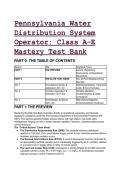
Pennsylvania Water
Distribution System
Operator: Class A-E
Mastery Test Bank
PART 0: THE TABLE OF CONTENTS
Section Title Cognitive Focus
PART I THE PREVIEW Axioms, Regulatory
Frameworks, & Operational
Imperatives
PART II THE ELITE TEST BANK The 30-Point Multiple-Choice
Gauntlet
Tier 1 Foundational Syntax & Definitional Mastery, Hard Deck
Application (Q1–10) Limits, & Core Formulas
Tier 2 Complex Application & Variable Alteration,
Simulation (Q11–20) Troubleshooting, & Legal
Compliance
Tier 3 Grandmaster Synthesis High-Stakes Mitigation,
(Q21–30) Cross-Disciplinary Synthesis
PART I: THE PREVIEW
Mastering this Elite Test Bank translates directly to operational supremacy and absolute
regulatory compliance under the Pennsylvania Department of Environmental Protection (PA
DEP). This rigorous gauntlet bridges abstract theory with high-stakes, real-world utility
management, forging you into a master operator capable of decisive, unimpeachable process
control decisions.
The "Critical Axioms" Cheat Sheet:
● The Disinfection Requirements Rule (DRR): The absolute minimum distribution
residual is 0.20 mg/L. Entry point failures trigger a strict 4-hour correction window before a
treatment technique violation occurs.
● The Revised Total Coliform Rule (RTCR): A Level 2 Assessment must be conducted by
an appropriately certified operator and is immediately triggered by an E. coli MCL violation
or a second Level 1 trigger within a rolling 12-month period.
● The Lead and Copper Rule (LCR): Compliance is strictly dictated by the 90th percentile
calculation (Action Levels: Pb = 0.015 mg/L, Cu = 1.3 mg/L). An exceedance mandates
Optimal Corrosion Control Treatment (OCCT).
, ● Hydraulic Friction Loss: The Hazen-Williams formula governs head loss; a higher
C-factor indicates a smoother internal pipe surface and lower friction.
● AWWA C651 Main Disinfection: The Continuous-Feed method requires a 25 mg/L initial
dose and a minimum 10 mg/L residual after 24 hours; the Slug method requires a 100
mg/L dose for a 3-hour contact time.
System Classification Matrix (25 Pa. Code Chapter 302)
Class System Flow/Capacity Description / Qualifier
Threshold
A > 5.0 Million Gallons per Day Highest capacity primary
(MGD) treatment classification.
B > 1.0 MGD to ≤ 5.0 MGD Intermediate primary treatment
classification.
C > 100,000 GPD to ≤ 1.0 MGD Small-to-medium primary
treatment classification.
D ≤ 100,000 Gallons per Day Small primary treatment
(GPD) classification.
WE Distribution / Satellite Systems For operators managing
distribution networks or
consecutive systems without
primary generation.
PART II: THE ELITE TEST BANK
Tier 1: Foundational Syntax & Application
Q1: A municipal water authority historically operates at an average daily flow of 4.5 Million
Gallons per Day (MGD). However, the PA DEP recently issued a new permit expanding the
facility's total design capacity to 6.2 MGD to accommodate regional growth. Based on the
classification framework in 25 Pa. Code Chapter 302, which certification is MOST ACCURATE
for the operator in responsible charge making process control decisions? A) Class B, because
the historical daily flow average remains strictly under the 5.0 MGD threshold. B) Class C,
because the expansion requires a provisional licensing period until a new 12-month average is
established. C) Class A, because the system's permitted design capacity now exceeds the 5.0
MGD threshold. D) Class WE, because all water systems exceeding 5.0 MGD are automatically
reclassified as distribution-only satellites.
● Answer: C (Class A, because the system's permitted design capacity now exceeds the
5.0 MGD threshold.)
● Distractor Analysis:
○ A is incorrect: Class B is legally reserved for systems greater than 1 MGD but less
than or equal to 5 MGD. Permitted design capacity, not historical flow averages,
dictates the legal classification of the system.
○ B is incorrect: Pennsylvania's Chapter 302 framework does not grant provisional
flow-averaging periods for capacity upgrades; the classification shifts immediately
upon the issuance of a permit changing the capacity.
○ D is incorrect: Class WE (or Class E) specifically designates a distribution system
or satellite collection system, not a primary treatment facility, regardless of the MGD
, threshold.
The Mentor's Analysis: System classifications under 25 Pa. Code Chapter 302 are strictly
governed by permitted design capacity, not real-time usage. When facing an infrastructure
expansion, the immediate priority is reevaluating the legal capacity threshold. By utilizing the
permitted capacity metric, you bypass the common trap of relying on daily operational flow
averages. Professional/Academic Intuition: Classify systems by their permitted design
capacity thresholds, never by fluctuating daily operational flows.
Q2: Under the PA DEP Disinfection Requirements Rule (DRR), an operator is performing
weekly distribution system monitoring at a dedicated compliance site. To ensure strict
compliance and prevent biofilm regrowth within the pipe network, which free chlorine residual
concentration represents the ABSOLUTE MINIMUM allowable limit throughout the distribution
system? A) 0.02 mg/L B) 0.20 mg/L C) 0.50 mg/L D) 1.50 mg/L
● Answer: B (0.20 mg/L)
● Distractor Analysis:
○ A is incorrect: The 0.02 mg/L limit is an outdated, legacy standard. It was
determined to be analytically undetectable by modern instruments and insufficient
for public health protection, prompting the DRR update to eliminate it.
○ C is incorrect: While 0.50 mg/L is recommended by the Water Research Foundation
for an optimized distribution system, the strict PA DEP regulatory minimum is
precisely 0.20 mg/L.
○ D is incorrect: 1.50 mg/L is the EPA's area-wide optimization recommendation for
monochloramine residuals to prevent nitrification, not the regulatory minimum for
free chlorine.
The Mentor's Analysis: The Disinfection Requirements Rule (DRR) eliminated the ambiguous
"detectable residual" legacy standard. When facing distribution monitoring under the DRR, the
immediate priority is ensuring no location falls below 0.20 mg/L. By utilizing this quantifiable
baseline, you bypass the common trap of interpreting trace, non-detectable readings as legally
compliant. Professional/Academic Intuition: A residual of 0.20 mg/L is the regulatory floor;
anything lower compromises the final barrier of microbial protection.
Q3: A contractor is commissioning a newly installed 12-inch ductile iron water main using the
AWWA C651 Continuous-Feed chlorination method. Following the preliminary flushing phase,
what are the MOST ACCURATE required parameters for the initial chlorine dose and the
minimum required residual after a 24-hour retention period? A) Initial dose of 50 mg/L; minimum
residual of 25 mg/L after 24 hours. B) Initial dose of 100 mg/L; minimum residual of 50 mg/L
after 3 hours. C) Initial dose of 25 mg/L; minimum residual of 10 mg/L after 24 hours. D) Initial
dose of 10 mg/L; minimum residual of 0.20 mg/L after 24 hours.
● Answer: C (Initial dose of 25 mg/L; minimum residual of 10 mg/L after 24 hours.)
● Distractor Analysis:
○ A is incorrect: These parameters represent an unnecessary chemical overfeed for
the Continuous-Feed method and do not align with the strict AWWA C651
standards.
○ B is incorrect: An initial dose of 100 mg/L with a 3-hour contact time is the exact
protocol for the Slug method, not the Continuous-Feed method.
○ D is incorrect: 0.20 mg/L is the DRR operational minimum for an active,
commissioned distribution system, but it is vastly insufficient for proving disinfection
efficacy during the commissioning phase of a new main where localized demand is
exceptionally high.
The Mentor's Analysis: Commissioning a new water main requires aggressive pathogen
Distribution System
Operator: Class A-E
Mastery Test Bank
PART 0: THE TABLE OF CONTENTS
Section Title Cognitive Focus
PART I THE PREVIEW Axioms, Regulatory
Frameworks, & Operational
Imperatives
PART II THE ELITE TEST BANK The 30-Point Multiple-Choice
Gauntlet
Tier 1 Foundational Syntax & Definitional Mastery, Hard Deck
Application (Q1–10) Limits, & Core Formulas
Tier 2 Complex Application & Variable Alteration,
Simulation (Q11–20) Troubleshooting, & Legal
Compliance
Tier 3 Grandmaster Synthesis High-Stakes Mitigation,
(Q21–30) Cross-Disciplinary Synthesis
PART I: THE PREVIEW
Mastering this Elite Test Bank translates directly to operational supremacy and absolute
regulatory compliance under the Pennsylvania Department of Environmental Protection (PA
DEP). This rigorous gauntlet bridges abstract theory with high-stakes, real-world utility
management, forging you into a master operator capable of decisive, unimpeachable process
control decisions.
The "Critical Axioms" Cheat Sheet:
● The Disinfection Requirements Rule (DRR): The absolute minimum distribution
residual is 0.20 mg/L. Entry point failures trigger a strict 4-hour correction window before a
treatment technique violation occurs.
● The Revised Total Coliform Rule (RTCR): A Level 2 Assessment must be conducted by
an appropriately certified operator and is immediately triggered by an E. coli MCL violation
or a second Level 1 trigger within a rolling 12-month period.
● The Lead and Copper Rule (LCR): Compliance is strictly dictated by the 90th percentile
calculation (Action Levels: Pb = 0.015 mg/L, Cu = 1.3 mg/L). An exceedance mandates
Optimal Corrosion Control Treatment (OCCT).
, ● Hydraulic Friction Loss: The Hazen-Williams formula governs head loss; a higher
C-factor indicates a smoother internal pipe surface and lower friction.
● AWWA C651 Main Disinfection: The Continuous-Feed method requires a 25 mg/L initial
dose and a minimum 10 mg/L residual after 24 hours; the Slug method requires a 100
mg/L dose for a 3-hour contact time.
System Classification Matrix (25 Pa. Code Chapter 302)
Class System Flow/Capacity Description / Qualifier
Threshold
A > 5.0 Million Gallons per Day Highest capacity primary
(MGD) treatment classification.
B > 1.0 MGD to ≤ 5.0 MGD Intermediate primary treatment
classification.
C > 100,000 GPD to ≤ 1.0 MGD Small-to-medium primary
treatment classification.
D ≤ 100,000 Gallons per Day Small primary treatment
(GPD) classification.
WE Distribution / Satellite Systems For operators managing
distribution networks or
consecutive systems without
primary generation.
PART II: THE ELITE TEST BANK
Tier 1: Foundational Syntax & Application
Q1: A municipal water authority historically operates at an average daily flow of 4.5 Million
Gallons per Day (MGD). However, the PA DEP recently issued a new permit expanding the
facility's total design capacity to 6.2 MGD to accommodate regional growth. Based on the
classification framework in 25 Pa. Code Chapter 302, which certification is MOST ACCURATE
for the operator in responsible charge making process control decisions? A) Class B, because
the historical daily flow average remains strictly under the 5.0 MGD threshold. B) Class C,
because the expansion requires a provisional licensing period until a new 12-month average is
established. C) Class A, because the system's permitted design capacity now exceeds the 5.0
MGD threshold. D) Class WE, because all water systems exceeding 5.0 MGD are automatically
reclassified as distribution-only satellites.
● Answer: C (Class A, because the system's permitted design capacity now exceeds the
5.0 MGD threshold.)
● Distractor Analysis:
○ A is incorrect: Class B is legally reserved for systems greater than 1 MGD but less
than or equal to 5 MGD. Permitted design capacity, not historical flow averages,
dictates the legal classification of the system.
○ B is incorrect: Pennsylvania's Chapter 302 framework does not grant provisional
flow-averaging periods for capacity upgrades; the classification shifts immediately
upon the issuance of a permit changing the capacity.
○ D is incorrect: Class WE (or Class E) specifically designates a distribution system
or satellite collection system, not a primary treatment facility, regardless of the MGD
, threshold.
The Mentor's Analysis: System classifications under 25 Pa. Code Chapter 302 are strictly
governed by permitted design capacity, not real-time usage. When facing an infrastructure
expansion, the immediate priority is reevaluating the legal capacity threshold. By utilizing the
permitted capacity metric, you bypass the common trap of relying on daily operational flow
averages. Professional/Academic Intuition: Classify systems by their permitted design
capacity thresholds, never by fluctuating daily operational flows.
Q2: Under the PA DEP Disinfection Requirements Rule (DRR), an operator is performing
weekly distribution system monitoring at a dedicated compliance site. To ensure strict
compliance and prevent biofilm regrowth within the pipe network, which free chlorine residual
concentration represents the ABSOLUTE MINIMUM allowable limit throughout the distribution
system? A) 0.02 mg/L B) 0.20 mg/L C) 0.50 mg/L D) 1.50 mg/L
● Answer: B (0.20 mg/L)
● Distractor Analysis:
○ A is incorrect: The 0.02 mg/L limit is an outdated, legacy standard. It was
determined to be analytically undetectable by modern instruments and insufficient
for public health protection, prompting the DRR update to eliminate it.
○ C is incorrect: While 0.50 mg/L is recommended by the Water Research Foundation
for an optimized distribution system, the strict PA DEP regulatory minimum is
precisely 0.20 mg/L.
○ D is incorrect: 1.50 mg/L is the EPA's area-wide optimization recommendation for
monochloramine residuals to prevent nitrification, not the regulatory minimum for
free chlorine.
The Mentor's Analysis: The Disinfection Requirements Rule (DRR) eliminated the ambiguous
"detectable residual" legacy standard. When facing distribution monitoring under the DRR, the
immediate priority is ensuring no location falls below 0.20 mg/L. By utilizing this quantifiable
baseline, you bypass the common trap of interpreting trace, non-detectable readings as legally
compliant. Professional/Academic Intuition: A residual of 0.20 mg/L is the regulatory floor;
anything lower compromises the final barrier of microbial protection.
Q3: A contractor is commissioning a newly installed 12-inch ductile iron water main using the
AWWA C651 Continuous-Feed chlorination method. Following the preliminary flushing phase,
what are the MOST ACCURATE required parameters for the initial chlorine dose and the
minimum required residual after a 24-hour retention period? A) Initial dose of 50 mg/L; minimum
residual of 25 mg/L after 24 hours. B) Initial dose of 100 mg/L; minimum residual of 50 mg/L
after 3 hours. C) Initial dose of 25 mg/L; minimum residual of 10 mg/L after 24 hours. D) Initial
dose of 10 mg/L; minimum residual of 0.20 mg/L after 24 hours.
● Answer: C (Initial dose of 25 mg/L; minimum residual of 10 mg/L after 24 hours.)
● Distractor Analysis:
○ A is incorrect: These parameters represent an unnecessary chemical overfeed for
the Continuous-Feed method and do not align with the strict AWWA C651
standards.
○ B is incorrect: An initial dose of 100 mg/L with a 3-hour contact time is the exact
protocol for the Slug method, not the Continuous-Feed method.
○ D is incorrect: 0.20 mg/L is the DRR operational minimum for an active,
commissioned distribution system, but it is vastly insufficient for proving disinfection
efficacy during the commissioning phase of a new main where localized demand is
exceptionally high.
The Mentor's Analysis: Commissioning a new water main requires aggressive pathogen