

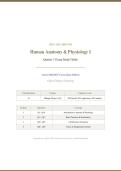
BIO 1100 / BIO1100
Human Anatomy & Physiology I
Quarter 1 Exam Study Guide
Latest 2026/2027 Curriculum Edition
Galen College of Nursing
Total Questions Format Cognitive Levels
34 Multiple Choice (A-D) 30% Recall | 50% Application | 20% Analysis
Sections Questions Coverage
1 Q1 - Q10 Introduction to Anatomy & Physiology
2 Q11 - Q17 Basic Chemistry & Biochemistry
3 Q18 - Q25 Cell Structure & Function
4 Q26 - Q34 Tissues & Integumentary System
Comprehensive Q&A with Verified Answers and A+ Graded Rationales
, BIO 1100 Quarter 1 Exam Q&A | Human Anatomy & Physiology I | Galen College of Nursing
Section 1: Introduction to Anatomy and Physiology (Q1-Q10)
Q1: A nursing instructor asks students to describe the relationship between anatomy and physiology. Which
student statement best reflects the principle of complementarity of structure and function?
A. Anatomy and physiology are independent disciplines with no direct relationship
B. Physiology can be understood without knowledge of anatomical structure
C. The structure of a body part directly determines its function, and function influences the shape of the structure
[CORRECT]
D. Anatomy focuses only on microscopic structures while physiology deals exclusively with organ systems
Correct Answer: C
Rationale: The principle of complementarity states that structure and function are inseparable; the form of a body part reflects
what it does, and its function shapes its anatomy. For example, the thin, flat shape of alveoli maximizes gas exchange surface area.
Anatomy and physiology are deeply interdependent disciplines. Neither can be fully understood in isolation, and both operate at all
levels of organization from chemical to organismal, as emphasized in Galen College of Nursing BIO 1100 foundational concepts.
Q2: A patient presents with appendicitis. The surgeon describes the surgical incision as a cut along the
midline dividing the abdomen into equal left and right halves. Which body plane was used?
A. Frontal (coronal) plane
B. Transverse (cross) plane
C. Midsagittal (median) plane [CORRECT]
D. Oblique plane
Correct Answer: C
Rationale: The midsagittal (median) plane divides the body or an organ into equal left and right halves along the midline. The
frontal (coronal) plane divides into anterior and posterior portions. The transverse plane divides into superior and inferior portions.
An oblique plane cuts diagonally. Since the incision divides the abdomen into equal halves, this is the midsagittal plane, a key
anatomical terminology concept tested in the BIO 1100 Quarter 1 exam.
Q3: During a physical examination, a physician notes that a patient's liver is located in the upper right region
of the abdominopelvic cavity, just inferior to the diaphragm. In which abdominopelvic quadrant and region is
the liver primarily located?
A. Left upper quadrant (LUQ); Left hypochondriac region
B. Right upper quadrant (RUQ); Right hypochondriac region [CORRECT]
C. Right lower quadrant (RLQ); Right lumbar region
D. Right upper quadrant (RUQ); Right lumbar region
Correct Answer: B
Rationale: The liver is primarily located in the right upper quadrant (RUQ) within the right hypochondriac region, positioned just
inferior to the diaphragm. The right hypochondriac region lies lateral to the epigastric region and contains the liver, gallbladder,
and part of the right kidney. The left hypochondriac region contains the spleen and stomach. The right lumbar region contains the
ascending colon. Understanding abdominopelvic quadrants and regions is essential for clinical documentation and communication
in nursing practice at Galen College.
Q4: An emergency room patient has sustained trauma to the posterior thoracic cavity. Which structures are
at greatest risk based on their anatomical location within this cavity?
A. Heart and great vessels
B. Lungs (within the pleural cavities) [CORRECT]
Page 2
Human Anatomy & Physiology I
Quarter 1 Exam Study Guide
Latest 2026/2027 Curriculum Edition
Galen College of Nursing
Total Questions Format Cognitive Levels
34 Multiple Choice (A-D) 30% Recall | 50% Application | 20% Analysis
Sections Questions Coverage
1 Q1 - Q10 Introduction to Anatomy & Physiology
2 Q11 - Q17 Basic Chemistry & Biochemistry
3 Q18 - Q25 Cell Structure & Function
4 Q26 - Q34 Tissues & Integumentary System
Comprehensive Q&A with Verified Answers and A+ Graded Rationales
, BIO 1100 Quarter 1 Exam Q&A | Human Anatomy & Physiology I | Galen College of Nursing
Section 1: Introduction to Anatomy and Physiology (Q1-Q10)
Q1: A nursing instructor asks students to describe the relationship between anatomy and physiology. Which
student statement best reflects the principle of complementarity of structure and function?
A. Anatomy and physiology are independent disciplines with no direct relationship
B. Physiology can be understood without knowledge of anatomical structure
C. The structure of a body part directly determines its function, and function influences the shape of the structure
[CORRECT]
D. Anatomy focuses only on microscopic structures while physiology deals exclusively with organ systems
Correct Answer: C
Rationale: The principle of complementarity states that structure and function are inseparable; the form of a body part reflects
what it does, and its function shapes its anatomy. For example, the thin, flat shape of alveoli maximizes gas exchange surface area.
Anatomy and physiology are deeply interdependent disciplines. Neither can be fully understood in isolation, and both operate at all
levels of organization from chemical to organismal, as emphasized in Galen College of Nursing BIO 1100 foundational concepts.
Q2: A patient presents with appendicitis. The surgeon describes the surgical incision as a cut along the
midline dividing the abdomen into equal left and right halves. Which body plane was used?
A. Frontal (coronal) plane
B. Transverse (cross) plane
C. Midsagittal (median) plane [CORRECT]
D. Oblique plane
Correct Answer: C
Rationale: The midsagittal (median) plane divides the body or an organ into equal left and right halves along the midline. The
frontal (coronal) plane divides into anterior and posterior portions. The transverse plane divides into superior and inferior portions.
An oblique plane cuts diagonally. Since the incision divides the abdomen into equal halves, this is the midsagittal plane, a key
anatomical terminology concept tested in the BIO 1100 Quarter 1 exam.
Q3: During a physical examination, a physician notes that a patient's liver is located in the upper right region
of the abdominopelvic cavity, just inferior to the diaphragm. In which abdominopelvic quadrant and region is
the liver primarily located?
A. Left upper quadrant (LUQ); Left hypochondriac region
B. Right upper quadrant (RUQ); Right hypochondriac region [CORRECT]
C. Right lower quadrant (RLQ); Right lumbar region
D. Right upper quadrant (RUQ); Right lumbar region
Correct Answer: B
Rationale: The liver is primarily located in the right upper quadrant (RUQ) within the right hypochondriac region, positioned just
inferior to the diaphragm. The right hypochondriac region lies lateral to the epigastric region and contains the liver, gallbladder,
and part of the right kidney. The left hypochondriac region contains the spleen and stomach. The right lumbar region contains the
ascending colon. Understanding abdominopelvic quadrants and regions is essential for clinical documentation and communication
in nursing practice at Galen College.
Q4: An emergency room patient has sustained trauma to the posterior thoracic cavity. Which structures are
at greatest risk based on their anatomical location within this cavity?
A. Heart and great vessels
B. Lungs (within the pleural cavities) [CORRECT]
Page 2



