

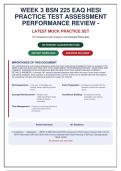
WEEK 3 BSN 225 EAQ HESI
PRACTICE TEST ASSESSMENT
PERFORMANCE REVIEW -
LATEST MOCK PRACTICE SET
161 Questions with Answers and Detailed Rationales
100 PERCENT GUARANTEED PASS
INSTANT DOWNLOAD ANSWERS INCLUDED
IMPORTANCE OF THIS DOCUMENT
This comprehensive examination preparation guide has been meticulously developed to help you succeed in the
WEEK 3 BSN 225 EAQ HESI PRACTICE TEST ASSESSMENT PERFORMANCE REVIEW - QUESTIONS AND
CORRECT ANSWERS WITH RATIONALES/ BSN 225 HESI PRACTICE QUESTIONS AND CORRECT
DETAILED ANSWERS. It contains 161 carefully selected questions that reflect the most current exam content
and testing strategies. Each question is accompanied by a correct answer and a detailed rationale that explains
the underlying concepts and reasoning required to master the material.
Self-Assessment – Test your knowledge and Exam Preparation – Familiarize yourself with the
identify areas requiring further question format and content
study areas
Concept Reinforcement – Deepen your Confidence Building – Develop test-taking
understanding through strategies and reduce
evidence-based exam anxiety
rationales
Time Management – Practice answering questions
under simulated exam
conditions
Review Summary 161 Questions
Foundations - Application - WEEK 3 BSN 225 EAQ HESI Assessment Performance Review AND Correct
WITH Rationales/ BSN 225 HESI AND Correct Detailed Adult Health Nursing II BSN 225 Undergraduate
YEAR 3 BSN
All answers with rationales
,Table of Contents
Section A - Management OF CARE Section B - Safety AND Infection
Questions 1 to 41 Control
Questions 42 to 82
Section C - Health Promotion AND Section D - Psychosocial Integrity
Maintenance Questions 124 to 161
Questions 83 to 123
,Section A - Management OF CARE
Q1.
A patient presents with chest pain for 2 hours, ECG showing ST-segment elevation in
leads II, III, aVF. Initial troponin is elevated. Patient reports no allergies. Which medication
should the nurse administer FIRST after establishing IV access?
A. Morphine sulfate 2 mg IV B. Oxygen 2 L/min via nasal cannula
C. Aspirin 324 mg non-enteric chewed D. Nitroglycerin 0.4 mg sublingual
Correct: C - Aspirin 324 mg non-enteric chewed
Rationale:
Aspirin reduces mortality by inhibiting platelet aggregation and is indicated immediately in
suspected STEMI. Oxygen is only given if SpO2 <90%. Nitroglycerin and morphine are used
for pain but not before antiplatelet therapy.
Q2.
In a patient with acute respiratory distress syndrome (ARDS) on volume-controlled
ventilation, the nurse notes plateau pressures of 32 cm H2O and a PaO2/FiO2 ratio of 180.
Which intervention should the nurse anticipate to reduce ventilator-induced lung injury?
A. Increase PEEP to 20 cm H2O B. Switch to pressure-controlled ventilation
C. Administer inhaled nitric oxide D. Perform a recruitment maneuver
Correct: A - Increase PEEP to 20 cm H2O
Rationale:
Higher PEEP (titrated to oxygenation) can improve PaO2/FiO2 and reduce atelectotrauma.
Plateau pressure is acceptable (<35 cm H2O) but increasing PEEP may improve compliance.
Nitric oxide is not first-line. Recruitment maneuvers can cause barotrauma.
Q3.
A patient with chronic kidney disease stage 3 develops oliguria and a rise in serum
creatinine from 1.2 to 2.8 mg/dL after cardiac catheterization with contrast. Urinalysis
shows muddy brown granular casts. Which action is CONTRAINDICATED?
A. Administer N-acetylcysteine 1200 mg PO B. Discontinue metformin
twice daily
C. Administer IV furosemide 40 mg D. Hold ACE inhibitor
Correct: C - Administer IV furosemide 40 mg
Page 3
, Section A - Management OF CARE
Rationale:
Furosemide is not recommended for prevention or treatment of contrast-induced
nephropathy; it may worsen volume depletion and kidney injury. N-acetylcysteine is used for
prevention. Metformin and ACE inhibitors are held due to risk of lactic acidosis and
hyperkalemia.
Q4.
A patient in diabetic ketoacidosis has a blood glucose of 520 mg/dL, potassium 3.2 mEq/L,
venous pH 7.18, and bicarbonate 10 mEq/L. After initiating IV fluids and insulin drip at 0.1
units/kg/hr, which lab value should be monitored MOST frequently to prevent a
life-threatening complication?
A. Serum potassium B. Serum glucose
C. Serum phosphorus D. Serum pH
Correct: A - Serum potassium
Rationale:
Insulin drives potassium intracellularly, exacerbating hypokalemia, which can cause cardiac
dysrhythmias. Potassium must be maintained >3.3 mEq/L before insulin is started. Glucose
falls gradually; pH and phosphorus are important but not as immediately lethal.
Q5.
A patient with severe acute pancreatitis develops Cullen sign and Grey Turner sign. Which
laboratory finding is MOST consistent with a complicated course and worse prognosis?
A. Lipase 3 times the upper normal limit B. C-reactive protein level 250 mg/L
C. Serum calcium 7.6 mg/dL D. AST 120 units/L
Correct: C - Serum calcium 7.6 mg/dL
Rationale:
Hypocalcemia in pancreatitis indicates saponification of calcium with free fatty acids,
reflecting extensive fat necrosis and predicts severe disease. Extremely high lipase but not
prognostic. CRP >150 indicates inflammation. AST elevation is nonspecific.
Q6.
A patient with acute ischemic stroke is 3.5 hours from symptom onset. CT scan is
negative for hemorrhage. Blood pressure is 185/110 mm Hg. Which intervention should
the nurse question?
A. Administer tissue plasminogen activator B. Lower blood pressure to <185/110 mm
(tPA) 0.9 mg/kg IV over 1 hour Hg before administering tPA
Page 4
PRACTICE TEST ASSESSMENT
PERFORMANCE REVIEW -
LATEST MOCK PRACTICE SET
161 Questions with Answers and Detailed Rationales
100 PERCENT GUARANTEED PASS
INSTANT DOWNLOAD ANSWERS INCLUDED
IMPORTANCE OF THIS DOCUMENT
This comprehensive examination preparation guide has been meticulously developed to help you succeed in the
WEEK 3 BSN 225 EAQ HESI PRACTICE TEST ASSESSMENT PERFORMANCE REVIEW - QUESTIONS AND
CORRECT ANSWERS WITH RATIONALES/ BSN 225 HESI PRACTICE QUESTIONS AND CORRECT
DETAILED ANSWERS. It contains 161 carefully selected questions that reflect the most current exam content
and testing strategies. Each question is accompanied by a correct answer and a detailed rationale that explains
the underlying concepts and reasoning required to master the material.
Self-Assessment – Test your knowledge and Exam Preparation – Familiarize yourself with the
identify areas requiring further question format and content
study areas
Concept Reinforcement – Deepen your Confidence Building – Develop test-taking
understanding through strategies and reduce
evidence-based exam anxiety
rationales
Time Management – Practice answering questions
under simulated exam
conditions
Review Summary 161 Questions
Foundations - Application - WEEK 3 BSN 225 EAQ HESI Assessment Performance Review AND Correct
WITH Rationales/ BSN 225 HESI AND Correct Detailed Adult Health Nursing II BSN 225 Undergraduate
YEAR 3 BSN
All answers with rationales
,Table of Contents
Section A - Management OF CARE Section B - Safety AND Infection
Questions 1 to 41 Control
Questions 42 to 82
Section C - Health Promotion AND Section D - Psychosocial Integrity
Maintenance Questions 124 to 161
Questions 83 to 123
,Section A - Management OF CARE
Q1.
A patient presents with chest pain for 2 hours, ECG showing ST-segment elevation in
leads II, III, aVF. Initial troponin is elevated. Patient reports no allergies. Which medication
should the nurse administer FIRST after establishing IV access?
A. Morphine sulfate 2 mg IV B. Oxygen 2 L/min via nasal cannula
C. Aspirin 324 mg non-enteric chewed D. Nitroglycerin 0.4 mg sublingual
Correct: C - Aspirin 324 mg non-enteric chewed
Rationale:
Aspirin reduces mortality by inhibiting platelet aggregation and is indicated immediately in
suspected STEMI. Oxygen is only given if SpO2 <90%. Nitroglycerin and morphine are used
for pain but not before antiplatelet therapy.
Q2.
In a patient with acute respiratory distress syndrome (ARDS) on volume-controlled
ventilation, the nurse notes plateau pressures of 32 cm H2O and a PaO2/FiO2 ratio of 180.
Which intervention should the nurse anticipate to reduce ventilator-induced lung injury?
A. Increase PEEP to 20 cm H2O B. Switch to pressure-controlled ventilation
C. Administer inhaled nitric oxide D. Perform a recruitment maneuver
Correct: A - Increase PEEP to 20 cm H2O
Rationale:
Higher PEEP (titrated to oxygenation) can improve PaO2/FiO2 and reduce atelectotrauma.
Plateau pressure is acceptable (<35 cm H2O) but increasing PEEP may improve compliance.
Nitric oxide is not first-line. Recruitment maneuvers can cause barotrauma.
Q3.
A patient with chronic kidney disease stage 3 develops oliguria and a rise in serum
creatinine from 1.2 to 2.8 mg/dL after cardiac catheterization with contrast. Urinalysis
shows muddy brown granular casts. Which action is CONTRAINDICATED?
A. Administer N-acetylcysteine 1200 mg PO B. Discontinue metformin
twice daily
C. Administer IV furosemide 40 mg D. Hold ACE inhibitor
Correct: C - Administer IV furosemide 40 mg
Page 3
, Section A - Management OF CARE
Rationale:
Furosemide is not recommended for prevention or treatment of contrast-induced
nephropathy; it may worsen volume depletion and kidney injury. N-acetylcysteine is used for
prevention. Metformin and ACE inhibitors are held due to risk of lactic acidosis and
hyperkalemia.
Q4.
A patient in diabetic ketoacidosis has a blood glucose of 520 mg/dL, potassium 3.2 mEq/L,
venous pH 7.18, and bicarbonate 10 mEq/L. After initiating IV fluids and insulin drip at 0.1
units/kg/hr, which lab value should be monitored MOST frequently to prevent a
life-threatening complication?
A. Serum potassium B. Serum glucose
C. Serum phosphorus D. Serum pH
Correct: A - Serum potassium
Rationale:
Insulin drives potassium intracellularly, exacerbating hypokalemia, which can cause cardiac
dysrhythmias. Potassium must be maintained >3.3 mEq/L before insulin is started. Glucose
falls gradually; pH and phosphorus are important but not as immediately lethal.
Q5.
A patient with severe acute pancreatitis develops Cullen sign and Grey Turner sign. Which
laboratory finding is MOST consistent with a complicated course and worse prognosis?
A. Lipase 3 times the upper normal limit B. C-reactive protein level 250 mg/L
C. Serum calcium 7.6 mg/dL D. AST 120 units/L
Correct: C - Serum calcium 7.6 mg/dL
Rationale:
Hypocalcemia in pancreatitis indicates saponification of calcium with free fatty acids,
reflecting extensive fat necrosis and predicts severe disease. Extremely high lipase but not
prognostic. CRP >150 indicates inflammation. AST elevation is nonspecific.
Q6.
A patient with acute ischemic stroke is 3.5 hours from symptom onset. CT scan is
negative for hemorrhage. Blood pressure is 185/110 mm Hg. Which intervention should
the nurse question?
A. Administer tissue plasminogen activator B. Lower blood pressure to <185/110 mm
(tPA) 0.9 mg/kg IV over 1 hour Hg before administering tPA
Page 4



