Stress and Health practice questions
Note from the writer: Please note that these are not official previous exam questions, as
those are property of Tilburg University and dr. Mirela Habibovic. I make practice questions
for my own revision, and they might be able to help you as well. There are on average 8
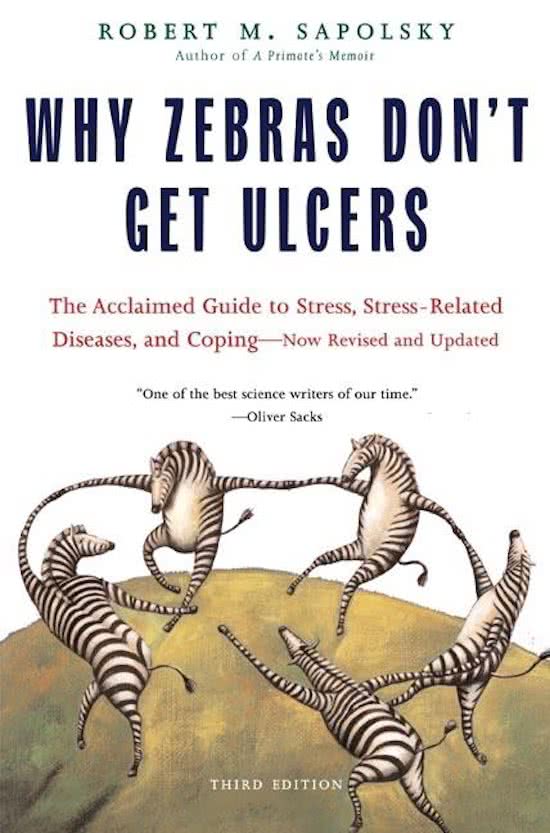
questions per lecture, some based on the articles and the book by Robert Sapolsky, and in
total there are 91 questions. The answer key is divided into chapters, following the format of
the questions. Good luck!
-Heidi Havula
Lecture 1 – Introduction
1. The correct definition of stress according to the lecture is…
a) When person perceives that their body is not capable to meet the external
demands (social, personal, or global).
b) When a person objectively perceives that a constellation of events activates the
fight or flight response.
c) When person perceives that demands exceed their personal and social resources to
cope with the demands.
2. What is the function of insulin in the stress response?
a) To encourage growth.
b) To inhibit growth.
c) None of the above.
3. Which is the correct order of General Adaptation Syndrome of Selye?
a) Exhaustion - alarm - resistance
b) Alarm – resistance - exhaustion
c) Resistance – alarm - exhaustion
4. What is meant by situational stereotypy?
a) Situations cause a different biological response.
b) Situational factors interact with personal resources.
c) Individual differences in stress response (perception, appraisal) cause differences
in situations.
5. Psychologists argued against the GAS (General adaptation syndrome) of Selye with
several points. Which answer was one of them?
a) Stress response is purely psychological.
b) Objective stressor interacts with our personality.
c) Stress response varies between individuals.
6. Which two variables affect our stress reaction, according to the Michigan stress
model?
a) Intimacy and profession
b) Personality and social support
, c) Glucagon levels and inherent resistance.
7. Which one of the following is not a short-term negative consequence of stress?
a) Boosted immunity
b) Negative mood
c) Difficulty in concentrating
8. Is the fight or flight response similar in males and females (in humans)?
a) No, males tend to have more fight-reaction and females tend to have tend-and-
befriend reaction.
b) No, females tend to have more fight-reaction and males tend to have tend-and-
befriend reaction.
c) Yes, the reaction is more dependent on individual factors rather than gender.
9. Which two hormones are the main drivers of stress response?
a) Estrogen and testosterone
b) ACTH and adrenaline/epinephrine
c) Glucocorticoids and adrenaline/epinephrine
Lecture 2 -Stress assessment
1. What is the first appraisal in Lazarus’ cognitive stress model?
a) Whether or not the person should run.
b) Whether or not one has the ability to cope with the stressor.
c) Whether or not a situation or event is threatening.
2. Which option includes the correct definitions of homeostasis and allostasis?
a) Homeostasis is the maintenance of stable and constant bodily conditions
(mechanism that is constantly present), while allostasis the process of achieving
homeostasis through behavioral change (temporary process).
b) Allostasis is the maintenance of stable and constant bodily conditions (mechanism
that is constantly present), while homeostasis the process of achieving allostasis
through behavioral change (temporary process).
c) Allostasis is the maintenance of bodily conditions through behavioral change
(mechanism that is constantly present), and homeostasis is also constantly present
to achieve balance in temperature and thirst regulation (mechanism that is
constantly present).
3. Which option describes the con of environmental assessment of stress?
a) It takes longer than surveys and is therefore time consuming.
b) You get less information about the person’s life
c) There is no information about the coping in stressful situations.
, 4. Which option describes the con of psychological assessment of stress?
a) The equipment needed can be very expensive.
b) You get less information about the coping in a stressful situation.
c) You cannot establish a direct relationship between the stressor and psychological
stress.
5. Which one of the following is not a way to induce stress in experiments?
a) Baseline anger assessment
b) TSST
c) The Stroop-task
6. According to Foley and Kirschbaum (2010), which hormone is the best measure for acute
stress response?
a) Noradrenaline
b) Adrenaline
c) Cortisol
7. Pereira and colleagues (2017) discussed passive and active stress resilience. Which one is
an example of both?
a) Neither of the below.
b) Active resilience: hormones, passive resilience: brain circuits activated by life
events
c) Passive resilience: hormones, active resilience: brain circuits activated by life
events
8. A high heart rate variability means…
a) Poor stress resilience and activation of the sympathetic nervous system
b) Good stress resilience and activation of the parasympathetic nervous system.
c) Genetic disposition to be prone to stress.
Lecture 3 – Stress assessment pt. 2
1. When a stressor is encountered, the 1) _____ causes a fast stress reaction, while 2)
_____ activates slower stress reaction.
a) 1) HPA (hypothalamic pituitary adrenal axis), 2) SAM (sympathetic adrenal
medullary axis)
b) 1) SAM, 2) HPA-axis
c) both 1 and 2 = HPA-axis
2. Which method of assessing stress hormone levels is considered the easiest and with
less setbacks?
a) Cortisol sample from blood
b) Cortisol sample from saliva
c) Cortisol sample from plasma
Note from the writer: Please note that these are not official previous exam questions, as
those are property of Tilburg University and dr. Mirela Habibovic. I make practice questions
for my own revision, and they might be able to help you as well. There are on average 8
questions per lecture, some based on the articles and the book by Robert Sapolsky, and in
total there are 91 questions. The answer key is divided into chapters, following the format of
the questions. Good luck!
-Heidi Havula
Lecture 1 – Introduction
1. The correct definition of stress according to the lecture is…
a) When person perceives that their body is not capable to meet the external
demands (social, personal, or global).
b) When a person objectively perceives that a constellation of events activates the
fight or flight response.
c) When person perceives that demands exceed their personal and social resources to
cope with the demands.
2. What is the function of insulin in the stress response?
a) To encourage growth.
b) To inhibit growth.
c) None of the above.
3. Which is the correct order of General Adaptation Syndrome of Selye?
a) Exhaustion - alarm - resistance
b) Alarm – resistance - exhaustion
c) Resistance – alarm - exhaustion
4. What is meant by situational stereotypy?
a) Situations cause a different biological response.
b) Situational factors interact with personal resources.
c) Individual differences in stress response (perception, appraisal) cause differences
in situations.
5. Psychologists argued against the GAS (General adaptation syndrome) of Selye with
several points. Which answer was one of them?
a) Stress response is purely psychological.
b) Objective stressor interacts with our personality.
c) Stress response varies between individuals.
6. Which two variables affect our stress reaction, according to the Michigan stress
model?
a) Intimacy and profession
b) Personality and social support
, c) Glucagon levels and inherent resistance.
7. Which one of the following is not a short-term negative consequence of stress?
a) Boosted immunity
b) Negative mood
c) Difficulty in concentrating
8. Is the fight or flight response similar in males and females (in humans)?
a) No, males tend to have more fight-reaction and females tend to have tend-and-
befriend reaction.
b) No, females tend to have more fight-reaction and males tend to have tend-and-
befriend reaction.
c) Yes, the reaction is more dependent on individual factors rather than gender.
9. Which two hormones are the main drivers of stress response?
a) Estrogen and testosterone
b) ACTH and adrenaline/epinephrine
c) Glucocorticoids and adrenaline/epinephrine
Lecture 2 -Stress assessment
1. What is the first appraisal in Lazarus’ cognitive stress model?
a) Whether or not the person should run.
b) Whether or not one has the ability to cope with the stressor.
c) Whether or not a situation or event is threatening.
2. Which option includes the correct definitions of homeostasis and allostasis?
a) Homeostasis is the maintenance of stable and constant bodily conditions
(mechanism that is constantly present), while allostasis the process of achieving
homeostasis through behavioral change (temporary process).
b) Allostasis is the maintenance of stable and constant bodily conditions (mechanism
that is constantly present), while homeostasis the process of achieving allostasis
through behavioral change (temporary process).
c) Allostasis is the maintenance of bodily conditions through behavioral change
(mechanism that is constantly present), and homeostasis is also constantly present
to achieve balance in temperature and thirst regulation (mechanism that is
constantly present).
3. Which option describes the con of environmental assessment of stress?
a) It takes longer than surveys and is therefore time consuming.
b) You get less information about the person’s life
c) There is no information about the coping in stressful situations.
, 4. Which option describes the con of psychological assessment of stress?
a) The equipment needed can be very expensive.
b) You get less information about the coping in a stressful situation.
c) You cannot establish a direct relationship between the stressor and psychological
stress.
5. Which one of the following is not a way to induce stress in experiments?
a) Baseline anger assessment
b) TSST
c) The Stroop-task
6. According to Foley and Kirschbaum (2010), which hormone is the best measure for acute
stress response?
a) Noradrenaline
b) Adrenaline
c) Cortisol
7. Pereira and colleagues (2017) discussed passive and active stress resilience. Which one is
an example of both?
a) Neither of the below.
b) Active resilience: hormones, passive resilience: brain circuits activated by life
events
c) Passive resilience: hormones, active resilience: brain circuits activated by life
events
8. A high heart rate variability means…
a) Poor stress resilience and activation of the sympathetic nervous system
b) Good stress resilience and activation of the parasympathetic nervous system.
c) Genetic disposition to be prone to stress.
Lecture 3 – Stress assessment pt. 2
1. When a stressor is encountered, the 1) _____ causes a fast stress reaction, while 2)
_____ activates slower stress reaction.
a) 1) HPA (hypothalamic pituitary adrenal axis), 2) SAM (sympathetic adrenal
medullary axis)
b) 1) SAM, 2) HPA-axis
c) both 1 and 2 = HPA-axis
2. Which method of assessing stress hormone levels is considered the easiest and with
less setbacks?
a) Cortisol sample from blood
b) Cortisol sample from saliva
c) Cortisol sample from plasma