

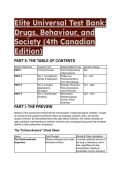
Elite Universal Test Bank:
Drugs, Behaviour, and
Society (4th Canadian
Edition)
PART 0: THE TABLE OF CONTENTS
Section Reference Cognitive Tier Subject Matter Focus Question Range
PART I Concept Preview Core Frameworks & N/A
Critical Axioms
PART II Tier 1: Foundational CDSA Law, Q1 – Q10
Syntax & Application Pharmacokinetics,
Core Neurobiology
PART II Tier 2: Complex Receptor Dynamics, Q11 – Q20
Application & Policy Exemptions,
Simulation Harm Reduction
PART II Tier 3: Grandmaster Multi-system Q21 – Q30
Synthesis Pathophysiology,
Toxicity, Policy
Synthesis
PART I: THE PREVIEW
Mastery of this assessment transcends the memorization of pharmacological variables; it forges
an executive-level cognitive framework where neurobiology, systemic policy, and clinical
practice intersect. By dismantling these thirty high-stakes scenarios, the scholar develops an
agile, predictive understanding of addiction medicine and sociological drug policy that translates
directly to elite professional competence.
The "Critical Axioms" Cheat Sheet
Axiom Core Principle Clinical & Policy Implication
The Pharmacokinetic Ethanol undergoes zero-order A constant absolute amount of
Imperative elimination kinetics. the drug is cleared per unit of
time, regardless of peak
concentration, leading to
predictable enzyme saturation
,Axiom Core Principle Clinical & Policy Implication
and toxicity.
The Dopaminergic Final The reinforcing properties of Addiction is hardwired through
Common Pathway substances of abuse converge the Ventral Tegmental Area
upon the mesolimbic dopamine (VTA) to the nucleus
system. accumbens, governing positive
reinforcement across all drug
classes.
The Canadian Legal The Controlled Drugs and Current sociological trends
Framework Substances Act (CDSA) strictly utilize Section 56 exemptions to
categorizes substances prioritize harm reduction and
(Schedules I-VIII). decriminalization over legacy
prohibitionist paradigms.
GABAergic Modulation Benzodiazepines and Benzodiazepines increase the
Divergence barbiturates are positive frequency of GABA_A channel
allosteric modulators with openings; barbiturates prolong
fundamentally divergent the duration. Concurrent use
kinetics. induces fatal respiratory
depression.
Prevention Frameworks Public health models are Supervised Consumption Sites
divided into primary, secondary, (SCS) and safe supply
and tertiary tiers. represent tertiary prevention,
prioritizing mortality reduction
over immediate abstinence.
PART II: THE ELITE TEST BANK
Q1: A federal policy analyst in Canada is reviewing a newly synthesized psychoactive
compound that presents a severe risk to public health, high abuse liability, and no recognized
medical utility. Based on the classification framework of the Canadian Controlled Drugs and
Substances Act (CDSA), into which category is this compound MOST LIKELY to be placed to
ensure the strictest trafficking and production penalties? A) Schedule II, alongside cannabis
derivatives and synthetic analogues. B) Schedule IV, alongside barbiturates and anabolic
steroids. C) Schedule I, alongside opiates, cocaine, and methamphetamines. D) Schedule III,
alongside lysergic acid diethylamide (LSD) and psilocybin.
● Answer: C (Schedule I, alongside opiates, cocaine, and methamphetamines.)
● Distractor Analysis:
○ A is incorrect: Following the implementation of the Cannabis Act in 2018, organic
cannabis was removed from the CDSA entirely. Schedule II previously housed
cannabis, and legacy assumptions regarding its current status under the CDSA
represent a critical administrative error.
○ B is incorrect: Schedule IV contains substances with lower relative abuse potentials
and recognized medical utility, such as benzodiazepines and barbiturates, carrying
lesser maximum penalties for trafficking.
○ D is incorrect: While Schedule III contains potent hallucinogens like LSD, it does not
carry the absolute highest statutory maximums for production and trafficking
reserved for Schedule I hard drugs.
The Mentor's Analysis: The CDSA categorizes substances into specific schedules dictating
, the severity of legal penalties. Schedule I is universally reserved for the most dangerous and
highly addictive substances, such as fentanyl, heroin, and cocaine. Professional/Academic
Intuition: Law dictates enforcement; Schedule I always represents the apex of statutory
severity and highest prosecutorial priority.
\n\n
Q2: A forensic toxicologist analyzes the blood alcohol concentration (BAC) of a subject who
consumed a massive quantity of ethanol. Despite the high peak concentration, the hepatic
system continues to metabolize the ethanol at a fixed rate of approximately 15 milligrams per
deciliter per hour. Based on the principles of pharmacokinetics, which metabolic mechanism is
PRIMARILY responsible for this phenomenon? A) First-order kinetics, where the rate of
elimination is directly proportional to the drug concentration. B) CYP450 enzyme induction,
resulting in rapid metabolic tolerance and accelerated clearance. C) Zero-order elimination,
resulting from the absolute saturation of the alcohol dehydrogenase enzyme. D) Postmortem
redistribution, causing an artificial stabilization of blood drug concentrations.
● Answer: C (Zero-order elimination, resulting from the absolute saturation of the alcohol
dehydrogenase enzyme.)
● Distractor Analysis:
○ A is incorrect: Ethanol explicitly violates first-order kinetics at standard recreational
doses because the metabolizing enzymes are easily overwhelmed and saturated.
○ B is incorrect: While chronic use induces CYP2E1 (contributing to metabolic
tolerance), it does not explain the fixed-rate elimination observed during acute
intoxication.
○ D is incorrect: Postmortem redistribution alters specific site concentrations after
death (e.g., femoral vs. cardiac blood) but does not govern the in vivo enzymatic
metabolic rate of the liver.
The Mentor's Analysis: Because the available alcohol dehydrogenase enzymes are rapidly
saturated even at low doses, ethanol metabolism shifts from first-order to zero-order kinetics. A
constant absolute amount of the drug is cleared per unit of time, rendering physiological
clearance entirely linear. Professional/Academic Intuition: When the enzyme is saturated,
the clearance rate is mathematically locked.
\n\n
Q3: During an experimental trial, a rodent is conditioned to press a lever for intravenous
administration of a psychostimulant. Microdialysis reveals a massive surge of a specific
neurotransmitter in the nucleus accumbens. Based on the neurobiology of addiction, the
activation of which specific neural circuit is MOST CRITICAL for this reinforcing effect? A) The
nigrostriatal dopamine pathway projecting from the substantia nigra to the dorsal striatum. B)
The mesolimbic dopamine pathway projecting from the ventral tegmental area to the nucleus
accumbens. C) The tuberoinfundibular pathway regulating prolactin secretion in the pituitary
gland. D) The spinothalamic tract responsible for the transmission of nociceptive stimuli.
● Answer: B (The mesolimbic dopamine pathway projecting from the ventral tegmental
area to the nucleus accumbens.)
● Distractor Analysis:
○ A is incorrect: The nigrostriatal pathway is primarily involved in the modulation of
voluntary movement; its degeneration causes Parkinson's disease, and it is not the
primary driver of reward reinforcement.
○ C is incorrect: The tuberoinfundibular pathway regulates endocrine function and
prolactin release, completely unrelated to behavioral reinforcement.
○ D is incorrect: The spinothalamic tract is a sensory pathway transmitting pain and
Drugs, Behaviour, and
Society (4th Canadian
Edition)
PART 0: THE TABLE OF CONTENTS
Section Reference Cognitive Tier Subject Matter Focus Question Range
PART I Concept Preview Core Frameworks & N/A
Critical Axioms
PART II Tier 1: Foundational CDSA Law, Q1 – Q10
Syntax & Application Pharmacokinetics,
Core Neurobiology
PART II Tier 2: Complex Receptor Dynamics, Q11 – Q20
Application & Policy Exemptions,
Simulation Harm Reduction
PART II Tier 3: Grandmaster Multi-system Q21 – Q30
Synthesis Pathophysiology,
Toxicity, Policy
Synthesis
PART I: THE PREVIEW
Mastery of this assessment transcends the memorization of pharmacological variables; it forges
an executive-level cognitive framework where neurobiology, systemic policy, and clinical
practice intersect. By dismantling these thirty high-stakes scenarios, the scholar develops an
agile, predictive understanding of addiction medicine and sociological drug policy that translates
directly to elite professional competence.
The "Critical Axioms" Cheat Sheet
Axiom Core Principle Clinical & Policy Implication
The Pharmacokinetic Ethanol undergoes zero-order A constant absolute amount of
Imperative elimination kinetics. the drug is cleared per unit of
time, regardless of peak
concentration, leading to
predictable enzyme saturation
,Axiom Core Principle Clinical & Policy Implication
and toxicity.
The Dopaminergic Final The reinforcing properties of Addiction is hardwired through
Common Pathway substances of abuse converge the Ventral Tegmental Area
upon the mesolimbic dopamine (VTA) to the nucleus
system. accumbens, governing positive
reinforcement across all drug
classes.
The Canadian Legal The Controlled Drugs and Current sociological trends
Framework Substances Act (CDSA) strictly utilize Section 56 exemptions to
categorizes substances prioritize harm reduction and
(Schedules I-VIII). decriminalization over legacy
prohibitionist paradigms.
GABAergic Modulation Benzodiazepines and Benzodiazepines increase the
Divergence barbiturates are positive frequency of GABA_A channel
allosteric modulators with openings; barbiturates prolong
fundamentally divergent the duration. Concurrent use
kinetics. induces fatal respiratory
depression.
Prevention Frameworks Public health models are Supervised Consumption Sites
divided into primary, secondary, (SCS) and safe supply
and tertiary tiers. represent tertiary prevention,
prioritizing mortality reduction
over immediate abstinence.
PART II: THE ELITE TEST BANK
Q1: A federal policy analyst in Canada is reviewing a newly synthesized psychoactive
compound that presents a severe risk to public health, high abuse liability, and no recognized
medical utility. Based on the classification framework of the Canadian Controlled Drugs and
Substances Act (CDSA), into which category is this compound MOST LIKELY to be placed to
ensure the strictest trafficking and production penalties? A) Schedule II, alongside cannabis
derivatives and synthetic analogues. B) Schedule IV, alongside barbiturates and anabolic
steroids. C) Schedule I, alongside opiates, cocaine, and methamphetamines. D) Schedule III,
alongside lysergic acid diethylamide (LSD) and psilocybin.
● Answer: C (Schedule I, alongside opiates, cocaine, and methamphetamines.)
● Distractor Analysis:
○ A is incorrect: Following the implementation of the Cannabis Act in 2018, organic
cannabis was removed from the CDSA entirely. Schedule II previously housed
cannabis, and legacy assumptions regarding its current status under the CDSA
represent a critical administrative error.
○ B is incorrect: Schedule IV contains substances with lower relative abuse potentials
and recognized medical utility, such as benzodiazepines and barbiturates, carrying
lesser maximum penalties for trafficking.
○ D is incorrect: While Schedule III contains potent hallucinogens like LSD, it does not
carry the absolute highest statutory maximums for production and trafficking
reserved for Schedule I hard drugs.
The Mentor's Analysis: The CDSA categorizes substances into specific schedules dictating
, the severity of legal penalties. Schedule I is universally reserved for the most dangerous and
highly addictive substances, such as fentanyl, heroin, and cocaine. Professional/Academic
Intuition: Law dictates enforcement; Schedule I always represents the apex of statutory
severity and highest prosecutorial priority.
\n\n
Q2: A forensic toxicologist analyzes the blood alcohol concentration (BAC) of a subject who
consumed a massive quantity of ethanol. Despite the high peak concentration, the hepatic
system continues to metabolize the ethanol at a fixed rate of approximately 15 milligrams per
deciliter per hour. Based on the principles of pharmacokinetics, which metabolic mechanism is
PRIMARILY responsible for this phenomenon? A) First-order kinetics, where the rate of
elimination is directly proportional to the drug concentration. B) CYP450 enzyme induction,
resulting in rapid metabolic tolerance and accelerated clearance. C) Zero-order elimination,
resulting from the absolute saturation of the alcohol dehydrogenase enzyme. D) Postmortem
redistribution, causing an artificial stabilization of blood drug concentrations.
● Answer: C (Zero-order elimination, resulting from the absolute saturation of the alcohol
dehydrogenase enzyme.)
● Distractor Analysis:
○ A is incorrect: Ethanol explicitly violates first-order kinetics at standard recreational
doses because the metabolizing enzymes are easily overwhelmed and saturated.
○ B is incorrect: While chronic use induces CYP2E1 (contributing to metabolic
tolerance), it does not explain the fixed-rate elimination observed during acute
intoxication.
○ D is incorrect: Postmortem redistribution alters specific site concentrations after
death (e.g., femoral vs. cardiac blood) but does not govern the in vivo enzymatic
metabolic rate of the liver.
The Mentor's Analysis: Because the available alcohol dehydrogenase enzymes are rapidly
saturated even at low doses, ethanol metabolism shifts from first-order to zero-order kinetics. A
constant absolute amount of the drug is cleared per unit of time, rendering physiological
clearance entirely linear. Professional/Academic Intuition: When the enzyme is saturated,
the clearance rate is mathematically locked.
\n\n
Q3: During an experimental trial, a rodent is conditioned to press a lever for intravenous
administration of a psychostimulant. Microdialysis reveals a massive surge of a specific
neurotransmitter in the nucleus accumbens. Based on the neurobiology of addiction, the
activation of which specific neural circuit is MOST CRITICAL for this reinforcing effect? A) The
nigrostriatal dopamine pathway projecting from the substantia nigra to the dorsal striatum. B)
The mesolimbic dopamine pathway projecting from the ventral tegmental area to the nucleus
accumbens. C) The tuberoinfundibular pathway regulating prolactin secretion in the pituitary
gland. D) The spinothalamic tract responsible for the transmission of nociceptive stimuli.
● Answer: B (The mesolimbic dopamine pathway projecting from the ventral tegmental
area to the nucleus accumbens.)
● Distractor Analysis:
○ A is incorrect: The nigrostriatal pathway is primarily involved in the modulation of
voluntary movement; its degeneration causes Parkinson's disease, and it is not the
primary driver of reward reinforcement.
○ C is incorrect: The tuberoinfundibular pathway regulates endocrine function and
prolactin release, completely unrelated to behavioral reinforcement.
○ D is incorrect: The spinothalamic tract is a sensory pathway transmitting pain and



