Marlie Snoeijen 2020-2021
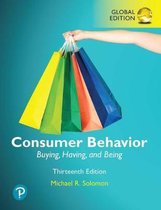
Samenvatting Consumer Behavior (Buying, Having and Being) – 13th edition
1. Introduction to consumer behavior
Consumer behavior: the study of the processes involved when individuals or groups
select/purchase/use/dispose of products/services/ideas/experiences to satisfy needs and desires.
Consumer behavior is an ongoing process.
Exchange: a transaction in which two or more organizations or people give and receive something of
value (expanded view: entire consumption process is important: prepurchase-purchase-
postpurchase)
Consumer: a person who identifies a need or desire, makes a purchase, and then disposes of the
product during the three stages of the consumption process.
→ Different people play a role in these events
→ Organizations/groups
Marketeers have to understand the wants and needs of different consumer
segments (market segmentation)
Demographics: statistics that measure observable aspects of a population.
• Age: different age groups = different wants/needs
• Gender: man-woman
• Family structure: single, married, young children, older couples
• Social class and income: the same social class: similar income/social
standing/occupations/interests/contacts
• Race and ethnicity
• Geography: geographic location
• Lifestyles: consumers have different lifestyles: the way we feel, what we value and what we
like to do.
Relationship marketing: building bonds with the customers
Database marketing: tracks specific consumer’s buying habits closely and tailors products and
messages precisely to people’s wants and needs based on this information (AH bonuskaart)
→ Big data: changing the way we think about consumer behavior
Our choices as customers relate in powerful ways to the rest of our lives.
Popular culture: the music, movies, sports, books, celebrities and other forms of entertainment that
the mass market produces and consumes
→ both a product and an inspiration for marketers
→ marketers play a significant role in our view of the world and how we live in it.
Role theory: much of consumer behavior resembles actions in a play. People act out many roles.
Relationships with a product:
Self-concept attachment To establish the user’s identity
Nostalgic attachment A link with a past self
Interdependence Part of the user’s daily routine
1
, Marlie Snoeijen 2020-2021
Love Product elicits emotional bonds of
warmth/passion
Our motivations to consume are complex and varied.
Fundamental premise consumer behavior: people often buy products not for what they do, but for
what they mean. (image/reputation is belangrijk)
Need: something a person must have to life/achieve a goal (‘Ik heb honger’)
Want: a specific manifestation of a need that personal and cultural factors determines (‘Ik wil een Big
Mac’)
Technology and culture create a new ‘always-on’ consumer.
• Internet of Things: the growing network of interconnected devices embedded in objects that
speak to one another.
• M2M
• Artificial intelligence
Many types of specialists study consumer behavior.
Paradigm: a set of beliefs that guide our understanding of the world
• Current paradigm: Positivism (modernism):
- human reason is supreme and there is a single, objective truth
that science can discover.
- Knowledge is context independent and time-free.
-Researcher/respondent are separate and independent.
• Interpretivism/CCT (postmodernism):
- questions upper assumptions. Too much emphasis on science
and technology, ignores complex social and cultural world in
which we really live.
- knowledge is context dependent and time-bound
- Researcher/respondent are interactive, researcher part of the phenomenon
- Symbolic, subjective experience is important. The world is a pastiche: a mixture of images
and ideas.
There are different perspectives regarding how and what we should understand
about consumer behavior.
It is crucial for marketers to stay on top of consumer trends.
• Sharing economy
• Authenticity and personalization
• Blurring of gender roles
• Social shopping
• Simplification
• etc…
2
, Marlie Snoeijen 2020-2021
2. Consumer well-being
Ethical business is good business.
A majority of consumers around the world say they are willing to pay more for ‘ethical’ products and
services.
Business ethics: rules of conduct that guide actions in the marketplace (what is right and what is
wrong)
→ differs among people, organizations and cultures
Do marketers create artificial needs? → Nee, a basic objective of marketing is to create awareness
that needs exist, not to create needs
Is marketing necessary? → Product meet exisiting needs, and marketing activities only help to
communicate their availability. Economics of information: advertising is an important source of
consumer learning.
Do marketers promise miracles? → Marketers simply do not know enough about people to
manipulate them.
Marketers have an obligation to provide safe and functional products as
part of their business activities.
If you’re not happy with a product/service, three possible courses of action:
• Voice response (directly to the retailer)
• Private response
• Third-party response (take legal action)
Although nobody likes criticism, organizations should encourage people to complain because:
• They get the chance to correct the situation
• Avoid an escalating problem
• Valuable insights about customer’s experiences that help improvement
• If customers do not believe that the store will respond to their complaint → they just switch
High customer satisfaction = big competitive advantage
Culture jamming: a strategy to disrupt efforts by the corporate world to dominate our cultural
landscape (Buy nothing day, TV Turnoff week)
Corporate social responsibility (CSR): processes that encourage the organization to make a positive
impact on the various stakeholders (consumers, employees, environment)
Transformative consumer research: promotes research projects that include the goal of helping
people or bringing about social change
Social marketing: the promotion of causes and ideas, such as energy conservation, charities and
population control
Cause marketing: a strategy that aligns a company/brand with a cause to generate business and
societal benefits
3
Samenvatting Consumer Behavior (Buying, Having and Being) – 13th edition
1. Introduction to consumer behavior
Consumer behavior: the study of the processes involved when individuals or groups
select/purchase/use/dispose of products/services/ideas/experiences to satisfy needs and desires.
Consumer behavior is an ongoing process.
Exchange: a transaction in which two or more organizations or people give and receive something of
value (expanded view: entire consumption process is important: prepurchase-purchase-
postpurchase)
Consumer: a person who identifies a need or desire, makes a purchase, and then disposes of the
product during the three stages of the consumption process.
→ Different people play a role in these events
→ Organizations/groups
Marketeers have to understand the wants and needs of different consumer
segments (market segmentation)
Demographics: statistics that measure observable aspects of a population.
• Age: different age groups = different wants/needs
• Gender: man-woman
• Family structure: single, married, young children, older couples
• Social class and income: the same social class: similar income/social
standing/occupations/interests/contacts
• Race and ethnicity
• Geography: geographic location
• Lifestyles: consumers have different lifestyles: the way we feel, what we value and what we
like to do.
Relationship marketing: building bonds with the customers
Database marketing: tracks specific consumer’s buying habits closely and tailors products and
messages precisely to people’s wants and needs based on this information (AH bonuskaart)
→ Big data: changing the way we think about consumer behavior
Our choices as customers relate in powerful ways to the rest of our lives.
Popular culture: the music, movies, sports, books, celebrities and other forms of entertainment that
the mass market produces and consumes
→ both a product and an inspiration for marketers
→ marketers play a significant role in our view of the world and how we live in it.
Role theory: much of consumer behavior resembles actions in a play. People act out many roles.
Relationships with a product:
Self-concept attachment To establish the user’s identity
Nostalgic attachment A link with a past self
Interdependence Part of the user’s daily routine
1
, Marlie Snoeijen 2020-2021
Love Product elicits emotional bonds of
warmth/passion
Our motivations to consume are complex and varied.
Fundamental premise consumer behavior: people often buy products not for what they do, but for
what they mean. (image/reputation is belangrijk)
Need: something a person must have to life/achieve a goal (‘Ik heb honger’)
Want: a specific manifestation of a need that personal and cultural factors determines (‘Ik wil een Big
Mac’)
Technology and culture create a new ‘always-on’ consumer.
• Internet of Things: the growing network of interconnected devices embedded in objects that
speak to one another.
• M2M
• Artificial intelligence
Many types of specialists study consumer behavior.
Paradigm: a set of beliefs that guide our understanding of the world
• Current paradigm: Positivism (modernism):
- human reason is supreme and there is a single, objective truth
that science can discover.
- Knowledge is context independent and time-free.
-Researcher/respondent are separate and independent.
• Interpretivism/CCT (postmodernism):
- questions upper assumptions. Too much emphasis on science
and technology, ignores complex social and cultural world in
which we really live.
- knowledge is context dependent and time-bound
- Researcher/respondent are interactive, researcher part of the phenomenon
- Symbolic, subjective experience is important. The world is a pastiche: a mixture of images
and ideas.
There are different perspectives regarding how and what we should understand
about consumer behavior.
It is crucial for marketers to stay on top of consumer trends.
• Sharing economy
• Authenticity and personalization
• Blurring of gender roles
• Social shopping
• Simplification
• etc…
2
, Marlie Snoeijen 2020-2021
2. Consumer well-being
Ethical business is good business.
A majority of consumers around the world say they are willing to pay more for ‘ethical’ products and
services.
Business ethics: rules of conduct that guide actions in the marketplace (what is right and what is
wrong)
→ differs among people, organizations and cultures
Do marketers create artificial needs? → Nee, a basic objective of marketing is to create awareness
that needs exist, not to create needs
Is marketing necessary? → Product meet exisiting needs, and marketing activities only help to
communicate their availability. Economics of information: advertising is an important source of
consumer learning.
Do marketers promise miracles? → Marketers simply do not know enough about people to
manipulate them.
Marketers have an obligation to provide safe and functional products as
part of their business activities.
If you’re not happy with a product/service, three possible courses of action:
• Voice response (directly to the retailer)
• Private response
• Third-party response (take legal action)
Although nobody likes criticism, organizations should encourage people to complain because:
• They get the chance to correct the situation
• Avoid an escalating problem
• Valuable insights about customer’s experiences that help improvement
• If customers do not believe that the store will respond to their complaint → they just switch
High customer satisfaction = big competitive advantage
Culture jamming: a strategy to disrupt efforts by the corporate world to dominate our cultural
landscape (Buy nothing day, TV Turnoff week)
Corporate social responsibility (CSR): processes that encourage the organization to make a positive
impact on the various stakeholders (consumers, employees, environment)
Transformative consumer research: promotes research projects that include the goal of helping
people or bringing about social change
Social marketing: the promotion of causes and ideas, such as energy conservation, charities and
population control
Cause marketing: a strategy that aligns a company/brand with a cause to generate business and
societal benefits
3