
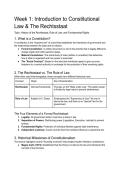
Week 1: Introduction to Constitutional
Law & The Rechtsstaat
Topic: History of the Rechtsstaat, Rule of Law, and Fundamental Rights.
1. What is a Constitution?
A constitution is the "supreme law" of a land that establishes the framework of government and
the relationship between the state and its citizens.
● Formal Constitution: A written document (or set of documents) that is legally difficult to
change (rigid) and holds supreme status.
● Material Constitution: The actual body of rules (written or unwritten) that determine
how a state is organized and how power is exercised.
● The "Social Contract": Based on the idea that individuals agree to give up some
freedoms to a central authority in exchange for the protection of their remaining rights.
2. The Rechtsstaat vs. The Rule of Law
While often used interchangeably, these concepts have different historical roots.
Concept Origin Key Characteristics
Rechtsstaat German/Continental Focuses on the "State under Law." The state's power
is limited by legal rules to prevent arbitrariness.
Rule of Law English (A.V. Dicey) Emphasizes the "Supremacy of Law." No one is
above the law, and there is no "special" law for the
government.
The Four Elements of a Formal Rechtsstaat:
1. Legality: All government action must have a basis in law.
2. Separation of Powers: Distributing power (Legislative, Executive, Judicial) to prevent
tyranny.
3. Fundamental Rights: Protection of individual liberties against state interference.
4. Independent Judiciary: Courts must be free from political influence to uphold the law.
3. Historical Milestones of Constitutionalism
The lecture highlights several "founding moments" that shaped modern Western constitutions:
● Magna Carta (1215): Established that the King is not above the law and introduced the
concept of due process.
, ● English Bill of Rights (1689): Shifted power from the Monarchy to Parliament,
establishing parliamentary sovereignty.
● U.S. Constitution (1787) & Bill of Rights (1791): Created the first modern written
constitution with a clear separation of powers and protected individual liberties.
● French Declaration of the Rights of Man (1789): Defined universal rights belonging to
"citizens" rather than just subjects of a crown.
4. Fundamental Rights
Difference in "generations" of rights:
● Classic Rights (1st Generation): Negative rights where the state must refrain from
acting (e.g., freedom of speech, freedom of religion, right to a fair trial).
● Social Rights (2nd Generation): Positive rights where the state is expected to act to
provide for the citizen (e.g., right to education, healthcare, social security)
Law & The Rechtsstaat
Topic: History of the Rechtsstaat, Rule of Law, and Fundamental Rights.
1. What is a Constitution?
A constitution is the "supreme law" of a land that establishes the framework of government and
the relationship between the state and its citizens.
● Formal Constitution: A written document (or set of documents) that is legally difficult to
change (rigid) and holds supreme status.
● Material Constitution: The actual body of rules (written or unwritten) that determine
how a state is organized and how power is exercised.
● The "Social Contract": Based on the idea that individuals agree to give up some
freedoms to a central authority in exchange for the protection of their remaining rights.
2. The Rechtsstaat vs. The Rule of Law
While often used interchangeably, these concepts have different historical roots.
Concept Origin Key Characteristics
Rechtsstaat German/Continental Focuses on the "State under Law." The state's power
is limited by legal rules to prevent arbitrariness.
Rule of Law English (A.V. Dicey) Emphasizes the "Supremacy of Law." No one is
above the law, and there is no "special" law for the
government.
The Four Elements of a Formal Rechtsstaat:
1. Legality: All government action must have a basis in law.
2. Separation of Powers: Distributing power (Legislative, Executive, Judicial) to prevent
tyranny.
3. Fundamental Rights: Protection of individual liberties against state interference.
4. Independent Judiciary: Courts must be free from political influence to uphold the law.
3. Historical Milestones of Constitutionalism
The lecture highlights several "founding moments" that shaped modern Western constitutions:
● Magna Carta (1215): Established that the King is not above the law and introduced the
concept of due process.
, ● English Bill of Rights (1689): Shifted power from the Monarchy to Parliament,
establishing parliamentary sovereignty.
● U.S. Constitution (1787) & Bill of Rights (1791): Created the first modern written
constitution with a clear separation of powers and protected individual liberties.
● French Declaration of the Rights of Man (1789): Defined universal rights belonging to
"citizens" rather than just subjects of a crown.
4. Fundamental Rights
Difference in "generations" of rights:
● Classic Rights (1st Generation): Negative rights where the state must refrain from
acting (e.g., freedom of speech, freedom of religion, right to a fair trial).
● Social Rights (2nd Generation): Positive rights where the state is expected to act to
provide for the citizen (e.g., right to education, healthcare, social security)



