NCTI FINAL Exam Questions and Answers
with Verified Solutions | Latest Updated 2026
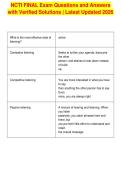
What is the most effective style of active
listening?
Combative listening Seeks to further your agenda, discounts
the other
person, and desires to tear down instead
of build-
up.
Competitive listening You are more interested in what you have
to say
than anything the other person has to say.
Even
more, you are always right
Passive listening A mixture of hearing and listening. When
you listen
passively, you catch phrases here and
there, but
you put forth little effort to understand and
retain
the overall message.
,Interested listening You care about understanding what the
other
person has to say, though you assume you
heard
correctly the first time without verification.
It is
good to be an interested listener but there
is an
even better way.
Active listening You genuinely care that you have heard
correctly
and understood what the other person
means. You
make an effort to clarify and comprehend
true
meaning for both intellectual and emotional
understanding.
Barriers to Solutions Fear, bias, laziness, distraction,
selfishness,
, what is quieting your outside? Show you are listening by using open
non-verbal,
body language. Pay attention to what your
facial
expressions are conveying, how you
stand, and
what you do with your body language.
Face the
other person and lean in. Tune out the
distractions
around. If you have to move the
conversation to
another place so you can concentrate,
then do so.
what is quieting your inside? When listening, turn off all of your internal
conversations and reduce your filters so
that you
can better suspend judgment. Listen for
more than
simply the words spoken but also for the
feelings
behind what is being said. Do not focus on
what
you want to say next but instead think of
questions
you can ask to gain deeper understanding
with Verified Solutions | Latest Updated 2026
What is the most effective style of active
listening?
Combative listening Seeks to further your agenda, discounts
the other
person, and desires to tear down instead
of build-
up.
Competitive listening You are more interested in what you have
to say
than anything the other person has to say.
Even
more, you are always right
Passive listening A mixture of hearing and listening. When
you listen
passively, you catch phrases here and
there, but
you put forth little effort to understand and
retain
the overall message.
,Interested listening You care about understanding what the
other
person has to say, though you assume you
heard
correctly the first time without verification.
It is
good to be an interested listener but there
is an
even better way.
Active listening You genuinely care that you have heard
correctly
and understood what the other person
means. You
make an effort to clarify and comprehend
true
meaning for both intellectual and emotional
understanding.
Barriers to Solutions Fear, bias, laziness, distraction,
selfishness,
, what is quieting your outside? Show you are listening by using open
non-verbal,
body language. Pay attention to what your
facial
expressions are conveying, how you
stand, and
what you do with your body language.
Face the
other person and lean in. Tune out the
distractions
around. If you have to move the
conversation to
another place so you can concentrate,
then do so.
what is quieting your inside? When listening, turn off all of your internal
conversations and reduce your filters so
that you
can better suspend judgment. Listen for
more than
simply the words spoken but also for the
feelings
behind what is being said. Do not focus on
what
you want to say next but instead think of
questions
you can ask to gain deeper understanding