NCTI Study Guide Exam Questions and
Answers with Verified Solutions | Latest
Updated 2026
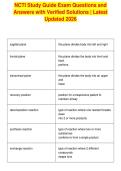
sagittal plane this plane divides body into left and right
frontal plane this plane divides the body into front and
back
portions.
transversal plane this plane divides the body into an upper
and
lower
recovery position position for unresponsive patient to
maintain airway
decomposition reaction type of reaction where one reactant breaks
down
into 2 or more products
synthesis reaction type of reaction where two or more
substances
combine to form a single product
exchange reaction type of reaction where 2 different
compounds
swaps ions
, reversible reactions type of reaction where products react and
transform back into original reactants
Cations ion that is positively charged
anions ion that is negatively charged
carbohydrates serves as energy source
lipids provide energy storage, insulation, and
make up
cell membranes
examples of carbohydrates glucose / oxygen
examples of lipids triglycerides / phospholipids
proteins building and repairing tissues, enzymes,
hormones
proteins are made up of: amino acids
nucleic acids store and transmit genetic info
mitosis produces two identical daughter cells with
the
same amount of chromosomes
Answers with Verified Solutions | Latest
Updated 2026
sagittal plane this plane divides body into left and right
frontal plane this plane divides the body into front and
back
portions.
transversal plane this plane divides the body into an upper
and
lower
recovery position position for unresponsive patient to
maintain airway
decomposition reaction type of reaction where one reactant breaks
down
into 2 or more products
synthesis reaction type of reaction where two or more
substances
combine to form a single product
exchange reaction type of reaction where 2 different
compounds
swaps ions
, reversible reactions type of reaction where products react and
transform back into original reactants
Cations ion that is positively charged
anions ion that is negatively charged
carbohydrates serves as energy source
lipids provide energy storage, insulation, and
make up
cell membranes
examples of carbohydrates glucose / oxygen
examples of lipids triglycerides / phospholipids
proteins building and repairing tissues, enzymes,
hormones
proteins are made up of: amino acids
nucleic acids store and transmit genetic info
mitosis produces two identical daughter cells with
the
same amount of chromosomes