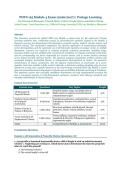
PHYS 165 Module 4 Exam (2026/2027) | Portage Learning
Two-Dimensional Kinematics, Projectile Motion, Uniform Circular Motion, and Relative Velocity
Actual Exam | Total Questions: 25 | Official Portage Learning PHYS 165 Module 4 Blueprint
Abstract
This document presents the official PHYS 165 Module 4 actual exam for the 2026/2027 Portage
Learning academic year, comprising exactly 25 university-level questions aligned to the Module 4
blueprint covering two-dimensional (2D) kinematics, projectile motion, uniform circular motion, and
relative velocity. The examination emphasizes the rigorous application of mathematical principles,
vector decomposition, and the systematic use of 2D kinematic equations to analyze motion in multiple
dimensions. Learners are required to evaluate projectile trajectory parameters including range,
maximum height, and time of flight under varied launch conditions, to compute centripetal acceleration
and the corresponding net forces responsible for circular motion, and to resolve relative velocities
across distinct inertial reference frames. The questions integrate quantitative problem solving with
conceptual analysis, demanding fluency in trigonometric decomposition of vectors, the geometric
interpretation of motion components, and the physical interpretation of acceleration as a vector
quantity. Each item includes a fully worked rationale, a distractor analysis clarifying why incorrect
options are wrong, and a specific reference to the 2026 Portage Learning PHYS 165 Module 4 course
material and standard university physics textbooks such as Halliday & Resnick and Young & Freedman.
This approach ensures that successful candidates demonstrate not only computational accuracy but
also a conceptual mastery of multi-dimensional mechanics consistent with industry standards and
scientific methodologies in classical physics.
Content Area Overview
Content Area Questions Key Topics Weight
Projectile launch, range, max height, time of
2D Kinematics &
8 (Q1-Q8) flight, trajectory analysis, horizontal launch, 30%
Projectile Motion
complementary angles
Uniform Circular Motion Centripetal acceleration, centripetal force, period
& Centripetal 6 (Q9-Q14) & frequency, direction of acceleration, tangential 25%
Acceleration velocity
River-boat problems, wind & aircraft, shortest
Relative Velocity &
5 (Q15-Q19) path/time, relative velocity addition, inertial 20%
Frames of Reference
frames
Vector addition, component resolution, resultant
Vector Analysis & 2D
6 (Q20-Q25) magnitude & direction, Pythagorean application, 25%
Displacement/Velocity
trigonometric angles
Total 25 Comprehensive Module 4 Assessment 100%
Examination Questions
Domain 1: 2D Kinematics & Projectile Motion (Questions 1-8)
1. A projectile is launched horizontally from a cliff of height h with an initial horizontal
velocity v. Neglecting air resistance, which factor alone determines the time the projectile
takes to reach the ground?
A. The horizontal velocity v
B. The vertical height h of the cliff
, C. The mass of the projectile
D. The angle of launch
Correct Answer: B. The vertical height h of the cliff
Rationale: For a horizontally launched projectile, the initial vertical velocity is zero. The vertical
motion is governed by h = (1/2)gt^2, so the time of flight t = sqrt(2h/g) depends only on the cliff
height h and gravitational acceleration g. The horizontal velocity only affects the horizontal range,
not the fall time.
Why Wrong: A is incorrect because horizontal velocity does not influence vertical free-fall time; the
two motions are independent. C is incorrect because, neglecting air resistance, mass cancels out of
kinematic equations (Galileo's equivalence principle). D is incorrect because the launch angle is
zero for a horizontal launch, and even if nonzero, it would affect vertical velocity, not the height-
dependent fall time alone.
Reference: Portage Learning PHYS 165 Module 4 (2026), Lesson 4.2 - Projectile Motion; Halliday
& Resnick, Fundamentals of Physics, 12th ed., Chapter 4, Section 4.4.
2. At the highest point of a projectile's trajectory (launched at an angle above horizontal),
which statement about the velocity is correct?
A. The velocity is completely zero
B. The velocity is equal to the initial launch velocity
C. The velocity equals the horizontal component of the initial velocity
D. The velocity equals the vertical component of the initial velocity
Correct Answer: C. The velocity equals the horizontal component of the initial velocity
Rationale: At maximum height, the vertical component of velocity becomes zero (v_y = 0), but the
horizontal component v_x = v_0 cos(theta) remains constant throughout the flight (neglecting air
resistance). Therefore, the velocity at the apex equals the horizontal component of the initial
velocity.
Why Wrong: A is incorrect because the horizontal component never becomes zero; only v_y is zero
at the apex. B is incorrect because the magnitude is reduced (only v_x remains, not the full v_0). D
is incorrect because v_y = 0 at the apex, not v_0 sin(theta).
Reference: Portage Learning PHYS 165 Module 4 (2026), Lesson 4.3 - Trajectory Analysis; Young
& Freedman, University Physics, 15th ed., Chapter 3, Section 3.3.
3. A ball is launched from ground level at an angle of 30 degrees above the horizontal with
an initial speed of 20 m/s. Taking g = 10 m/s^2, what is the horizontal component of the
initial velocity?
A. 10.0 m/s
B. 17.3 m/s
C. 20.0 m/s
D. 5.0 m/s
Correct Answer: B. 17.3 m/s
Rationale: The horizontal component is v_x = v_0 cos(theta) = 20 * cos(30 degrees) = 20 * 0.866 =
17.3 m/s. The cosine of 30 degrees equals sqrt(3)/2 approximately 0.866, yielding 17.3 m/s when
multiplied by the initial speed.
Why Wrong: A is incorrect; 10 m/s would be v_0 sin(30) = 20 * 0.5, which is the vertical
component, not horizontal. C is incorrect; 20 m/s is the full initial speed, not a component. D is
incorrect; 5 m/s does not correspond to any standard trigonometric component at this angle.
Reference: Portage Learning PHYS 165 Module 4 (2026), Lesson 4.1 - Vector Decomposition of
Velocity; Halliday & Resnick, Chapter 4, Section 4.1.
4. For a projectile launched on level ground (no air resistance) with a fixed initial speed
v_0, which launch angle produces the maximum horizontal range?
Two-Dimensional Kinematics, Projectile Motion, Uniform Circular Motion, and Relative Velocity
Actual Exam | Total Questions: 25 | Official Portage Learning PHYS 165 Module 4 Blueprint
Abstract
This document presents the official PHYS 165 Module 4 actual exam for the 2026/2027 Portage
Learning academic year, comprising exactly 25 university-level questions aligned to the Module 4
blueprint covering two-dimensional (2D) kinematics, projectile motion, uniform circular motion, and
relative velocity. The examination emphasizes the rigorous application of mathematical principles,
vector decomposition, and the systematic use of 2D kinematic equations to analyze motion in multiple
dimensions. Learners are required to evaluate projectile trajectory parameters including range,
maximum height, and time of flight under varied launch conditions, to compute centripetal acceleration
and the corresponding net forces responsible for circular motion, and to resolve relative velocities
across distinct inertial reference frames. The questions integrate quantitative problem solving with
conceptual analysis, demanding fluency in trigonometric decomposition of vectors, the geometric
interpretation of motion components, and the physical interpretation of acceleration as a vector
quantity. Each item includes a fully worked rationale, a distractor analysis clarifying why incorrect
options are wrong, and a specific reference to the 2026 Portage Learning PHYS 165 Module 4 course
material and standard university physics textbooks such as Halliday & Resnick and Young & Freedman.
This approach ensures that successful candidates demonstrate not only computational accuracy but
also a conceptual mastery of multi-dimensional mechanics consistent with industry standards and
scientific methodologies in classical physics.
Content Area Overview
Content Area Questions Key Topics Weight
Projectile launch, range, max height, time of
2D Kinematics &
8 (Q1-Q8) flight, trajectory analysis, horizontal launch, 30%
Projectile Motion
complementary angles
Uniform Circular Motion Centripetal acceleration, centripetal force, period
& Centripetal 6 (Q9-Q14) & frequency, direction of acceleration, tangential 25%
Acceleration velocity
River-boat problems, wind & aircraft, shortest
Relative Velocity &
5 (Q15-Q19) path/time, relative velocity addition, inertial 20%
Frames of Reference
frames
Vector addition, component resolution, resultant
Vector Analysis & 2D
6 (Q20-Q25) magnitude & direction, Pythagorean application, 25%
Displacement/Velocity
trigonometric angles
Total 25 Comprehensive Module 4 Assessment 100%
Examination Questions
Domain 1: 2D Kinematics & Projectile Motion (Questions 1-8)
1. A projectile is launched horizontally from a cliff of height h with an initial horizontal
velocity v. Neglecting air resistance, which factor alone determines the time the projectile
takes to reach the ground?
A. The horizontal velocity v
B. The vertical height h of the cliff
, C. The mass of the projectile
D. The angle of launch
Correct Answer: B. The vertical height h of the cliff
Rationale: For a horizontally launched projectile, the initial vertical velocity is zero. The vertical
motion is governed by h = (1/2)gt^2, so the time of flight t = sqrt(2h/g) depends only on the cliff
height h and gravitational acceleration g. The horizontal velocity only affects the horizontal range,
not the fall time.
Why Wrong: A is incorrect because horizontal velocity does not influence vertical free-fall time; the
two motions are independent. C is incorrect because, neglecting air resistance, mass cancels out of
kinematic equations (Galileo's equivalence principle). D is incorrect because the launch angle is
zero for a horizontal launch, and even if nonzero, it would affect vertical velocity, not the height-
dependent fall time alone.
Reference: Portage Learning PHYS 165 Module 4 (2026), Lesson 4.2 - Projectile Motion; Halliday
& Resnick, Fundamentals of Physics, 12th ed., Chapter 4, Section 4.4.
2. At the highest point of a projectile's trajectory (launched at an angle above horizontal),
which statement about the velocity is correct?
A. The velocity is completely zero
B. The velocity is equal to the initial launch velocity
C. The velocity equals the horizontal component of the initial velocity
D. The velocity equals the vertical component of the initial velocity
Correct Answer: C. The velocity equals the horizontal component of the initial velocity
Rationale: At maximum height, the vertical component of velocity becomes zero (v_y = 0), but the
horizontal component v_x = v_0 cos(theta) remains constant throughout the flight (neglecting air
resistance). Therefore, the velocity at the apex equals the horizontal component of the initial
velocity.
Why Wrong: A is incorrect because the horizontal component never becomes zero; only v_y is zero
at the apex. B is incorrect because the magnitude is reduced (only v_x remains, not the full v_0). D
is incorrect because v_y = 0 at the apex, not v_0 sin(theta).
Reference: Portage Learning PHYS 165 Module 4 (2026), Lesson 4.3 - Trajectory Analysis; Young
& Freedman, University Physics, 15th ed., Chapter 3, Section 3.3.
3. A ball is launched from ground level at an angle of 30 degrees above the horizontal with
an initial speed of 20 m/s. Taking g = 10 m/s^2, what is the horizontal component of the
initial velocity?
A. 10.0 m/s
B. 17.3 m/s
C. 20.0 m/s
D. 5.0 m/s
Correct Answer: B. 17.3 m/s
Rationale: The horizontal component is v_x = v_0 cos(theta) = 20 * cos(30 degrees) = 20 * 0.866 =
17.3 m/s. The cosine of 30 degrees equals sqrt(3)/2 approximately 0.866, yielding 17.3 m/s when
multiplied by the initial speed.
Why Wrong: A is incorrect; 10 m/s would be v_0 sin(30) = 20 * 0.5, which is the vertical
component, not horizontal. C is incorrect; 20 m/s is the full initial speed, not a component. D is
incorrect; 5 m/s does not correspond to any standard trigonometric component at this angle.
Reference: Portage Learning PHYS 165 Module 4 (2026), Lesson 4.1 - Vector Decomposition of
Velocity; Halliday & Resnick, Chapter 4, Section 4.1.
4. For a projectile launched on level ground (no air resistance) with a fixed initial speed
v_0, which launch angle produces the maximum horizontal range?