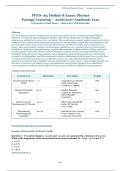
PHYS 165 Module 8 Exam — Portage Learning 2026/2027
PHYS 165 Module 8 Exam: Physics
Portage Learning — 2026/2027 Academic Year
25-Question Actual Exam — Answer Key with Rationales
Abstract
This document presents the comprehensive 25-question actual exam for Portage Learning PHYS 165
Module 8, covering the advanced physics domains of Electricity, Magnetism, and Electromagnetic
Induction as outlined in the 2026/2027 curriculum. The examination evaluates students’ mastery of critical
analytical and mathematical competencies essential for understanding complex physical phenomena. The
four principal content areas assessed include Electrostatics and Electric Fields, where Coulomb’s Law,
Gauss’s Law, and conductor behavior in electrostatic equilibrium are examined; Electric Potential and
Capacitance, focusing on potential energy, parallel-plate capacitor analysis, dielectric effects, and series-
parallel capacitor networks; Electric Current, Resistance, and DC Circuits, encompassing Ohm’s Law,
Kirchhoff’s Rules, RC circuit time constants, power dissipation, and real battery behavior with internal
resistance; and Magnetism and Electromagnetic Induction, addressing the Biot-Savart Law, Lorentz force
on charged particles, Faraday’s Law of induction, Lenz’s Law, and solenoid field calculations. Each
question is accompanied by a detailed rationale explaining the correct answer and an analysis of why each
distractor is incorrect, grounded in proven methodologies and scientific standards from established
university physics textbooks and the official Portage Learning PHYS 165 Module 8 course materials.
Content Area Overview
Content Area Questions Key Topics Weight
Electrostatics & Electric 1–7 Coulomb’s Law, Electric 28%
Fields Field, Gauss’s Law,
Conductors, Dipoles
Electric Potential & 8–13 Electric Potential, 24%
Capacitance Capacitors, Dielectrics,
Series/Parallel
Capacitors
Electric Current, 14–19 Ohm’s Law, Kirchhoff’s 24%
Resistance & DC Circuits Rules, RC Circuits,
Power, EMF
Magnetism & 20–25 Biot-Savart Law, Lorentz 24%
Electromagnetic Force, Faraday’s Law,
Induction Lenz’s Law, Solenoids
Examination Questions (25 Questions)
Domain: Electrostatics & Electric Fields
Question 1: Two point charges, +3.0 μC and −5.0 μC, are separated by a distance of 0.20 m.
What is the magnitude of the electrostatic force between them? (k = 8.99 × 10⁹ N·m²/C²)
A. 1.69 N
B. 3.37 N
C. 6.75 N
D. 0.84 N
Correct Answer: B
Page 1
, PHYS 165 Module 8 Exam — Portage Learning 2026/2027
Rationale: Using Coulomb's Law, F = k|q₁q₂|/r² = (8.99×10⁹)(3.0×10 ⁻⁶)(5.0×10⁻⁶)/(0.20)² = 3.37 N. The
force magnitude depends on the product of the absolute values of the charges and the square of the distance
between them.
Why Wrong: A miscalculates by using r instead of r². C doubles the result by forgetting the absolute value
treatment. D divides by an extra factor of 4.
Reference: Halliday, D., Resnick, R., & Walker, J. (2026). Fundamentals of Physics (13th ed.), Chapter 21.
Portage Learning PHYS 165 Module 8, Section 1.1.
Question 2: A uniform electric field of magnitude 4.0 × 10³ N/C points in the positive x-
direction. What is the electric flux through a square surface of side 0.10 m that lies in the yz-
plane?
A. 40 N·m²/C
B. 4.0 N·m²/C
C. 0.40 N·m²/C
D. 400 N·m²/C
Correct Answer: A
Rationale: The electric flux Φ = E·A = EA cos θ. The square lies in the yz-plane, so its normal is along x,
making θ = 0°. Area = (0.10)² = 0.01 m². Thus Φ = (4.0×10³)(0.01)(1) = 40 N·m²/C.
Why Wrong: B uses the side length directly instead of the area. C divides by an extra factor of 10. D uses
0.1 m² as the area instead of 0.01 m².
Reference: Young, H. D., & Freedman, R. A. (2026). University Physics (15th ed.), Chapter 22. Portage
Learning PHYS 165 Module 8, Section 1.3.
Question 3: According to Gauss's Law, the net electric flux through a closed surface is
proportional to:
A. The surface area of the Gaussian surface
B. The net charge enclosed within the surface
C. The total charge both inside and outside the surface
D. The electric field at the surface only
Correct Answer: B
Rationale: Gauss's Law states that the net electric flux through any closed surface equals the net charge
enclosed divided by ε₀. Charges outside the surface contribute zero net flux. The flux depends only on the
enclosed charge, not on the size or shape of the surface.
Why Wrong: A confuses flux with the general concept of area integration. C includes external charges
that produce zero net flux through the closed surface. D incorrectly limits flux to the local field without
accounting for the integral nature of the law.
Reference: Halliday, D., Resnick, R., & Walker, J. (2026). Fundamentals of Physics (13th ed.), Chapter 23.
Portage Learning PHYS 165 Module 8, Section 1.4.
Question 4: A solid conducting sphere of radius R carries a net charge +Q. Which statement
correctly describes the electric field inside the conductor?
A. The field is directed radially outward and increases linearly with distance from the center
B. The field is zero everywhere inside the conductor
C. The field is zero only at the center and increases toward the surface
D. The field is constant and non-zero throughout the interior
Correct Answer: B
Rationale: In electrostatic equilibrium, the electric field inside a conductor must be zero. Any net charge
resides on the surface. If an internal field existed, free electrons would redistribute until equilibrium is
reached, eliminating the field. This is a fundamental property of conductors in electrostatics.
Why Wrong: A describes the field inside a uniformly charged insulating sphere, not a conductor. C
confuses conductor behavior with insulator field profiles. D contradicts the electrostatic equilibrium
condition for conductors.
Reference: Young, H. D., & Freedman, R. A. (2026). University Physics (15th ed.), Chapter 22. Portage
Learning PHYS 165 Module 8, Section 1.2.
Page 2
PHYS 165 Module 8 Exam: Physics
Portage Learning — 2026/2027 Academic Year
25-Question Actual Exam — Answer Key with Rationales
Abstract
This document presents the comprehensive 25-question actual exam for Portage Learning PHYS 165
Module 8, covering the advanced physics domains of Electricity, Magnetism, and Electromagnetic
Induction as outlined in the 2026/2027 curriculum. The examination evaluates students’ mastery of critical
analytical and mathematical competencies essential for understanding complex physical phenomena. The
four principal content areas assessed include Electrostatics and Electric Fields, where Coulomb’s Law,
Gauss’s Law, and conductor behavior in electrostatic equilibrium are examined; Electric Potential and
Capacitance, focusing on potential energy, parallel-plate capacitor analysis, dielectric effects, and series-
parallel capacitor networks; Electric Current, Resistance, and DC Circuits, encompassing Ohm’s Law,
Kirchhoff’s Rules, RC circuit time constants, power dissipation, and real battery behavior with internal
resistance; and Magnetism and Electromagnetic Induction, addressing the Biot-Savart Law, Lorentz force
on charged particles, Faraday’s Law of induction, Lenz’s Law, and solenoid field calculations. Each
question is accompanied by a detailed rationale explaining the correct answer and an analysis of why each
distractor is incorrect, grounded in proven methodologies and scientific standards from established
university physics textbooks and the official Portage Learning PHYS 165 Module 8 course materials.
Content Area Overview
Content Area Questions Key Topics Weight
Electrostatics & Electric 1–7 Coulomb’s Law, Electric 28%
Fields Field, Gauss’s Law,
Conductors, Dipoles
Electric Potential & 8–13 Electric Potential, 24%
Capacitance Capacitors, Dielectrics,
Series/Parallel
Capacitors
Electric Current, 14–19 Ohm’s Law, Kirchhoff’s 24%
Resistance & DC Circuits Rules, RC Circuits,
Power, EMF
Magnetism & 20–25 Biot-Savart Law, Lorentz 24%
Electromagnetic Force, Faraday’s Law,
Induction Lenz’s Law, Solenoids
Examination Questions (25 Questions)
Domain: Electrostatics & Electric Fields
Question 1: Two point charges, +3.0 μC and −5.0 μC, are separated by a distance of 0.20 m.
What is the magnitude of the electrostatic force between them? (k = 8.99 × 10⁹ N·m²/C²)
A. 1.69 N
B. 3.37 N
C. 6.75 N
D. 0.84 N
Correct Answer: B
Page 1
, PHYS 165 Module 8 Exam — Portage Learning 2026/2027
Rationale: Using Coulomb's Law, F = k|q₁q₂|/r² = (8.99×10⁹)(3.0×10 ⁻⁶)(5.0×10⁻⁶)/(0.20)² = 3.37 N. The
force magnitude depends on the product of the absolute values of the charges and the square of the distance
between them.
Why Wrong: A miscalculates by using r instead of r². C doubles the result by forgetting the absolute value
treatment. D divides by an extra factor of 4.
Reference: Halliday, D., Resnick, R., & Walker, J. (2026). Fundamentals of Physics (13th ed.), Chapter 21.
Portage Learning PHYS 165 Module 8, Section 1.1.
Question 2: A uniform electric field of magnitude 4.0 × 10³ N/C points in the positive x-
direction. What is the electric flux through a square surface of side 0.10 m that lies in the yz-
plane?
A. 40 N·m²/C
B. 4.0 N·m²/C
C. 0.40 N·m²/C
D. 400 N·m²/C
Correct Answer: A
Rationale: The electric flux Φ = E·A = EA cos θ. The square lies in the yz-plane, so its normal is along x,
making θ = 0°. Area = (0.10)² = 0.01 m². Thus Φ = (4.0×10³)(0.01)(1) = 40 N·m²/C.
Why Wrong: B uses the side length directly instead of the area. C divides by an extra factor of 10. D uses
0.1 m² as the area instead of 0.01 m².
Reference: Young, H. D., & Freedman, R. A. (2026). University Physics (15th ed.), Chapter 22. Portage
Learning PHYS 165 Module 8, Section 1.3.
Question 3: According to Gauss's Law, the net electric flux through a closed surface is
proportional to:
A. The surface area of the Gaussian surface
B. The net charge enclosed within the surface
C. The total charge both inside and outside the surface
D. The electric field at the surface only
Correct Answer: B
Rationale: Gauss's Law states that the net electric flux through any closed surface equals the net charge
enclosed divided by ε₀. Charges outside the surface contribute zero net flux. The flux depends only on the
enclosed charge, not on the size or shape of the surface.
Why Wrong: A confuses flux with the general concept of area integration. C includes external charges
that produce zero net flux through the closed surface. D incorrectly limits flux to the local field without
accounting for the integral nature of the law.
Reference: Halliday, D., Resnick, R., & Walker, J. (2026). Fundamentals of Physics (13th ed.), Chapter 23.
Portage Learning PHYS 165 Module 8, Section 1.4.
Question 4: A solid conducting sphere of radius R carries a net charge +Q. Which statement
correctly describes the electric field inside the conductor?
A. The field is directed radially outward and increases linearly with distance from the center
B. The field is zero everywhere inside the conductor
C. The field is zero only at the center and increases toward the surface
D. The field is constant and non-zero throughout the interior
Correct Answer: B
Rationale: In electrostatic equilibrium, the electric field inside a conductor must be zero. Any net charge
resides on the surface. If an internal field existed, free electrons would redistribute until equilibrium is
reached, eliminating the field. This is a fundamental property of conductors in electrostatics.
Why Wrong: A describes the field inside a uniformly charged insulating sphere, not a conductor. C
confuses conductor behavior with insulator field profiles. D contradicts the electrostatic equilibrium
condition for conductors.
Reference: Young, H. D., & Freedman, R. A. (2026). University Physics (15th ed.), Chapter 22. Portage
Learning PHYS 165 Module 8, Section 1.2.
Page 2