

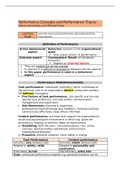
Performance Concepts and Performance Theory
Sabine Sonnentag, and Michael Frese
Learning Learn the views on job performance and understand their
Goals characteristics
Definition of Performance
Action (behavioral) Behaviors relevant to the organizational
aspect goals
Only scaled actions performance
Outcome aspect Consequence/ Result of individuals’
behaviors
Depend on external factors
They are related but do not overlap
In practice it is difficult to distinguish between the two aspects
In this paper performance is used in a behavioral
aspect
Performance Multidimensionality
Task performance: individuals’ proficiency which contributes to
the technical core of an organization (Direct: production workers
OR Indirect: managers)
Five factors of task performance: Job-specific and non-job
specific task proficiency, oral and written communication,
management and supervision
Sub-dimensions: planning & organizing,
guiding/directing/motivating/ give feedback, training/coaching,
communicate effectively, keep others informed.
Context performance: activities that support the organizational,
social and psychological environment in which org. goals are
pursued e.g. helping co-workers, ideas of improvement
a) Stabilizing: OCB (altruism, conscientiousness, civic virtue,
courtesy, sportsmanship) spontaneity and prosocial
organizational behavior.
b) Proactive: personal initiative, voice, being in charge
Task Performance Context performance
Activities vary between jobs Activities stable between jobs
Related to ability, skills Related to personality and
motivation
Prescribed, in-role Discretionary, extra-role
Expt: contextual performance aspects e.g. personal initiative can be
, predicted by both abilities and motivation
They have unequal contributions to managerial jobs
Performance as a dynamic concept
Learning processes/ Long-term changes: performance
increases proportionally to the time spent on the job but later
reaches a plateau.
a) Transition stage: early skill acquisition, novel tasks that
require cognitive abilities (available resources and declarative
knowledge)
b) Maintenance stage: performance becomes more automatic,
relies on procedural knowledge, psychomotor abilities and
dispositional factors are important e.g. interests, motives
Short-term changes/temporary: psycho-physiological changes
dependent on situation e.g. stress, fatigue, sleep disturbance not
necess. Leading to decrease in performance
Perspectives on Performance
1. Individual Differences Perspective
Core Question: Which individuals perform best?
Components of performance: e.g. job-specific task
Determinants:
1. Declarative knowledge and skill
2. Procedural knowledge and skill
3. Motivation: choice to perform, level and persistence of effort
Campbell’s
Predictors:
model
Declarative abilities, personality, education, experience, training
aptitude-treatment
Procedural same + practice
Motivation did not specify
Limitation: He ignored situational factors
Task performance is a function of cognitive ability and contextual
Motowidlo’s is a function of personality
model Cognitive ability small effect on contextual performance
Personality minor effect on task performance
Research on ID and Performance
Cognitive abilities strong relationship with performance (UNDERLYING MECH:
help the knowledge and skill acquisition)
Personality smaller association (mostly with neuroticism and conscientiousness)
Motivation individual differences in motivation might derive from dif in
motivational traits or skills
o Traits: narrower than personality traits (anxiety, nAch)
o Skills: domain-specific, related to self-regulatory strategies and influenced by
situation (learning, training) – emotional or motivation control
Sabine Sonnentag, and Michael Frese
Learning Learn the views on job performance and understand their
Goals characteristics
Definition of Performance
Action (behavioral) Behaviors relevant to the organizational
aspect goals
Only scaled actions performance
Outcome aspect Consequence/ Result of individuals’
behaviors
Depend on external factors
They are related but do not overlap
In practice it is difficult to distinguish between the two aspects
In this paper performance is used in a behavioral
aspect
Performance Multidimensionality
Task performance: individuals’ proficiency which contributes to
the technical core of an organization (Direct: production workers
OR Indirect: managers)
Five factors of task performance: Job-specific and non-job
specific task proficiency, oral and written communication,
management and supervision
Sub-dimensions: planning & organizing,
guiding/directing/motivating/ give feedback, training/coaching,
communicate effectively, keep others informed.
Context performance: activities that support the organizational,
social and psychological environment in which org. goals are
pursued e.g. helping co-workers, ideas of improvement
a) Stabilizing: OCB (altruism, conscientiousness, civic virtue,
courtesy, sportsmanship) spontaneity and prosocial
organizational behavior.
b) Proactive: personal initiative, voice, being in charge
Task Performance Context performance
Activities vary between jobs Activities stable between jobs
Related to ability, skills Related to personality and
motivation
Prescribed, in-role Discretionary, extra-role
Expt: contextual performance aspects e.g. personal initiative can be
, predicted by both abilities and motivation
They have unequal contributions to managerial jobs
Performance as a dynamic concept
Learning processes/ Long-term changes: performance
increases proportionally to the time spent on the job but later
reaches a plateau.
a) Transition stage: early skill acquisition, novel tasks that
require cognitive abilities (available resources and declarative
knowledge)
b) Maintenance stage: performance becomes more automatic,
relies on procedural knowledge, psychomotor abilities and
dispositional factors are important e.g. interests, motives
Short-term changes/temporary: psycho-physiological changes
dependent on situation e.g. stress, fatigue, sleep disturbance not
necess. Leading to decrease in performance
Perspectives on Performance
1. Individual Differences Perspective
Core Question: Which individuals perform best?
Components of performance: e.g. job-specific task
Determinants:
1. Declarative knowledge and skill
2. Procedural knowledge and skill
3. Motivation: choice to perform, level and persistence of effort
Campbell’s
Predictors:
model
Declarative abilities, personality, education, experience, training
aptitude-treatment
Procedural same + practice
Motivation did not specify
Limitation: He ignored situational factors
Task performance is a function of cognitive ability and contextual
Motowidlo’s is a function of personality
model Cognitive ability small effect on contextual performance
Personality minor effect on task performance
Research on ID and Performance
Cognitive abilities strong relationship with performance (UNDERLYING MECH:
help the knowledge and skill acquisition)
Personality smaller association (mostly with neuroticism and conscientiousness)
Motivation individual differences in motivation might derive from dif in
motivational traits or skills
o Traits: narrower than personality traits (anxiety, nAch)
o Skills: domain-specific, related to self-regulatory strategies and influenced by
situation (learning, training) – emotional or motivation control



