

Lecture 1: history
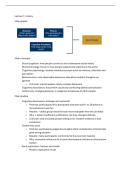
Main graphs
Main concepts
- Social cognition: how people construct and understand social reality
- Phenomenology: focus on how people subjectively experience the world
- Cognitive psychology: studies mental processes such as memory, attention and
perception
- Behaviourism: only observable behaviour should be studied; thoughts are
ignored
o Criticism: cannot explain many complex behaviors
- Cognitive dissonance: discomfort caused by conflicting beliefs and behavior
- Conformity: changing behavior or judgements because of other people
Main studies
- Cognitive dissonance: festinger and carlsmith
o Premise: participants did a boring task and were paid 1 or 20 dollars to
tell someone it was fun
o Results: 1 dollar group rated the task more enjoyable than the 20 dollar
o Why: 1 dollar insufficient justification. So they changed attitude.
o Criticism: only included people willing to lie; modern evidence is less
consistent
- Conformity: asch
o Premise: participants judged line lengths while confederates intentionally
gave wrong answers
o Results: many participants conformed to the incorrect majority
o Why: normative influence (fit in) and informational influence (others know
better)
- Asch replication: franzen and mader
o Modern replication of ash
, o Result: conformity still occurred; financial incentives only slightly
reduced it
Lecture 2: memory
Main graphs
,Main concepts
- Encoding: creating memories from experiences
- Storage: maintainging information in memory
- Retrieval: recalling information from memory
- Short term: temporary storage
- Long term: lasting storage
- Explicit (declarative memory): conscious memory: Remembering your birthday
party.
- Implicit memory: unconscious memory influences : Typing your password
without thinking about each key.
- Episodic memory: memory for specific events : Remembering your first day at
university.
- Semantic memory: general knowledge and concepts: Knowing that Amsterdam
is the capital of the Netherlands.
- Procedural memory: skills and routines: riding a bike
- Autobiographical memory: memory of your own life story: remembering where
you grew up
- Source monitoring: determining where a memory came from
o Problem: imagined events can be confused for real ones
- Phantom flashbulbs: very confident memories can still be inaccurate
- Semantic networks: memory is organized in connected networks of concepts
- Distinctiveness: unexpected information gets deeper encoding and is
remembred better
- Primacy effect: items presented first are remembered better
- Recency effect: items presented last are remembered better
- False memory reconstruction: people can remember events that never
happened
- Framing: the wording of information changes memory
, - Goal relevance: goal influence what information is remembred
- Debunking: correcting misinformation after exposure
o Works, but cannot fully undo informartion
- Prebunking / inoculation: preparing people beforehand to resist misinformation
Main studies
- Forgetting curve: ebbingshaus
o Premise: studied memory by learning nonsense syllables and testing
recall over time
o Results: most forgetting happens shortly after learning, then levels of
o Takeaway: memory naturally decays over time without rehearsal
o Criticism: used meaningless syllables, may not reflect real life memory
- Source monitoring: johnson
o Premise: investigated how people determine where a memory came from
o Results: people sometimes confuse imagined events with real events
o Takeaway: memory is not only about remembering information, but also
remembering its source
o Criticism: errors are more common in lab settings than in everyday life
- Phantom flashbulbs: neisser and harsch
o Premise: students reported where they were when they heard about the
challenger disaster and were asked again years later
o Results: participants were highly confident but often inaccurate
o Takeaway: confidence is not accuracy
- Person memory: hastie and kumar
o Premise: participants learned information about a person that was either
▪ Congruent with expectation
▪ Neutral
▪ Incongruent with expectations
o Results:
▪ Incongruent information remembred best
▪ Primacy and recency effects occured
o Takeaway: unexpected information get deeper processing and is
remembred better
- Lost in the mall: loftus and pickrell
o Premise: participants received several childhood memories, one of which
was false
o Results: about 25% developed a memory for the false event
o Takeaway : entirely false memories can be created
o Criticism: Being lost in a mall is a relatively mild event; results may not
generalize to traumatic memories.
- False memory replication
Main graphs
Main concepts
- Social cognition: how people construct and understand social reality
- Phenomenology: focus on how people subjectively experience the world
- Cognitive psychology: studies mental processes such as memory, attention and
perception
- Behaviourism: only observable behaviour should be studied; thoughts are
ignored
o Criticism: cannot explain many complex behaviors
- Cognitive dissonance: discomfort caused by conflicting beliefs and behavior
- Conformity: changing behavior or judgements because of other people
Main studies
- Cognitive dissonance: festinger and carlsmith
o Premise: participants did a boring task and were paid 1 or 20 dollars to
tell someone it was fun
o Results: 1 dollar group rated the task more enjoyable than the 20 dollar
o Why: 1 dollar insufficient justification. So they changed attitude.
o Criticism: only included people willing to lie; modern evidence is less
consistent
- Conformity: asch
o Premise: participants judged line lengths while confederates intentionally
gave wrong answers
o Results: many participants conformed to the incorrect majority
o Why: normative influence (fit in) and informational influence (others know
better)
- Asch replication: franzen and mader
o Modern replication of ash
, o Result: conformity still occurred; financial incentives only slightly
reduced it
Lecture 2: memory
Main graphs
,Main concepts
- Encoding: creating memories from experiences
- Storage: maintainging information in memory
- Retrieval: recalling information from memory
- Short term: temporary storage
- Long term: lasting storage
- Explicit (declarative memory): conscious memory: Remembering your birthday
party.
- Implicit memory: unconscious memory influences : Typing your password
without thinking about each key.
- Episodic memory: memory for specific events : Remembering your first day at
university.
- Semantic memory: general knowledge and concepts: Knowing that Amsterdam
is the capital of the Netherlands.
- Procedural memory: skills and routines: riding a bike
- Autobiographical memory: memory of your own life story: remembering where
you grew up
- Source monitoring: determining where a memory came from
o Problem: imagined events can be confused for real ones
- Phantom flashbulbs: very confident memories can still be inaccurate
- Semantic networks: memory is organized in connected networks of concepts
- Distinctiveness: unexpected information gets deeper encoding and is
remembred better
- Primacy effect: items presented first are remembered better
- Recency effect: items presented last are remembered better
- False memory reconstruction: people can remember events that never
happened
- Framing: the wording of information changes memory
, - Goal relevance: goal influence what information is remembred
- Debunking: correcting misinformation after exposure
o Works, but cannot fully undo informartion
- Prebunking / inoculation: preparing people beforehand to resist misinformation
Main studies
- Forgetting curve: ebbingshaus
o Premise: studied memory by learning nonsense syllables and testing
recall over time
o Results: most forgetting happens shortly after learning, then levels of
o Takeaway: memory naturally decays over time without rehearsal
o Criticism: used meaningless syllables, may not reflect real life memory
- Source monitoring: johnson
o Premise: investigated how people determine where a memory came from
o Results: people sometimes confuse imagined events with real events
o Takeaway: memory is not only about remembering information, but also
remembering its source
o Criticism: errors are more common in lab settings than in everyday life
- Phantom flashbulbs: neisser and harsch
o Premise: students reported where they were when they heard about the
challenger disaster and were asked again years later
o Results: participants were highly confident but often inaccurate
o Takeaway: confidence is not accuracy
- Person memory: hastie and kumar
o Premise: participants learned information about a person that was either
▪ Congruent with expectation
▪ Neutral
▪ Incongruent with expectations
o Results:
▪ Incongruent information remembred best
▪ Primacy and recency effects occured
o Takeaway: unexpected information get deeper processing and is
remembred better
- Lost in the mall: loftus and pickrell
o Premise: participants received several childhood memories, one of which
was false
o Results: about 25% developed a memory for the false event
o Takeaway : entirely false memories can be created
o Criticism: Being lost in a mall is a relatively mild event; results may not
generalize to traumatic memories.
- False memory replication



