Chapter 1: Introduction to the Field of Organizational Behavior
Organizational behavior, OB = the study of what people think, feel, and do in and around
organizations
- Organizations = groups of people who work interdependently toward some purpose
- OB offers a core foundation of knowledge and skill development for successful work in
organizations
o Through comprehending and predicting workplace behavior and events
o Through influencing workplace behavior and events
- OB is vital to an organization's survival and success
- Organisational effectiveness = an ideal state in which an organization has a good fit with its
external environment, effectively transforms inputs to outputs through human capital, and
satisfies the needs of key stakeholders
o Goals may be too easy, may change over time, and are hard to measure
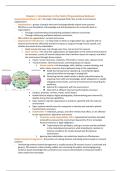
o Open systems = the view that organizations are dependent on the external environments
for resources, consist of internal subsystems that transform inputs to outputs, and affect
the environment through those outputs
• Inputs: human resources, materials, information, money, laws, cultural norms
• Transformation: internal processes converting inputs to outputs
§ Human capital = the knowledge, skills, abilities, creative thinking, and
other values resources that employees bring to the organization
t Kodak had strong human capital (e.g. inventing the digital
camera) but failed to leverage it strategically
t Enhancing human capital results in better job performance by
acquiring more skills and knowledge, better adaptation to rapidly
changing environments, and more investment and rewarding for
workforce
t External fit is alignment with the environment
t Internal fit is efficient internal transformation processes
• Outputs: products, services, waste, social impact
• Kodak failed to adapt to digital photography, demonstrating poor external fit,
despite strong internal capabilities
• Open systems help the organization to maintain a good fit with the external
environment
• Open systems identify ways for companies to develop and maintain optimal
transformation processes
• Stakeholders = individuals, groups, and other entities that affect, or are affected
by the organization's objectives and actions
§ Corporate social responsibility, CSR = organizational activities intended
to benefit society and the environment beyond the firm's immediate
financial interests or legal obligations
t Triple-bottom-line philosphy: aiming to survive and be profitable
in the marketplace (economic), while intending to maintain or
improve conditions for society (social) and the physical
environment
§ Ignoring key stakeholders can undermine long-term effectiveness
Evidence-based management = the practice of making decision and taking actions based on research
evidence
- Overlooking evidence-based management is usually because OB research access is restricted and
generic, OB research is about testing validity not convincing the public, dismissing/ignoring
evidence-based knowledge that contradicts one's preconceived beliefs, and because leaders
often exhibit herd mentality
, o Can be fixed by being skeptical of hype, seeking views of several sources, keeping in mind
that a story may only illustrate an idea, and by resisting the urge to engage in herd
behavior
Inclusive workplace = a workplace that values people of all identities and allows them to be fully
themselves while contributing to the organization
- Individual level: enabling people to feel psychologically safe, engaged, valued
- Team level: giving groups voices
- Organizational level: assessing recruitment, rewards, social and information networks
- Surface-level diversity = the observable demographic or physiological differences in people (e.g.
race, ethnicity, gender, age, and physical disabilities)
- Deep-level diversity = differences in the psychological characteristics of employees (e.g.
personalities, beliefs, values, and attitudes)
o Diversity is advantageous for better decision making, employee attitudes, team
performance, and it is more representative
o Diversity is disadvantageous for communication, coordination, and cooperation
Anchors of OB
1. Multidisciplinary anchor: OB borrows theories from other disciplines
2. Contingency anchor: the effect of one variable on another variable is context-dependent
3. Multiple levels of analysis anchor: OB is made up of three levels - individual (employee) level,
team level, and organizational level
- Team level: diverse teams outperform homogeneous teams as they bring broader perspectives
but they also face higher risks of conflict and coordination problems
- Organizational level: mission statement = an organisation's overarching purpose and values,
which evolves over time
Work-life integration = the degree that people are effectively engaged in their various (non)work
roles and have a low degree of role conflict across those life domains
- Maximized by integrating two or more roles, through flexible work scheduling, compatibility of
(non)work roles, and by engaging in boundary management across roles (scheduling time blocks,
creating physical role spaces, applying technological boundaries, and communicating role
boundary expectations)
- Work-life balance = incorrectly implying that (non)work roles are completely separate and
opposing partitions
- Work-life conflict = having insufficient time and energy remaining for other aspects of one’s life
- Remote work = any arrangement whereby an individual performs organizational tasks while
located away from the employer's physical premises, usually connected through various forms of
information technology
o Advantages: better work-life integration, lower turnover, higher productivity, financial
benefits, benefitting lower greenhouse gas emission
• Employees who work better from home have higher self-motivation, self-
organization, need for autonomy, and a lower need for social interaction
• Remote work should require low interdependence, the needed resources should
be transported home or are available digitally, and task performance must be
measurable
• Remote work should have rewards and promotions based on performance and
other measurable contributions, regular supportive (video) communication
o Disadvantages: more social isolation, less word-of-mouth information, lower cohesion,
weak culture
MARS (Motivation, Ability, Role perceptions, Situation) model = a model depicting the four
variables that directly influence an individual's voluntary behavior and performance
- Earlier it was thought that performance = person x situation
- Then it was thought that performance = ability x motivation (skill-and-will model)
, 1. Motivation = the forces within a person that affect the direction, intensity, and persistence of
effort for voluntary behavior (cognitive thoughts and emotional conditions)
1. Direction = the path along which people steer their effort (where to steer the car)
2. Intensity = the amount of effort allocated to the goal (how much you put your foot down
on the accelerator)
3. Persistence = the length of time that one continues to exert effort toward an objective
(how long you drive toward your destination)
2. Ability = the natural aptitudes, learned capabilities, and habits required to successfully complete
a task
1. Aptitudes = natural physical or cognitive talents that help employees learn specific tasks
more quickly and perform them better
• Personnel selection research found that IQ is the strongest predictor of job
performance, especially in complex jobs, which explains why organisations rely
heavily on cognitive ability tests, structured interviews, and conscientiousness
measures
2. Learned capabilities = skills and knowledge that one acquires through learning
3. Habits = tendencies to engage in specific behaviors in response to contextual cues and
enacted with little conscious awareness
3. Role perceptions = the degree to which a person understands the job duties assigned to or
expected of him or her
1. Task responsibilities
2. Performance priorities
3. Appropriate behaviors and procedures
4. Situational factors = external conditions beyond an
employee's direct control (time pressure, budget constraints,
technology, colleagues)
o Situations can either enable or constrain
performance, regardless of motivation or ability
o Work environments should provide cues to guide and motivate
- Fran at UvA has high motivation, high IQ, excellent teaching evaluations, and poor supervisor
rating
o There may be role perception mismatch (e.g. teaching is valued less than research)
o There may be situational constraints (e.g. lack of time for research
o Performance was judged on criteria which Fran did not prioritise
o Performance problems are rarely due to motivation alone
Types of individual behavior
- Task performance = the individual's voluntary goal-directed behaviors that contribute to
organizational objectives
o Proficient task performance = how well employees perform the work efficiently and
accurately
o Adaptive task performance = how well employees modify their thoughts and behavior to
align with and support a new or changing work process or work setting
o Proactive task performance = how well employees take the initiative to anticipate and
introduce new work patterns that benefit the organization
- Organisational citizenship behavior, OCB = various forms of cooperation and helpfulness to
others that support the organization's social and psychological context
o Can have negative effects through lower career success in companies that reward task
performance, or through higher work-family conflict
- Counterproductive work behavior, CWB = voluntary behaviors that have the potential to
(in)directly harm the organization
- Joining and staying with the organization (retention)
- Maintaining work attendance (absenteeism, presenteeism, and lateness)
Organizational behavior, OB = the study of what people think, feel, and do in and around
organizations
- Organizations = groups of people who work interdependently toward some purpose
- OB offers a core foundation of knowledge and skill development for successful work in
organizations
o Through comprehending and predicting workplace behavior and events
o Through influencing workplace behavior and events
- OB is vital to an organization's survival and success
- Organisational effectiveness = an ideal state in which an organization has a good fit with its
external environment, effectively transforms inputs to outputs through human capital, and
satisfies the needs of key stakeholders
o Goals may be too easy, may change over time, and are hard to measure
o Open systems = the view that organizations are dependent on the external environments
for resources, consist of internal subsystems that transform inputs to outputs, and affect
the environment through those outputs
• Inputs: human resources, materials, information, money, laws, cultural norms
• Transformation: internal processes converting inputs to outputs
§ Human capital = the knowledge, skills, abilities, creative thinking, and
other values resources that employees bring to the organization
t Kodak had strong human capital (e.g. inventing the digital
camera) but failed to leverage it strategically
t Enhancing human capital results in better job performance by
acquiring more skills and knowledge, better adaptation to rapidly
changing environments, and more investment and rewarding for
workforce
t External fit is alignment with the environment
t Internal fit is efficient internal transformation processes
• Outputs: products, services, waste, social impact
• Kodak failed to adapt to digital photography, demonstrating poor external fit,
despite strong internal capabilities
• Open systems help the organization to maintain a good fit with the external
environment
• Open systems identify ways for companies to develop and maintain optimal
transformation processes
• Stakeholders = individuals, groups, and other entities that affect, or are affected
by the organization's objectives and actions
§ Corporate social responsibility, CSR = organizational activities intended
to benefit society and the environment beyond the firm's immediate
financial interests or legal obligations
t Triple-bottom-line philosphy: aiming to survive and be profitable
in the marketplace (economic), while intending to maintain or
improve conditions for society (social) and the physical
environment
§ Ignoring key stakeholders can undermine long-term effectiveness
Evidence-based management = the practice of making decision and taking actions based on research
evidence
- Overlooking evidence-based management is usually because OB research access is restricted and
generic, OB research is about testing validity not convincing the public, dismissing/ignoring
evidence-based knowledge that contradicts one's preconceived beliefs, and because leaders
often exhibit herd mentality
, o Can be fixed by being skeptical of hype, seeking views of several sources, keeping in mind
that a story may only illustrate an idea, and by resisting the urge to engage in herd
behavior
Inclusive workplace = a workplace that values people of all identities and allows them to be fully
themselves while contributing to the organization
- Individual level: enabling people to feel psychologically safe, engaged, valued
- Team level: giving groups voices
- Organizational level: assessing recruitment, rewards, social and information networks
- Surface-level diversity = the observable demographic or physiological differences in people (e.g.
race, ethnicity, gender, age, and physical disabilities)
- Deep-level diversity = differences in the psychological characteristics of employees (e.g.
personalities, beliefs, values, and attitudes)
o Diversity is advantageous for better decision making, employee attitudes, team
performance, and it is more representative
o Diversity is disadvantageous for communication, coordination, and cooperation
Anchors of OB
1. Multidisciplinary anchor: OB borrows theories from other disciplines
2. Contingency anchor: the effect of one variable on another variable is context-dependent
3. Multiple levels of analysis anchor: OB is made up of three levels - individual (employee) level,
team level, and organizational level
- Team level: diverse teams outperform homogeneous teams as they bring broader perspectives
but they also face higher risks of conflict and coordination problems
- Organizational level: mission statement = an organisation's overarching purpose and values,
which evolves over time
Work-life integration = the degree that people are effectively engaged in their various (non)work
roles and have a low degree of role conflict across those life domains
- Maximized by integrating two or more roles, through flexible work scheduling, compatibility of
(non)work roles, and by engaging in boundary management across roles (scheduling time blocks,
creating physical role spaces, applying technological boundaries, and communicating role
boundary expectations)
- Work-life balance = incorrectly implying that (non)work roles are completely separate and
opposing partitions
- Work-life conflict = having insufficient time and energy remaining for other aspects of one’s life
- Remote work = any arrangement whereby an individual performs organizational tasks while
located away from the employer's physical premises, usually connected through various forms of
information technology
o Advantages: better work-life integration, lower turnover, higher productivity, financial
benefits, benefitting lower greenhouse gas emission
• Employees who work better from home have higher self-motivation, self-
organization, need for autonomy, and a lower need for social interaction
• Remote work should require low interdependence, the needed resources should
be transported home or are available digitally, and task performance must be
measurable
• Remote work should have rewards and promotions based on performance and
other measurable contributions, regular supportive (video) communication
o Disadvantages: more social isolation, less word-of-mouth information, lower cohesion,
weak culture
MARS (Motivation, Ability, Role perceptions, Situation) model = a model depicting the four
variables that directly influence an individual's voluntary behavior and performance
- Earlier it was thought that performance = person x situation
- Then it was thought that performance = ability x motivation (skill-and-will model)
, 1. Motivation = the forces within a person that affect the direction, intensity, and persistence of
effort for voluntary behavior (cognitive thoughts and emotional conditions)
1. Direction = the path along which people steer their effort (where to steer the car)
2. Intensity = the amount of effort allocated to the goal (how much you put your foot down
on the accelerator)
3. Persistence = the length of time that one continues to exert effort toward an objective
(how long you drive toward your destination)
2. Ability = the natural aptitudes, learned capabilities, and habits required to successfully complete
a task
1. Aptitudes = natural physical or cognitive talents that help employees learn specific tasks
more quickly and perform them better
• Personnel selection research found that IQ is the strongest predictor of job
performance, especially in complex jobs, which explains why organisations rely
heavily on cognitive ability tests, structured interviews, and conscientiousness
measures
2. Learned capabilities = skills and knowledge that one acquires through learning
3. Habits = tendencies to engage in specific behaviors in response to contextual cues and
enacted with little conscious awareness
3. Role perceptions = the degree to which a person understands the job duties assigned to or
expected of him or her
1. Task responsibilities
2. Performance priorities
3. Appropriate behaviors and procedures
4. Situational factors = external conditions beyond an
employee's direct control (time pressure, budget constraints,
technology, colleagues)
o Situations can either enable or constrain
performance, regardless of motivation or ability
o Work environments should provide cues to guide and motivate
- Fran at UvA has high motivation, high IQ, excellent teaching evaluations, and poor supervisor
rating
o There may be role perception mismatch (e.g. teaching is valued less than research)
o There may be situational constraints (e.g. lack of time for research
o Performance was judged on criteria which Fran did not prioritise
o Performance problems are rarely due to motivation alone
Types of individual behavior
- Task performance = the individual's voluntary goal-directed behaviors that contribute to
organizational objectives
o Proficient task performance = how well employees perform the work efficiently and
accurately
o Adaptive task performance = how well employees modify their thoughts and behavior to
align with and support a new or changing work process or work setting
o Proactive task performance = how well employees take the initiative to anticipate and
introduce new work patterns that benefit the organization
- Organisational citizenship behavior, OCB = various forms of cooperation and helpfulness to
others that support the organization's social and psychological context
o Can have negative effects through lower career success in companies that reward task
performance, or through higher work-family conflict
- Counterproductive work behavior, CWB = voluntary behaviors that have the potential to
(in)directly harm the organization
- Joining and staying with the organization (retention)
- Maintaining work attendance (absenteeism, presenteeism, and lateness)