

Summary Grassland Science
Morphology and development
Grasses
- Family name: Gramineae or Poaceae
- Ca. 10000 species
- Ca. 50 species provide 99% of grasses in man-made grasslands
Legumes:
- Family name: Leguminosae or Fabaceae (legume, pea or bean family)
- 16000 – 20.000 species
- Red clover (trifolium prataense)
- White clover (trifolium …)
- Lucerne (medicoga sativa)
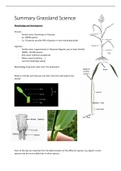
Morphology of grasses: basic unit: the phytomere
Node is a thicker part that you can feel, from the internode to the
sheath
Parts of the leaf are important for the determination of the different species. E.g. ligule in some
species may be more visible than in other species.
,Transparent tissue in the picture is the ligule. Auricle is not visible.
Auricles are outer side, ligule on inner side
Tiller: Grass stem. Phytomeres connected to each other.
Tillering: production of side shoots (producing multiple stems (tillers) starting from the initial single
seedling)
Components do not extent at the same time. In the beginning, internodes are compressed, very
short. Entire bottom section is the stem of a young grass plant. The leaves are very close together:
As the grass plant develops further, the compressed internodes start to extent and push the attached
leaf upwards.
Whole grass plant is a collection of tillers (and branches).
Number of tillers that a grass plant makes can be tuned to
the environment that the grass plant grows in.
Why is tillering important?
- Helps establishment (esp. in light sowing)
- Essential in regeneration after cutting or grazing
,Tillers:
- Grow from basal phytomeres (ground-level) on mother tiller
- Are similar to mother tiller in size and shape
- Produce their own roots → partly independent
o Can completely disconnect from mother shoot (makes
it a kind of clone)
Axillary branches:
- Grow from phytomeres higher up in the mother tiller
- Are generally shorter and have fewer phytomeres than mother
tiller
- Have no roots → fully dependent
Picture: tillers produced their own roots (right). Middle: younger plant, with a tiller that is growing
from the main stem. On the left, even younger tiller.
, Ms: mainstem
T1: tiller 1 (has emerged from the axil of
leaf 1)
T2: tiller 2 (has emerged from the second
leaf)
T11: tiller has emerged from the first leaf of
T1
S: spikelet
Examples of tiller identification:
- Tiller growing from phytomere 3 on
the main tiller = T3
- Tiller growing on the phytomere 2
on T4 = T42
Stolons and rhizomes:
- Stolons
o A.k.a. runners
o Goal to produce new plants
o Typically growing at or above soil level
o Horizontal stems
o Contain chlorophyll (can photosynthesise)
o E.g. strawberry plant, vinca minor, ajuga reptans
o Stoloniferous grass:
▪ Centipede grass
▪ St. Augustine grass
▪ Zoysia grass
▪ Bermuda grass
- Rhizomes:
o Grow below-ground
o Lack chlorophyll
o E.g. Lilly of the valley
o Rhizomatous grass:
▪ Bermuda grass
▪ Couch grass
▪ Zoysia grass
Stolons and rhizomes:
- Horizontal stems (have nodes)
- Produce roots at the nodes
- Vegetative propagation (cloning)
Clones are grown from stolons and rhizomes
Inflorescence is a raceme, spike or a panicle
Flower structure of a grass plant
Raceme: no branching
Panicle: branching
Morphology and development
Grasses
- Family name: Gramineae or Poaceae
- Ca. 10000 species
- Ca. 50 species provide 99% of grasses in man-made grasslands
Legumes:
- Family name: Leguminosae or Fabaceae (legume, pea or bean family)
- 16000 – 20.000 species
- Red clover (trifolium prataense)
- White clover (trifolium …)
- Lucerne (medicoga sativa)
Morphology of grasses: basic unit: the phytomere
Node is a thicker part that you can feel, from the internode to the
sheath
Parts of the leaf are important for the determination of the different species. E.g. ligule in some
species may be more visible than in other species.
,Transparent tissue in the picture is the ligule. Auricle is not visible.
Auricles are outer side, ligule on inner side
Tiller: Grass stem. Phytomeres connected to each other.
Tillering: production of side shoots (producing multiple stems (tillers) starting from the initial single
seedling)
Components do not extent at the same time. In the beginning, internodes are compressed, very
short. Entire bottom section is the stem of a young grass plant. The leaves are very close together:
As the grass plant develops further, the compressed internodes start to extent and push the attached
leaf upwards.
Whole grass plant is a collection of tillers (and branches).
Number of tillers that a grass plant makes can be tuned to
the environment that the grass plant grows in.
Why is tillering important?
- Helps establishment (esp. in light sowing)
- Essential in regeneration after cutting or grazing
,Tillers:
- Grow from basal phytomeres (ground-level) on mother tiller
- Are similar to mother tiller in size and shape
- Produce their own roots → partly independent
o Can completely disconnect from mother shoot (makes
it a kind of clone)
Axillary branches:
- Grow from phytomeres higher up in the mother tiller
- Are generally shorter and have fewer phytomeres than mother
tiller
- Have no roots → fully dependent
Picture: tillers produced their own roots (right). Middle: younger plant, with a tiller that is growing
from the main stem. On the left, even younger tiller.
, Ms: mainstem
T1: tiller 1 (has emerged from the axil of
leaf 1)
T2: tiller 2 (has emerged from the second
leaf)
T11: tiller has emerged from the first leaf of
T1
S: spikelet
Examples of tiller identification:
- Tiller growing from phytomere 3 on
the main tiller = T3
- Tiller growing on the phytomere 2
on T4 = T42
Stolons and rhizomes:
- Stolons
o A.k.a. runners
o Goal to produce new plants
o Typically growing at or above soil level
o Horizontal stems
o Contain chlorophyll (can photosynthesise)
o E.g. strawberry plant, vinca minor, ajuga reptans
o Stoloniferous grass:
▪ Centipede grass
▪ St. Augustine grass
▪ Zoysia grass
▪ Bermuda grass
- Rhizomes:
o Grow below-ground
o Lack chlorophyll
o E.g. Lilly of the valley
o Rhizomatous grass:
▪ Bermuda grass
▪ Couch grass
▪ Zoysia grass
Stolons and rhizomes:
- Horizontal stems (have nodes)
- Produce roots at the nodes
- Vegetative propagation (cloning)
Clones are grown from stolons and rhizomes
Inflorescence is a raceme, spike or a panicle
Flower structure of a grass plant
Raceme: no branching
Panicle: branching



