

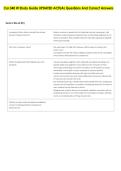
Cor 340 W Study Guide UPDATED ACTUAL Questions And Correct Answers
C
Terms in this set (81)
According to Plato, what is a techne? How is moral Tekhne, or techne, is derived from the Greek term technê, meaning art, craft,
decision making a techne? technique, or skill, and plays an important role in Ancient Greek philosophy (in, for
instance, Xenophon, Plato, Aristotle) where it is most often opposed to epistêmê,
meaning knowledge
What does compassion mean? The word means "to "suffer with" someone, with the sense of coming to the
person's aid."
Compassion is not pity. Pity means "a feeling of sadness or fear at the unavoidable
lot of another, either deserved or undeserved"
What is the Hippocratic Oath? Identify some of its I will use those dietary regimens which will benefit my patients according to my
standards greatest ability and judgement, and I will do no harm or injustice to them.
I will not give a lethal drug to anyone if I am asked, nor will I advise such a plan;
and similarly I will not give a woman a pessary to cause an abortion.
In purity and according to divine law will I carry out my life and my art.
I will not use the knife, even upon those suffering from stones, but I will leave this
to those who are trained in this craft.
Into whatever homes I go, I will enter them for the benefit of the sick, avoiding any
voluntary act of impropriety or corruption, including the seduction of women or
men, whether they are free men or slaves.
Whatever I see or hear in the lives of my patients, whether in connection with my
professional practice or not, which ought not to be spoken of outside, I will keep
secret, as considering all such things to be private.
What do we mean when one speaks of professional
conduct as distinguished from professional
performance?
, What is an ethic? A moral? A value? Ethic: From the Greek "ethos" which means a custom. Customs are habits found
within human cultures,passed from generation to generation
Moral: is prescriptive,not descriptive. Morals are binding norms of human
behavior on any and all groups of persons.
Value: A value is descriptive,no prescriptive.It describes what a particular person
or groups values in the practice of ethics.
Which three things must be moral in a human act to make Motive, Means and End or Goal
it moral
identify and describe utilitarianism, deontological ethics Utilitarianism:A moral act is judged by how it maximizes pleasure and minimizes
(Kant), and virtue ethics. (Use the slides, or video lectures pain or suffering for the most people possible
on my YouTube theology channel.) Deontology: Is an ethical theory that uses rules to distinguish right from wrong
Virtue Ethics: A theory of ethics which is concerned with the virtue or moral
character of the person carrying out an action,rather than their duties or the end
results of their actions
Who were the two philosophers behind utilitarianism? Jeremy Bentham and John Stuart Mill
What was the major disagreement between those two Moral outcomes can be measured through character development which yields
philosophers? human flourishing,and the development of social goods.
What is the Categorical Imperative? Who developed it? "Categorical" meaning and moral ideal. "Imperative" means that it must be acted
on in some way.
Immanuel Kant developed its morality for Kant is a product of practical
philosophy it is how the world ought to be. This ideal world is the product of
moral duty and our need for happiness.
What makes a cardinal virtue, cardinal? As existing in the very act of reason.
What was the chief virtue for Aristotle? Why? Prudence, also known as practical wisdom.In war, soldiers must fight with
prudence by making judgments through practical wisdom. This virtue is a must to
obtain because courage requires judgments to be made.
Who was Lactantius? Born in north Africa,he was a convert to Christianity. He served as an advisor and
tutor in the court of Emperor Constantine I. He wrote the Institutes after pagan
philosophers helped launch the Great persecution.He sought to convert the
intellect of the Roman Empire by unifying Pagan philosophy with the Christian
faith. He compliments the content of Greek philosophy including virtue ethics,but
they are lacking unless they find their true origin in the world of God.
Who was Confucius? Chinese teacher and philosopher. He was an editor of Chinese virtue ethics,but
developed the tradition too. Moral force,filial piety,and self-cultivation
What does Aristotle mean when he says that a virtue sits moral virtue as a disposition to behave in the right manner and as a mean
between excess and deficiency? between extremes of deficiency and excess, which are vices. We learn moral
virtue primarily through habit and practice rather than through reasoning and
instruction
What was the chief virtue for Aquinas? Why? ranked prudence as the first cardinal virtue because it is concerned with the
intellect.
C
Terms in this set (81)
According to Plato, what is a techne? How is moral Tekhne, or techne, is derived from the Greek term technê, meaning art, craft,
decision making a techne? technique, or skill, and plays an important role in Ancient Greek philosophy (in, for
instance, Xenophon, Plato, Aristotle) where it is most often opposed to epistêmê,
meaning knowledge
What does compassion mean? The word means "to "suffer with" someone, with the sense of coming to the
person's aid."
Compassion is not pity. Pity means "a feeling of sadness or fear at the unavoidable
lot of another, either deserved or undeserved"
What is the Hippocratic Oath? Identify some of its I will use those dietary regimens which will benefit my patients according to my
standards greatest ability and judgement, and I will do no harm or injustice to them.
I will not give a lethal drug to anyone if I am asked, nor will I advise such a plan;
and similarly I will not give a woman a pessary to cause an abortion.
In purity and according to divine law will I carry out my life and my art.
I will not use the knife, even upon those suffering from stones, but I will leave this
to those who are trained in this craft.
Into whatever homes I go, I will enter them for the benefit of the sick, avoiding any
voluntary act of impropriety or corruption, including the seduction of women or
men, whether they are free men or slaves.
Whatever I see or hear in the lives of my patients, whether in connection with my
professional practice or not, which ought not to be spoken of outside, I will keep
secret, as considering all such things to be private.
What do we mean when one speaks of professional
conduct as distinguished from professional
performance?
, What is an ethic? A moral? A value? Ethic: From the Greek "ethos" which means a custom. Customs are habits found
within human cultures,passed from generation to generation
Moral: is prescriptive,not descriptive. Morals are binding norms of human
behavior on any and all groups of persons.
Value: A value is descriptive,no prescriptive.It describes what a particular person
or groups values in the practice of ethics.
Which three things must be moral in a human act to make Motive, Means and End or Goal
it moral
identify and describe utilitarianism, deontological ethics Utilitarianism:A moral act is judged by how it maximizes pleasure and minimizes
(Kant), and virtue ethics. (Use the slides, or video lectures pain or suffering for the most people possible
on my YouTube theology channel.) Deontology: Is an ethical theory that uses rules to distinguish right from wrong
Virtue Ethics: A theory of ethics which is concerned with the virtue or moral
character of the person carrying out an action,rather than their duties or the end
results of their actions
Who were the two philosophers behind utilitarianism? Jeremy Bentham and John Stuart Mill
What was the major disagreement between those two Moral outcomes can be measured through character development which yields
philosophers? human flourishing,and the development of social goods.
What is the Categorical Imperative? Who developed it? "Categorical" meaning and moral ideal. "Imperative" means that it must be acted
on in some way.
Immanuel Kant developed its morality for Kant is a product of practical
philosophy it is how the world ought to be. This ideal world is the product of
moral duty and our need for happiness.
What makes a cardinal virtue, cardinal? As existing in the very act of reason.
What was the chief virtue for Aristotle? Why? Prudence, also known as practical wisdom.In war, soldiers must fight with
prudence by making judgments through practical wisdom. This virtue is a must to
obtain because courage requires judgments to be made.
Who was Lactantius? Born in north Africa,he was a convert to Christianity. He served as an advisor and
tutor in the court of Emperor Constantine I. He wrote the Institutes after pagan
philosophers helped launch the Great persecution.He sought to convert the
intellect of the Roman Empire by unifying Pagan philosophy with the Christian
faith. He compliments the content of Greek philosophy including virtue ethics,but
they are lacking unless they find their true origin in the world of God.
Who was Confucius? Chinese teacher and philosopher. He was an editor of Chinese virtue ethics,but
developed the tradition too. Moral force,filial piety,and self-cultivation
What does Aristotle mean when he says that a virtue sits moral virtue as a disposition to behave in the right manner and as a mean
between excess and deficiency? between extremes of deficiency and excess, which are vices. We learn moral
virtue primarily through habit and practice rather than through reasoning and
instruction
What was the chief virtue for Aquinas? Why? ranked prudence as the first cardinal virtue because it is concerned with the
intellect.



