
Lecture 7: Gynaecopathology
The uterus has 3 layers:
1. Endometrium: inner layer, mucosa, glandular epithelium +
stroma
2. Myometrium: smooth muscle tissue
3. Serosa/peritoneum: outer layer, mesothelial lining
From each layer you can have diseases:
Epithelial tumors: endometrial polyp, endometrial carcinoma
Mesenchymal tumors: leiomyomas, leiomyosarcoma
Mesothelial lining tumors are less common
Leiomyomas: benign, usually no complaints unless very large, no
histological marker, most common benign tumor
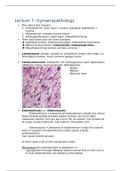
Leiomyosarcoma: malignant, not homogeneous upon appearance
(different colors) macroscopically. Histologically:
Atypia
Mitosis
Necrosis seen
Endometriosis v.s. Adenomyosis:
Endometriosis = presence of endometrium outside the uterus
Signs include spread of tubes and/or stroma, can occur after
caesarean section, but can also occur for no reason. Can spread up
to lungs, lymph nodes etc. Can lead to “chocolate cyst”
Adenomyosis = presence of endometrium inside the uterine
wall (= invasion of endometrium inside causes a bulky
endometrium)
Can cause menstrual pain
In both cases a lot of iron and blood is seen
Mechanism for endometriosis in abdomen =>
- regurgitation through fallopian tubes (normal flow is from out to
in, but endometriosis can spread up the tubes)
, - pelvic veins allow it to grow extrapelvic
- lymph nodes
Endometrial polyps: can sometime transform into malignant
Risk factors:
- Obesity
- Tamoxifen use
- Menopause
Hyperplastic endometrium is when lots of (benign) polyps are
seen
Atypical hyperplasia = high risk for cancer hyperplasia.
Characterized by:
- Too much epithelium compared to glands and stroma.
- Too many nuclei in endothelium (indicative of abnormal mitosis)
Usual solution is hysterectomy, unless patient is too obese to
operate on. For younger females, they might opt to keep their
uterus.
Endometrial carcinoma = arises from inner lining of uterus, most
common type of malignant tumor is endometrioid adenocarcinoma
(80%), serous carcinoma and clear cell carcinoma.
Risk factors match those of polyps (obesity, diabetes, hypertension,
fertility), but also include estrogen exposure and germline mutations
Symptom = post-menopausal bleeding
Clinical course depends on the tumor stage and how and where it
has spread. Also on Grades:
Endometroid adenocarcinoma:
Grade 1: well differentiated (glands and original tissue is defined)
Grade 2: moderately differentiated
Grade 3: poorly differentiated
Serous and clear cell carcinoma are always Grade 3
These carcinomas are generally Grade 1, can have squamous or
mucinous differentiation (not in Serous and clear cell carcinoma).
Have low mitotic activity.
Immunological staining markers: p53 (is normally expression in this
kind), PAX8+, ER+, PR+, loss of PTEN and mismatch repair genes.
Here you see
glandular
formulation, and
good squamous
differentiation
Solid growth is less
than 5%
, Serous carcinoma: has a lot of nuclear pleomorphism, an atrophic
background not hyperplastic
Immunological staining = abnormal p53 (either complete loss or
abnormal), p16+, ER-/+, WT-/+
Clear cell carcinoma: clear cells with distinct borders (glycogen+),
hobnailing (nucleus protrudes into surrounding)
Immunological staining = lower ER & PR, p16 and p53
Molecular classification of endometrial cancers:
Most common HPV related cancer is cervical cancer. Head-neck
and oropharynx tumors are also HPV related. But HPV doesn’t just
cause cancers, it can also cause genital warts, precancers etc
HPV (Human Papillomavirus):
- double stranded virus, with 6 early and 2 late ORFs
- It doesn’t circulate in blood but affects epithelial sites (= strictly
epitheliotropic)
- There are 50 genital types, both low risk (= 6 and 11) and high
risk (= 16, 18, 31, 33 and 45).
- Life-time risk is around 80%, but 20% get a CIN (=cervical
intraepithelial neoplasia, is a small cervical lesion), and 2-3%
develop cervical cancer (RARE)
The uterus has 3 layers:
1. Endometrium: inner layer, mucosa, glandular epithelium +
stroma
2. Myometrium: smooth muscle tissue
3. Serosa/peritoneum: outer layer, mesothelial lining
From each layer you can have diseases:
Epithelial tumors: endometrial polyp, endometrial carcinoma
Mesenchymal tumors: leiomyomas, leiomyosarcoma
Mesothelial lining tumors are less common
Leiomyomas: benign, usually no complaints unless very large, no
histological marker, most common benign tumor
Leiomyosarcoma: malignant, not homogeneous upon appearance
(different colors) macroscopically. Histologically:
Atypia
Mitosis
Necrosis seen
Endometriosis v.s. Adenomyosis:
Endometriosis = presence of endometrium outside the uterus
Signs include spread of tubes and/or stroma, can occur after
caesarean section, but can also occur for no reason. Can spread up
to lungs, lymph nodes etc. Can lead to “chocolate cyst”
Adenomyosis = presence of endometrium inside the uterine
wall (= invasion of endometrium inside causes a bulky
endometrium)
Can cause menstrual pain
In both cases a lot of iron and blood is seen
Mechanism for endometriosis in abdomen =>
- regurgitation through fallopian tubes (normal flow is from out to
in, but endometriosis can spread up the tubes)
, - pelvic veins allow it to grow extrapelvic
- lymph nodes
Endometrial polyps: can sometime transform into malignant
Risk factors:
- Obesity
- Tamoxifen use
- Menopause
Hyperplastic endometrium is when lots of (benign) polyps are
seen
Atypical hyperplasia = high risk for cancer hyperplasia.
Characterized by:
- Too much epithelium compared to glands and stroma.
- Too many nuclei in endothelium (indicative of abnormal mitosis)
Usual solution is hysterectomy, unless patient is too obese to
operate on. For younger females, they might opt to keep their
uterus.
Endometrial carcinoma = arises from inner lining of uterus, most
common type of malignant tumor is endometrioid adenocarcinoma
(80%), serous carcinoma and clear cell carcinoma.
Risk factors match those of polyps (obesity, diabetes, hypertension,
fertility), but also include estrogen exposure and germline mutations
Symptom = post-menopausal bleeding
Clinical course depends on the tumor stage and how and where it
has spread. Also on Grades:
Endometroid adenocarcinoma:
Grade 1: well differentiated (glands and original tissue is defined)
Grade 2: moderately differentiated
Grade 3: poorly differentiated
Serous and clear cell carcinoma are always Grade 3
These carcinomas are generally Grade 1, can have squamous or
mucinous differentiation (not in Serous and clear cell carcinoma).
Have low mitotic activity.
Immunological staining markers: p53 (is normally expression in this
kind), PAX8+, ER+, PR+, loss of PTEN and mismatch repair genes.
Here you see
glandular
formulation, and
good squamous
differentiation
Solid growth is less
than 5%
, Serous carcinoma: has a lot of nuclear pleomorphism, an atrophic
background not hyperplastic
Immunological staining = abnormal p53 (either complete loss or
abnormal), p16+, ER-/+, WT-/+
Clear cell carcinoma: clear cells with distinct borders (glycogen+),
hobnailing (nucleus protrudes into surrounding)
Immunological staining = lower ER & PR, p16 and p53
Molecular classification of endometrial cancers:
Most common HPV related cancer is cervical cancer. Head-neck
and oropharynx tumors are also HPV related. But HPV doesn’t just
cause cancers, it can also cause genital warts, precancers etc
HPV (Human Papillomavirus):
- double stranded virus, with 6 early and 2 late ORFs
- It doesn’t circulate in blood but affects epithelial sites (= strictly
epitheliotropic)
- There are 50 genital types, both low risk (= 6 and 11) and high
risk (= 16, 18, 31, 33 and 45).
- Life-time risk is around 80%, but 20% get a CIN (=cervical
intraepithelial neoplasia, is a small cervical lesion), and 2-3%
develop cervical cancer (RARE)



