

Geschreven door studenten die geslaagd zijn Direct beschikbaar na je betaling Online lezen of als PDF Verkeerd document? Gratis ruilen 4,6 TrustPilot
logo-home
Document preview thumbnail
Voorbeeld 3 van de 17 pagina's
Tentamen (uitwerkingen)

CHEM120/ CHEM120 Exam 3 V2 (2026/2027 Update) – General, Organic & Biological Chemistry | Questions & Answers | Verified Solutions | Chamberlain

Document preview thumbnail
Voorbeeld 3 van de 17 pagina's

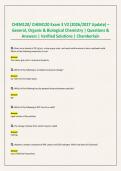
…..DLDD CHEM120/ CHEM120 Exam 3 V2 (2026/2027 Update) – General, Organic & Biological Chemistry | Questions & Answers | Verified Solutions | Chamberlain Q. Silver has a density of 10.5 g/mL, a silvery-gray color, and reacts with bromine to form a yellowish solid. Which of the following statements is true? Answer The silvery-gray color is a physical property Q. Which of the following is considered a physical change? Answer Ice melts to form liquid water. Q. Which of the following has the greatest distance between particles? Answer gas Q. Which of the following is NOT true for a solid? Answer rapid motion of the particles Q. The change of phase from solid to liquid is called Answer melting Q. Heptane is always composed of 84% carbon and 16% hydrogen. Which law does this illustrate? Answer Law of Definite Proportions Q. How does Dalton's atomic theory explain that compounds always have the same mass ratio of elements (such as silver sulfide always being 7 parts silver and 1 part sulfide by weight) Answer Compounds are formed by atoms combining in fixed proportions. Q. In the following balanced reaction: CH3CH2OH + 3 O2 -- 2 CO2 + 3 H2O how many H atoms are in the products? Answer 6 Q. Increasing the concentration of a reaction (for example, using a 10% solution instead of a 5% solution) would affect the rated of a reaction in what way? Answer It would increase the rate Q. When you have a cold or flu, often your body temperature rises (you have a fever). Your body is Answer speeding up reactions to attack and destroy the bacteria Q. The function of a catalyst is to Answer increase the rate of reaction Q. A catalyst is distinguished by Answer having the same amount present at the end of the reaction as there was before the reaction Q. Exothermic reactions Answer release heat Q. Avogadro's number is the number of Answer particles in one mole of a substance Q. How many atoms of C are in 1 mole of CO2 Answer 6.02 x 10²³ Q. Which of the following contains the largest number of carbon atoms? Answer 1 mole of C6H12O6 Q. The molar mass of a substance is defined as: Answer the number of grams in one mole of that substance Q. What is the mass of a mole of sodium atoms (Na)? Answer 23g Q. To make octane (gasoline), 8 grams of carbon need to react with 3 grams of hydrogen. How many grams of hydrogen would be needed to react with 24 grams of carbon? Answer 9g Q. To make octane (gasoline), 8 grams of carbon need to react with 3 grams of hydrogen. How many grams of octane could be made from 24 grams of carbon and the proper amount of hydrogen? Answer 33g Q. What is the correct coefficient for O2 the following reaction? Answer ___ Fe + ___ O2 -- ___ Fe3O4 2 Q. Answer ___ Cu + ___ AgNO3 -- ___ Cu(NO3)2 + ___ Ag 1 Q. What is the correct coefficient for N2 in the following reaction? Answer ___ H2 + ___ N2 -- ___ NH3 1 Q. What is the correct coefficient for Al in the following reaction? Answer ___ Al + ___ O2 -- Al2O3 4 Q. What is the molar mass of Ca(C2H3O2)2? Answer 158.18 g/mol Q. What is the molar mass of H2SO4? Answer 98.08 g/mol Q. The molar mass of CaCl2 is 111.16 g/mol. Answer 4.3 moles Q. Vitamins contain FeSO4. How many grams of FeSO4 is 0.1 mole? The molar mass of FeSO4 is 151.91 g/mol. Answer 15.19g Q. Using the following balanced equation: Answer Ca3P2 + 6 H2O -- 2 PH3 + 3 Ca(OH)2 Q. How many moles of H2O would be needed to react with 6 moles of Ca3P2? Answer 36moles Q. Using the following balanced equation: Answer Ca3P2 + 6 H2O -- 2 PH3 + 3 Ca(OH)2 Q. How many moles of PH3 would be produced in the reaction (still using 6 moles of Ca3P2)? Answer 12 moles Q. How are molecular orbitals constructed? Answer Mixing atomic orbitals Q. The mixing of n Atomic orbitals creates ___ Molecular orbitals Answer n Q. Constructive combination of orbitals leads to a _________ molecular orbital with ________ energy than the atomic orbitals Answer bonding; lower Q. destructive combination of orbitals leads to a _________ molecular orbital with ________ energy than the atomic orbitals Answer antibonding, higher Q. Each MO holds ___ electrons with ____ spins Answer 2; opposite Q. Bond order = Answer 1/2(# of bonding electrons - # of antibonding electrons) Q. A higher bond order means Answer Stronger shorter bonds Q. if bond order is 0 no bond will form Answer bond order = 1 bond order = 2 bond order = 3 single bond double bond triple bond Q. Draw MO diagram and give bond order of of H2; H2-;He2; Li2 Answer done Q. a substance is paramagnetic if __________. This means it is ________ Answer it has unpaired electrons; attracted to an applied magnetic field Q. a substance is dimagnetic if __________. This means it is ________ Answer it has paired electrons; repelled from an applied magnetic field Q. Average mass = Answer (total mass of atoms in sample ) /(# of atoms in sample) Q. isotopes of the same element Answer have different atomic masses Q. if Cu-63 has a mass of 62.93 and an abundance of 69.09% and Cu-65 has a mass of 64.90 and an abundance of 30.91% what mass is displayed on the periodic table? Answer 63.55 Q. Silver has two naturally occurring isotopes with the following isotopic masses: Ag 108.9047 amu Ag 106.90509 amu. The average atomic mass of silver is 107.8682 amu. What is the percentage abundance of the lighter of the two isotopes? Answer 51.84% Q. Formula mass- Answer the sum of the atomic masses for the atoms in a chemical formula Q. Formula mass of CaCl2 Answer 110.99 amu Q. Molecular mass Answer The formula mass of a molecular compound Q. 1 mol Answer 6.02 X 10^23 Q. Calculate number of ethanol molecules in 1.25 mol of ethanol (C2H6O). Answer 7.53 x 10^23 C2H6O molecules Q. Molar mass Answer the mass in grams of one mole of a substance (g/mol) Q. Molar mass is ___________ formula mass Answer equal to Q. To convert from grams to moles you _________ by the __________ Answer divide by; Molar mass To convert from moles to grams you _________ by the __________ multiply by; molar mass Calculate the mass of 0.200 mol of MgCl2. 19.0 g MgCl2 To convert from grams to formula units use molar mass to convert to moles then avogadro's number to convert to formula units Calculate the number of CO2 molecules in a 10.8 g sample. 1.48 x 10²³ CO2 molecules How many moles of each atom are in C3H8O3 3 mol C atoms, 8 mol H atoms, 3 mol O atoms How many grams of nitrogen are present in 46.34 g of NH4NO3? 16.22 g N Calculate moles of CaCl2, Ca2+ ions and Cl- ions, and number of CaCl2units and Cl- ions in a 1.38 g sample of CaCl2. 0.0124 mol CaCl2 0.0124 mol of Ca2+ 0.0248 mol of Cl- 7.46 x 10²¹CaCl2 formula units 1.49 x 10²²Cl- ions What is the mass percent of C in ethanol (C2H5OH) (molar mass = 46.07 g/mol)? 52.14% To calculate empirical formulas 1.Calculate the mass of each element (unless given) 2.Convert mass to moles by using molar mass of each element. 3.Divide all by the smallest number of moles 4.Multiply all mole ratios by a number to make all whole numbers. Determine the empirical formulas for a compound that gives the following percentages on analysis (in mass percent): 71.65% Cl; 24.27% C; 4.07% H Empirical formula: ClCH2 Combustion analysis is used for compounds containing ___, ____, and _____ C, H, and O In combustion C is determined by the_________. H is determined by the___________ O is determined by the mass of CO2 produced mass of H2O produced difference in mass after the C and H have been determined. Isopropyl alcohol, sold as rubbing alcohol, is composed of C, H, and O. Combustion of 0.255 g of isopropyl alcohol produces 0.561 g of CO2 and 0.306 g of H2O. Determine the empirical formula of isopropyl alcohol. C3H8O formula for Molecular formula molecular formula = empirical formula * n where n = molar mass/ empirical formula molar mass Chemical equation a shorthand description of a chemical reaction using symbols and formulas to represent the compounds involved in a chemical equation coefficients tell the number of formula units or molecules in a chemical equation subscripts tell the number of atoms of each element in a molecule or formula unit When balancing equations apply the ________, with which you _____________ law of conservation of mass; balance eqs by balancing atoms Balance the following equations:• H2 (g) + O2 (g) -- H2O (l) • Na (s) + H2O -- NaOH (aq) + H2 (g)• Co2O3 (s) + C (s) -- Co (s) + CO2 (g)• Ca(OH)2 (aq)+ H3PO4(aq)- Ca3(PO4)2(aq) + H2O(l) 2 H2 (g) + O2 (g) -- 2H2O (l) • 2 Na (s) + 2H2O -- 2NaOH (aq) + H2 (g)• Co2O3 (s) + 3 C (s) -- 3Co (s) + CO2 (g)• 3Ca(OH)2 (aq)+ 2H3PO4(aq)-- Ca3(PO4)2(aq) + 6H2O(l) Combustion reaction the reaction of a substance with O2 to form one or more oxygen containing compounds, often with water Combustion of C2H5OH C2H5OH (l) + O2 (g) -- CO2(g) + 3H2O(g) When balancing a combustion reaction start with ___, then ___, then ___ C; H; O In a balanced chemical equation the coefficients represent the ratio of moles of reactants and products stoichiometry study of numerical relationship between chemical quantities in a chemical reaction How many moles of O2 are required to react with 6.48 mol of NH3 completely in the reaction4 NH3 (g) + 5 O2 (g) -- 4 NO (g) + 6 H2O (l)? 8.10 mol O2 How many grams of water are produced in the oxidation of 1.00 g of glucose, C6H12O6? C6H12O6 + 6 O2-- 6 CO2 + 6 H2O 0.600 g H2O Limiting reactant the reactant that limits the amount of product in a chemical reaction; the reactant that makes the least amount of product Determine the amount of excess reactant left over in the reaction 2 H2 (g) + O2(g) --2 H2O (g) 0.5 mol O2 Theoretical yield the amount of product that can be made in a chemical reaction based on the amount of limiting reactant actual yeild amount of product actually produced by a chemical reaction percent yield actual yield/theoretical yield x 100 The limiting reactant can be determined by _________ or _______ quantities of products formed or reactant quantities N2(g) + 3 H2(g) 2 NH3(g)If 4 mol N2react with 6 mol H2, which is the limiting reactant? How many moles of NH3 will be produced? 4 Mol NH3 Ammonia, NH3, can be synthesized by the reaction:2 NO(g) + 5 H2(g) 2 NH3(g) + 2 H2O(g)When 86.3 g NO reacts with 25.6 g H2, 40.5 g NH3is produced. Find the limiting reactant, theoretical yield in grams, and percent yield. 49 g NH3 82.7% Ammonia, NH3, can be synthesized by the reaction:2 NO(g) + 5 H2(g) 2 NH3(g) + 2 H2O(g)When 86.3 g NO reacts with 25.6 g H2, 40.5 g NH3is produced. What amount (in grams) of excess reactant remains? 11.1 g H2 When water dissolves salt ions are __________ hydrated NaCl dissolves in water NaCl (aq) -- Na+ (aq) + Cl- (aq) Solubility of Ionic Compounds depends on attraction of ions to each other and water molecules When water interacts with ethanol _____ ions form no a solute is a dissolved substance liquid water is a solvent the electrical conductivity of a solution refers to the ability of that solution to conduct electricity Nonelectrolytes substances that dissolve in water to form a solution that does not conduct electricity/ form an ions electrolytes substances that dissolve in water to form a solution that does conduct electricity strong electrolytes substances that are completely ionized upon dissolution; types of strong electrolytes soluble ionic compounds, strong acids, strong bases upon dissolution strong acids completely ionize to form H+ ions upon dissolution strong bases completely ionize to form OH- ions Common strong acids Hydrochloric acid (HCl) Hydrobromic acid (HBr) Hydroiodic acid (HI) Perchloric acid (HClO4) Nitric acid (HNO3) Sulfuric acid (H2SO4) Common strong bases Group 1A metal hydroxides: LiOH, NaOH, KOH, RbOH, CsOH Heavy group 2A metal hydroxides: Ca(OH)2, Sr(OH)2, Ba(OH)2 Weak electrolytes substances that are partially ionized upon dissolution Weak electrolyte types Weak acids, weak bases upon dissolution weak acids are partially ionized to produce H+ ions upon dissolution weak bases are partially ionized to produce OH- ions When Nonelectrolytes are dissolved Molecules are _______ but do not __________ dispersed; break up into ions Molarity definition the amount of solute in moles in one liter of solution molarity formula amount of solute (mol) / volume of solution (L) Calculate the molarity of a solution containing 10.0 g NaCl in 250 mL solution. 0.683 mol/L How many milliliters of 0.50 M Na2SO4 solution are needed to provide 0.038 mol of this salt? 76 mL What are the molar concentrations of Na+ ions and Cl-ions in a 1.0 M aqueous solution of NaCl? 1 M NaCl 1 M Na+ ! M Cl- What are the molar concentrations of Na+ ions and SO42-ions in a 1.0 M aqueous solution of Na2SO4? 1 M Na2SO4 2 M Na + 1 M SO4 2- How to prepare 1.00 L of a 0.200 M K2Cr2O7 (potassium dichromate) solution? 1. 2. 1.Add 58.8 g K2Cr2O7 to 1.00 L volumetric flask− 2.Add enough water to make 1.00 L solution. Molarity formula M1V1=M2V2 How do we prepare 500.0 ml of 1.00 M acetic acid (CH3COOH) solution from a 17.4 M stock solution of acetic acid? 28.7 mL What are the concentrations of each ion in a mixture of 45.0 mL of 0.272 M NaCl and 65.0 mL of 0.0247 M Na2CO3? [Cl-] = 0.111 M; [CO32-] = 0.0146 M [Na+] = 0.140 M Types of Solution reactions precipitation, acid-base, oxidation-reduction precipitation reaction 2 aq reactants produce 1 aq and 1 insoluble (s) product Predict what will happen when aqueous solutions of Na2SO4 and Pb(NO3)2 are mixed Na2SO4 (aq) + Pb(NO3)2 (aq) -- PbSO4 (s) + 2NaNO3 (aq) Predict what will happen when aqueous solutions of KNO3 and BaCl2 are mixed Since both Ba(NO3)2 and KCl are soluble in water, there is no reaction. Net ionic equation shows only the species that actually take part in the reaction Spectator ions species that do not change in equation Steps to write a net ionic equation 1.Write a balanced formula equation. 2.All strong electrolytes (soluble salts, strong acids and strong bases) are written as ions. Insoluble substances, weak electrolytes and nonelectrolytes are written in molecules. 3.Cross out anything that remains unchanged (spectator ions) from the left side to the right side of the equation. 4.Write the net ionic equation with the species that remain. What volume (in L) of 0.150 M KCl solution will completely react with 0.150 L of a 0.175 M Pb(NO3)2solution? How many grams of precipitate will form? 7.30 g PbCl2 Acids substances that ionize in water to form H+ ions common acids Strong: HCl, HNO3, H2SO4 weak: CH3COOH monoprotic acid an acid that can donate only one proton (hydrogen ion) per molecule ex. HCl, HNO3, CH3COOH diprotic acids Acids that contain two ionizable hydrogens Ex: H2SO4 bases Subtstances that produce OH- ions in a solution common bases NaOH, KOH, Ca(OH)2,NH3 Acid-base (neutralization) reaction an acid reacts with a base and the two neutralize each other, producing water and a salt salt ionic compound whose cation comes from a base and whose anion comes from an acid Net ionic equation of H2SO4(aq)+ NaOH (aq)-- H+(aq)+ OH-(aq)-- H2O (l) Net ionic equation of CH3COOH (aq)+ KOH (aq)-- CH3COOH (aq)+ OH-(aq)--CH3COO- (aq) H2O (l) titration analytical technique in which one can calculate the concentration of a solute in a solution in a titration the equivalence point is when moles of H+ = Moles of OH- What is the molarity of a H2SO4 solution if 22.46 mL is needed to neutralize 24.18 mL of 0.2014 M NaOH solution? 0.1084 M An environmental chemist analyzed the effluent (the released waste material) from an industrial process known to produce the compounds carbon tetrachloride (CCl4) and benzoic acid (HC7H5O2), a weak acid that has one acidic hydrogen atom per molecule. A sample of this effluent weighing 0.3518 g was shaken with water, and the resulting aqueous solution required 10.59 mL of 0.1546 M NaOH for neutralization. Calculate the mass percent of HC7H5O2 in the original sample 1.67 X 10^-3 mol OH- 0.1999 g HC7H5O2 56.82% Oxidation when an atom loses electrons Reduction when an atom gains electrons Oxidation-reduction (or redox)reactions electrons are transferred from one reactant to another Oxidation state/number number assigned to each element in a reaction to determine the electron flow Rules for assigning oxidation state An atom in an element is 0 ex. Na(s) a monatomic ion is the same as it's charge ex. Na+ Fluorine is -1 in it's compounds ex. HF Oxygen is -2 in it's compounds save for peroxides (O2 2+) where it is -1 ex. H2O Hydrogen is +1 in it's covalent compounds ex. HCl Oxidation-reduction reaction CH4 + 2O2 -- CO2 + 2H2O C in CH4 is oxidized. CH4 is a reducing agent.•O in O2 is reduced. O2 is an oxidizing agent balance the Oxidation-reduction reaction PbO(s) + NH3 (g) -- N2 (g) + H2O (l) + Pb(s) 3PbO(s) + 2NH3 (g) -- N2 (g) + 3H2O (l) + 3Pb(s)

Voorbeeld van de inhoud

…..DLDD\\\\\\\

CHEM120/ CHEM120 Exam 3 V2 (2026/2027 Update) –
General, Organic & Biological Chemistry | Questions &
Answers | Verified Solutions | Chamberlain

Q. Silver has a density of 10.5 g/mL, a silvery-gray color, and reacts with bromine to form a yellowish solid.
Which of the following statements is true?

Answer
The silvery-gray color is a physical property


Q. Which of the following is considered a physical change?
Answer
Ice melts to form liquid water.


Q. Which of the following has the greatest distance between particles?
Answer
gas


Q. Which of the following is NOT true for a solid?
Answer
rapid motion of the particles


Q. The change of phase from solid to liquid is called
Answer
melting


Q. Heptane is always composed of 84% carbon and 16% hydrogen. Which law does this illustrate?
Answer
Law of Definite Proportions

,Q. How does Dalton's atomic theory explain that compounds always have the same mass ratio of elements
(such as silver sulfide always being 7 parts silver and 1 part sulfide by weight)

Answer
Compounds are formed by atoms combining in fixed proportions.


Q. In the following balanced reaction: CH3CH2OH + 3 O2 --> 2 CO2 + 3 H2O how many H atoms are in the
products?

Answer
6


Q. Increasing the concentration of a reaction (for example, using a 10% solution instead of a 5% solution)
would affect the rated of a reaction in what way?

Answer
It would increase the rate


Q. When you have a cold or flu, often your body temperature rises (you have a fever). Your body is
Answer
speeding up reactions to attack and destroy the bacteria


Q. The function of a catalyst is to
Answer
increase the rate of reaction


Q. A catalyst is distinguished by
Answer
having the same amount present at the end of the reaction as there was before the reaction


Q. Exothermic reactions
Answer
release heat

, Q. Avogadro's number is the number of
Answer
particles in one mole of a substance


Q. How many atoms of C are in 1 mole of CO2
Answer
6.02 x 10²³


Q. Which of the following contains the largest number of carbon atoms?
Answer
1 mole of C6H12O6


Q. The molar mass of a substance is defined as:
Answer
the number of grams in one mole of that substance


Q. What is the mass of a mole of sodium atoms (Na)?
Answer
23g


Q. To make octane (gasoline), 8 grams of carbon need to react with 3 grams of hydrogen. How many grams
of hydrogen would be needed to react with 24 grams of carbon?

Answer
9g


Q. To make octane (gasoline), 8 grams of carbon need to react with 3 grams of hydrogen. How many grams
of octane could be made from 24 grams of carbon and the proper amount of hydrogen?

Answer
33g

Documentinformatie

Geüpload op
18 maart 2026
Aantal pagina's
17
Geschreven in
2025/2026
Type
Tentamen (uitwerkingen)
Bevat
Vragen en antwoorden
€11,10

Verkeerd document? Gratis ruilen Binnen 14 dagen na aankoop en voor het downloaden kun je een ander document kiezen. Je kunt het bedrag gewoon opnieuw besteden.
Geschreven door studenten die geslaagd zijn
Direct beschikbaar na je betaling
Online lezen of als PDF

Verkocht
4
Volgers
0
Items
374
Laatst verkocht
3 maanden geleden


Echte notities, van echte studenten
Elk document op Stuvia is geschreven door een medestudent die hetzelfde vak deed. Zo leer je van iemand die het al heeft gehaald.


Waarom studenten kiezen voor Stuvia

Gemaakt door medestudenten, geverifieerd door reviews

Kwaliteit die je kunt vertrouwen: geschreven door studenten die slaagden en beoordeeld door anderen die dit document gebruikten.

Niet tevreden? Kies een ander document

Geen zorgen! Je kunt voor hetzelfde geld direct een ander document kiezen dat beter past bij wat je zoekt.

Betaal zoals je wilt, start meteen met leren

Geen abonnement, geen verplichtingen. Betaal zoals je gewend bent via iDeal of creditcard en download je PDF-document meteen.

Student with book image

“Gekocht, gedownload en geslaagd. Zo makkelijk kan het dus zijn.”

Alisha Student

Bezig met je bronvermelding?

Maak nauwkeurige citaten in APA, MLA en Harvard met onze gratis bronnengenerator.

Bezig met je bronvermelding?

Veelgestelde vragen

