
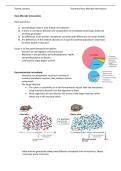
Tijmen Lourens Summary Host-Microbe Interactions
Host-Microbe Interactions
Main questions:
1) Do individuals share a core human microbiome?
2) Is there a correlation between the composition of microbiota colonizing a body site
and host genotype?
3) Do difference in the human microbiome correlate with differences in human health?
4) Are differences in the relative abundance of specific bacterial populations important
to either health or disease?
Focus is on the gastrointestinal microbiota
- Humans are monogastric and omnivorous
- Microbes in the gut affect early development, health,
and predisposition to disease
- Colonization of gut begins at birth
Gastrointestinal microbiota:
- Intestinal microorganisms carry out a variety of
essential metabolic reactions that produce various
compounds.
- The large intestine:
• The colon is essentially an in vivo fermentation vessel, with the microbiota
using nutrients derived from the digestion of food
• Most organisms are restricted to the lumen of the large intestine, while
others are in the mucosal layers
,Tijmen Lourens Summary Host-Microbe Interactions
Lecture 2: 16S rRNA gene sequencing (8 – 12); Illumina sequencing; shotgun
sequencing
Shotgun sequencing:
- Sequence all the DNA in the environment, the ‘biome’
Delivers:
- Taxonomic distribution over all kingdoms and viruses (not
only one thing)
- Microbial strain information
- Functional analysis, metabolic pathways
1) Study design and experimental protocol. The importance of this step is often
underestimated in metagenomics.
2) Computational pre-processing. Computational quality control (QC) steps minimize
fundamental sequence biases or artifacts such as removal of sequencing adaptors,
quality trimming, removal of sequencing duplicates (using for example, FastQC,
Trimmomatic121 of Picard tools). Foreign or non-target DNA sequences are also
filtered, and samples are subsampled to normalize read numbers if the diversity of
taxa or functions is compared.
3) Sequence analysis: this should comprise a combination of ‘read-based’ and
‘assembly-based’ approaches depending on the experimental objectives. Both
approaches have advantages and limitations.
4) Post-processing: various multivariate statistical techniques can be used to interpret
the data.
5) Validation: conclusions from high-dimensional biological data are susceptible to
study-driven biases, so follow-up analyses are vital.
,Tijmen Lourens Summary Host-Microbe Interactions
The contribution of diet to modulating the microbiota and its crucial role in orchestrating the
host–microbiota crosstalk is evident from the beginning of life;
• Early life:
- Human milk oligosaccharides (HMOs) participate in the maturation of the microbiota
in early infancy,
- Introduction of solid food increases bacterial richness,
• Members of the gut microbiota are not only sensitive to proportions of certain
dietary constituents but also respond differently to nutrition. Such microbial
response will eventually reflect on the host physiology and behaviour.
, Tijmen Lourens Summary Host-Microbe Interactions
Type 1 diabetes is increasing in developed countries. Genetic and environmental factors
are involved. (In Finland)
- The abundance of the specific Bifidobacterium bifidum (or longdon) is in Russia much
higher than in Estonia and really higher than in Finland. So having the right
Bifidobacterium seems to be protective against diabetes.
• Hygiene hypothesis: the early gut microbiome is characterized by early
heterogeneity of Bifidobacterium species and individualized accrual of taxa
over time, is this disturbed?
• Antibiotics really disturb the
colonization on the baby.
Host-Microbe Interactions
Main questions:
1) Do individuals share a core human microbiome?
2) Is there a correlation between the composition of microbiota colonizing a body site
and host genotype?
3) Do difference in the human microbiome correlate with differences in human health?
4) Are differences in the relative abundance of specific bacterial populations important
to either health or disease?
Focus is on the gastrointestinal microbiota
- Humans are monogastric and omnivorous
- Microbes in the gut affect early development, health,
and predisposition to disease
- Colonization of gut begins at birth
Gastrointestinal microbiota:
- Intestinal microorganisms carry out a variety of
essential metabolic reactions that produce various
compounds.
- The large intestine:
• The colon is essentially an in vivo fermentation vessel, with the microbiota
using nutrients derived from the digestion of food
• Most organisms are restricted to the lumen of the large intestine, while
others are in the mucosal layers
,Tijmen Lourens Summary Host-Microbe Interactions
Lecture 2: 16S rRNA gene sequencing (8 – 12); Illumina sequencing; shotgun
sequencing
Shotgun sequencing:
- Sequence all the DNA in the environment, the ‘biome’
Delivers:
- Taxonomic distribution over all kingdoms and viruses (not
only one thing)
- Microbial strain information
- Functional analysis, metabolic pathways
1) Study design and experimental protocol. The importance of this step is often
underestimated in metagenomics.
2) Computational pre-processing. Computational quality control (QC) steps minimize
fundamental sequence biases or artifacts such as removal of sequencing adaptors,
quality trimming, removal of sequencing duplicates (using for example, FastQC,
Trimmomatic121 of Picard tools). Foreign or non-target DNA sequences are also
filtered, and samples are subsampled to normalize read numbers if the diversity of
taxa or functions is compared.
3) Sequence analysis: this should comprise a combination of ‘read-based’ and
‘assembly-based’ approaches depending on the experimental objectives. Both
approaches have advantages and limitations.
4) Post-processing: various multivariate statistical techniques can be used to interpret
the data.
5) Validation: conclusions from high-dimensional biological data are susceptible to
study-driven biases, so follow-up analyses are vital.
,Tijmen Lourens Summary Host-Microbe Interactions
The contribution of diet to modulating the microbiota and its crucial role in orchestrating the
host–microbiota crosstalk is evident from the beginning of life;
• Early life:
- Human milk oligosaccharides (HMOs) participate in the maturation of the microbiota
in early infancy,
- Introduction of solid food increases bacterial richness,
• Members of the gut microbiota are not only sensitive to proportions of certain
dietary constituents but also respond differently to nutrition. Such microbial
response will eventually reflect on the host physiology and behaviour.
, Tijmen Lourens Summary Host-Microbe Interactions
Type 1 diabetes is increasing in developed countries. Genetic and environmental factors
are involved. (In Finland)
- The abundance of the specific Bifidobacterium bifidum (or longdon) is in Russia much
higher than in Estonia and really higher than in Finland. So having the right
Bifidobacterium seems to be protective against diabetes.
• Hygiene hypothesis: the early gut microbiome is characterized by early
heterogeneity of Bifidobacterium species and individualized accrual of taxa
over time, is this disturbed?
• Antibiotics really disturb the
colonization on the baby.



