Lecture 3.1 – case 8 behaviour
Self- study:
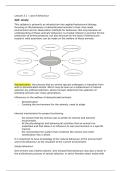
This syllabus is primarily an introduction into applied behavioural biology,
focusing on the behaviour of domesticated animals in their man-made
environment and on observation methods for behaviour. Not only because an
understanding of these animals' behaviour is of great interest in practice for the
production of animal products, but also because on the basis of behavioural
research valid assertions can be made on the welfare of these animals.
Domestication: the process that an animal species undergoes in transition from
wild to domesticated animal. Which may be seen as a replacement of natural
selection by artificial selection, where humans determine the selection of
breeding animals over many generations.
Influences on the welfare of domesticated animals:
- Domestication
- Creating the environment for the animals, need to adapt
Internal mechanisms for proper functioning:
- the senses that the animal uses to probe its internal and external
environment.
- all the physiological and behavioural activities that an animal can
undertake and that allow it to influence its own environment in a specific
manner.
- the neuroendocrine system that combines the senses and motor
coordination into a whole.
It is important to have knowledge of the natural behaviour of the animal itself
and of its behaviour as the resultant of the current environment.
Study behaviour:
One of them was Charles Darwin, who showed that behaviour was also a factor in
the evolutionary process of sexual selection, in which females select males with
Self- study:
This syllabus is primarily an introduction into applied behavioural biology,
focusing on the behaviour of domesticated animals in their man-made
environment and on observation methods for behaviour. Not only because an
understanding of these animals' behaviour is of great interest in practice for the
production of animal products, but also because on the basis of behavioural
research valid assertions can be made on the welfare of these animals.
Domestication: the process that an animal species undergoes in transition from
wild to domesticated animal. Which may be seen as a replacement of natural
selection by artificial selection, where humans determine the selection of
breeding animals over many generations.
Influences on the welfare of domesticated animals:
- Domestication
- Creating the environment for the animals, need to adapt
Internal mechanisms for proper functioning:
- the senses that the animal uses to probe its internal and external
environment.
- all the physiological and behavioural activities that an animal can
undertake and that allow it to influence its own environment in a specific
manner.
- the neuroendocrine system that combines the senses and motor
coordination into a whole.
It is important to have knowledge of the natural behaviour of the animal itself
and of its behaviour as the resultant of the current environment.
Study behaviour:
One of them was Charles Darwin, who showed that behaviour was also a factor in
the evolutionary process of sexual selection, in which females select males with