06-01-2025
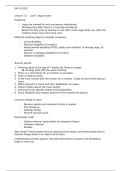
Lecture 1.1 - case 7 dog/ senses
Hulphond
- dogs are trained for only one person individually.
- Old dogs stay after there is a new dog introduced.
- Before the first year of training is over 40% of the dogs drops out, after the
medical check even more drop outs.
Different assisting dogs for multiple occasions:
- Visual disability
- Physical disability (8 months)
- Mental health disability (PTSD, adults and children) therapy dogs (6
months)
- Seizure or epilepsy disability (6 months)
- Diabetes disability
Training period:
1. Training starts at the age of 7 weeks old. Bred or bought.
All dogs start with the same training.
2. Then, in a host family for 12 months, to socialize.
3. Then a medical check.
4. In the main facility with the trainer for 2 months. To get to know what dog you
have.
5. Match dog with a client and their disabilities, on paper.
6. Clients meets dog at the main facility.
7. Training for the specific needs of the disabilities.
8. Every disability has another period of time (mentioned above).
Common things to learn:
- Receive signals and respond to them in signals
- Pick things up
- Gettings things
- Touch pull and push
Dog breeds used:
- Golden retriever (more likely for diseases/ illness)
- Labrador retriever
- Poodles
Why these? These breeds have an ideal physical height, and there breeds like to
retrieve things which is an ideal trait to learn.
Crossbreeding creates genetic diversity (less physical issues) and inbreeding
leads to more etc.
, 06-01-2025
Self- study material:
Pavlov experiment
Training a dog to associate a certain stimulus with a certain response.
Classical condition: a response that was originally elicited by one stimulus can
now be elicited by another stimulus that originally had no effect.
Second stimulus (example food) is the a conditioned stimulus,
Innate reflex: the stimulus is called an unconditioned stimulus and it’s response
an unconditioned response.
- Sense organs catch information from the environment, the information
they catch are stimuli, also impulses.
Sensory receptors within a sense organ transform energy from a stimulus into
nerve action potentials, making sense organs biological transducers. The
nerve action potentials are transmitted to the central nervous system, eliciting a
response via the reflex arc.
- Due to adaptation not all stimuli reach the central nervous system,
because of repeatedly exposure to a stimulus. A form of protection to
prevent the central nervous system to become overwhelmed with
stimuli.
Reflex act is involuntary, not controlled.
Reflex arcs are neurons which work in groups and contains neurons. Parts of a
typical reflex:
1. A receptor: a sense organ in skin, muscle or another organ
2. An afferent neuron: also called sensory neuron.
3. The central nervous system: here synaptic connections are made between
sensory neurons and interneurons.
4. An efferent neuron: also called motor neuron. The efferent neuron makes a
synaptic connection with the interneuron and carries stimuli from the
central nervous system
5. An effector: with an effector the animal responds to environmental
changes.
These neurons bring information about
peripheral reflexes to the brain. The receptors
of each sense organ are connected to cells in
different specialized areas of the cerebral
cortex of the brain.
Lecture 1.1 - case 7 dog/ senses
Hulphond
- dogs are trained for only one person individually.
- Old dogs stay after there is a new dog introduced.
- Before the first year of training is over 40% of the dogs drops out, after the
medical check even more drop outs.
Different assisting dogs for multiple occasions:
- Visual disability
- Physical disability (8 months)
- Mental health disability (PTSD, adults and children) therapy dogs (6
months)
- Seizure or epilepsy disability (6 months)
- Diabetes disability
Training period:
1. Training starts at the age of 7 weeks old. Bred or bought.
All dogs start with the same training.
2. Then, in a host family for 12 months, to socialize.
3. Then a medical check.
4. In the main facility with the trainer for 2 months. To get to know what dog you
have.
5. Match dog with a client and their disabilities, on paper.
6. Clients meets dog at the main facility.
7. Training for the specific needs of the disabilities.
8. Every disability has another period of time (mentioned above).
Common things to learn:
- Receive signals and respond to them in signals
- Pick things up
- Gettings things
- Touch pull and push
Dog breeds used:
- Golden retriever (more likely for diseases/ illness)
- Labrador retriever
- Poodles
Why these? These breeds have an ideal physical height, and there breeds like to
retrieve things which is an ideal trait to learn.
Crossbreeding creates genetic diversity (less physical issues) and inbreeding
leads to more etc.
, 06-01-2025
Self- study material:
Pavlov experiment
Training a dog to associate a certain stimulus with a certain response.
Classical condition: a response that was originally elicited by one stimulus can
now be elicited by another stimulus that originally had no effect.
Second stimulus (example food) is the a conditioned stimulus,
Innate reflex: the stimulus is called an unconditioned stimulus and it’s response
an unconditioned response.
- Sense organs catch information from the environment, the information
they catch are stimuli, also impulses.
Sensory receptors within a sense organ transform energy from a stimulus into
nerve action potentials, making sense organs biological transducers. The
nerve action potentials are transmitted to the central nervous system, eliciting a
response via the reflex arc.
- Due to adaptation not all stimuli reach the central nervous system,
because of repeatedly exposure to a stimulus. A form of protection to
prevent the central nervous system to become overwhelmed with
stimuli.
Reflex act is involuntary, not controlled.
Reflex arcs are neurons which work in groups and contains neurons. Parts of a
typical reflex:
1. A receptor: a sense organ in skin, muscle or another organ
2. An afferent neuron: also called sensory neuron.
3. The central nervous system: here synaptic connections are made between
sensory neurons and interneurons.
4. An efferent neuron: also called motor neuron. The efferent neuron makes a
synaptic connection with the interneuron and carries stimuli from the
central nervous system
5. An effector: with an effector the animal responds to environmental
changes.
These neurons bring information about
peripheral reflexes to the brain. The receptors
of each sense organ are connected to cells in
different specialized areas of the cerebral
cortex of the brain.