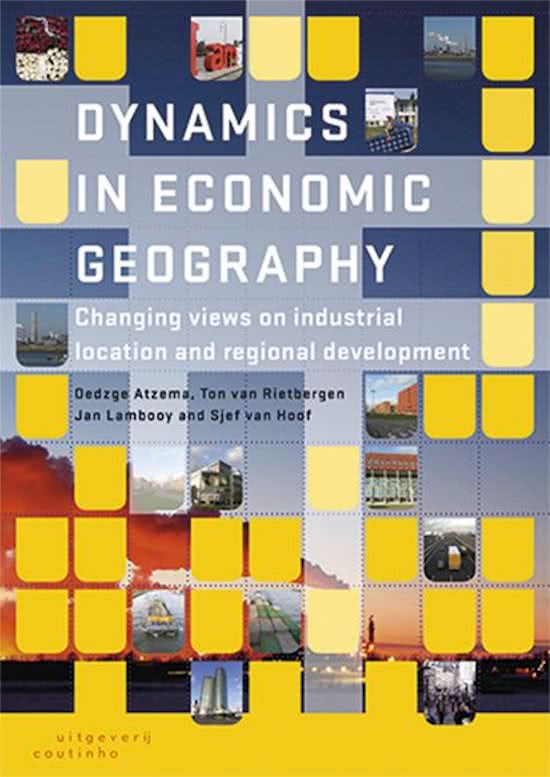
Location in a globalized world notes from the book Dynamics in economic
geography – Oedzge Atzema (2014)
Week 1
Chapter 1 – application possibilities for economic geography
1.1 Rediscovery of economic geography
Most renewed views in economic geography are aimed at policy development
Climate and location play a significant role in explaining differences in wealth, but are not all
determining factors
Silicon Valley – example of Schumpeter creative destruction
Why Silicon Valley cannot be easily replicated:
- A continual influx of highly trained engineers
- An enterprise culture with no fear of failure
- Ample venture capital available
- A government policy creating the right growth conditions.
1.2 Location, distance, networks
Two approaches in economic geography – Crevoisier (1999)- Economics shaped by regions
Homogenizing- classical and neoclassical theory, focus on finding regularity and patterning,
ignores historical and spatial deviations from the theory
Particularizing – focus on finding explanations for the particular and unusual embracing
temporal and geographic deviations
Location – matter of physical location (costs) and size of agglomeration (benefits)
Contrary to O’Brien and Friedman, Ghemawat did not believe the rise of the Internet had
drastically changed the importance of distance. Rather than restricting the scope of the
concept to physical distance, he distinguished four dimensions: geographic, cultural,
administrative and economic distance.
Ghemawat thinks that cultural and administrative distance has a stronger effect on
international trade than geographic distance
Summarizing the force of economic geography, prominent economic geographer Ron
Martin said it applies insights from economics, political science, sociology and psychology to
what actually takes place in physical space
Friedman 2005 – symbol of new age- the internet
Shift from regional to global competition
, 1.3 industry and environment
Globalization – lower transaction costs à increased specialization and fragmentation of the
production
‘functional’ and ‘spatial’ – restricted to factors that influence why an economic activity
located in the particular place
Marc de Smidt – production environment as s ‘all the external conditions that influence
both the decision to locate a business in a particular place and how it subsequently
functions’
We can see to aspects that characterize economic geography i.e. location choice and
regional development
Soft location factors – look and feel of premises, the quality of the surrounding area,
reputation of the region
Importance of soft location factors depends on the type of activity
Most sensitive to soft location factors are
- Sales
- Consultancy
- Shared services
, Week 2
Chapter 2 – Classical and neoclassical location theory
2.1 - introduction
Location theory – generally an economic issue faced with constraints
Assumption to all theories- sellers aim to maximize profits (constrained by costs), buyers
aim to maximize utility (constrained by income)
Classical location theory- strong focus on spatial variation, in cost of production and
transportation factors.
Neoclassical theory - also takes spatial variation in profits into account
2.2 – classical economics: minimal cost
Adam Smith in The Wealth of Nations (1776) laid the foundations of classical theory
- Each type of supply creates its own demand
- Availability of factors of production- determine opportunities for industry
- Entrepreneur allocation problem- maximum production minimum cost, geographical aspect:
cost vary pe location
Von Thunen – agricultural land use
Alfred Weber- industrial location choice
2.2.1 Agricultural land use according to Von Thunen
Classical location theory
- Perfect competition on the markets
- Fixed prices
- Competition based on costs
- People are fully informed and act rationally – “homo economicus”
- World – “isotropic space” – no geographical barriers (mountains, rivers)
- Deductive – look at commonalities
- Choose location with the lowest overall cost
Von Thunen theory
- Land use changed as the distance to market increased
- Expensive land cultivated differently than cheap land, cost of transport added to the market,
this determines the land use
- Additional assumptions:
• Space is isotropic: flat and boundless, with no natural barriers. Natural resources and
climate are the same everywhere.
• Land is uniform: farmers can have the same animals and grow the same crops anywhere
• There is one single market: the nearest town or village.
,• Transport costs vary per product.
• Transport costs increase linearly as the distance to the market increases.
• There is one single mode of transport: all products are taken to the market by ox-drawn
cart.
• The return per hectare is the same for all the crops in the area.
W – profit
VM – market price – [fixed by Von Thunen (due to perfect competition)]
P – production cost
T – transport costs
Profits (W) decrease as the distance increase due to transportation cost – at one point it not
feasible to grow that crop – other crop will be grown
Due to isotropic space, ability to see concentric circles representing agricultural land use
Von Thunen model still applies today,’ distance to market explains one-third of the variation
in farm value’
, 2.2.2 Industrial location according to Alfred Weber
Weber’s theory
- Aim to keep minimal transport costs
- Spatial variation in cost of labor and benefits of scale
- Isotropic space
- Raw materials are unevenly distributed
- Finished products are sold in a single marketplace (town/city)
- Labor is not mobile, but its available everywhere
- Transport costs for raw materials and finished goods are based on the weight of the goods
and the distance they are transported
- Transport cost increase linearly as distance increases
- Perfect competition
Factors determining location (Standort factors):
3 criteria
1. Applicability
- General location factors (transport costs, accessibility) apply to every type of business ,
specific location factors apply to certain type of businesses (availability, cooling water)
2. Nature
- Natural technical location factors- infrastructure
- societal cultural location factors- regional development support from the central
government
3. Functionality
- Regional effects- availability of functional resources
- Economies of agglomeration - the cost benefits thanks to the spatial concentration of a
variety of industries
Deglomeration -> result of diseconomies of agglomeration – cost incurred due to clustering
of a range of industrial sectors. E.g. traffic congestion
, Raw materials – important role in Weber’s location theory (2 types)
Ubiquitous material
- can be found anywhere e.g., oxygen, water, internet
- not relevant as location factor
- these materials attract businesses to the market
Localized material
- locally available raw material – coal, oil fields
- location of business depends on weight loss in the process
- a lot of weight loss – businesses tend to locate closer to raw resources
- little weight loss- the location of business is not that important
Location triangle
Three points: market (M), raw material 1 (G1) and 2 (G2)
Isocost lines – points for which the transport costs of that material are the same
Isopadanes: points where overall cost (total input costs and transportation output costs) are
identical (lowest overall cost – ideal location)
If one material during processing losses more weight, optimal location shifts towards
direction of that material
If extra transport costs are counterbalanced by cheaper labor, the optimal location is
wherever the labor is the cheapest
geography – Oedzge Atzema (2014)
Week 1
Chapter 1 – application possibilities for economic geography
1.1 Rediscovery of economic geography
Most renewed views in economic geography are aimed at policy development
Climate and location play a significant role in explaining differences in wealth, but are not all
determining factors
Silicon Valley – example of Schumpeter creative destruction
Why Silicon Valley cannot be easily replicated:
- A continual influx of highly trained engineers
- An enterprise culture with no fear of failure
- Ample venture capital available
- A government policy creating the right growth conditions.
1.2 Location, distance, networks
Two approaches in economic geography – Crevoisier (1999)- Economics shaped by regions
Homogenizing- classical and neoclassical theory, focus on finding regularity and patterning,
ignores historical and spatial deviations from the theory
Particularizing – focus on finding explanations for the particular and unusual embracing
temporal and geographic deviations
Location – matter of physical location (costs) and size of agglomeration (benefits)
Contrary to O’Brien and Friedman, Ghemawat did not believe the rise of the Internet had
drastically changed the importance of distance. Rather than restricting the scope of the
concept to physical distance, he distinguished four dimensions: geographic, cultural,
administrative and economic distance.
Ghemawat thinks that cultural and administrative distance has a stronger effect on
international trade than geographic distance
Summarizing the force of economic geography, prominent economic geographer Ron
Martin said it applies insights from economics, political science, sociology and psychology to
what actually takes place in physical space
Friedman 2005 – symbol of new age- the internet
Shift from regional to global competition
, 1.3 industry and environment
Globalization – lower transaction costs à increased specialization and fragmentation of the
production
‘functional’ and ‘spatial’ – restricted to factors that influence why an economic activity
located in the particular place
Marc de Smidt – production environment as s ‘all the external conditions that influence
both the decision to locate a business in a particular place and how it subsequently
functions’
We can see to aspects that characterize economic geography i.e. location choice and
regional development
Soft location factors – look and feel of premises, the quality of the surrounding area,
reputation of the region
Importance of soft location factors depends on the type of activity
Most sensitive to soft location factors are
- Sales
- Consultancy
- Shared services
, Week 2
Chapter 2 – Classical and neoclassical location theory
2.1 - introduction
Location theory – generally an economic issue faced with constraints
Assumption to all theories- sellers aim to maximize profits (constrained by costs), buyers
aim to maximize utility (constrained by income)
Classical location theory- strong focus on spatial variation, in cost of production and
transportation factors.
Neoclassical theory - also takes spatial variation in profits into account
2.2 – classical economics: minimal cost
Adam Smith in The Wealth of Nations (1776) laid the foundations of classical theory
- Each type of supply creates its own demand
- Availability of factors of production- determine opportunities for industry
- Entrepreneur allocation problem- maximum production minimum cost, geographical aspect:
cost vary pe location
Von Thunen – agricultural land use
Alfred Weber- industrial location choice
2.2.1 Agricultural land use according to Von Thunen
Classical location theory
- Perfect competition on the markets
- Fixed prices
- Competition based on costs
- People are fully informed and act rationally – “homo economicus”
- World – “isotropic space” – no geographical barriers (mountains, rivers)
- Deductive – look at commonalities
- Choose location with the lowest overall cost
Von Thunen theory
- Land use changed as the distance to market increased
- Expensive land cultivated differently than cheap land, cost of transport added to the market,
this determines the land use
- Additional assumptions:
• Space is isotropic: flat and boundless, with no natural barriers. Natural resources and
climate are the same everywhere.
• Land is uniform: farmers can have the same animals and grow the same crops anywhere
• There is one single market: the nearest town or village.
,• Transport costs vary per product.
• Transport costs increase linearly as the distance to the market increases.
• There is one single mode of transport: all products are taken to the market by ox-drawn
cart.
• The return per hectare is the same for all the crops in the area.
W – profit
VM – market price – [fixed by Von Thunen (due to perfect competition)]
P – production cost
T – transport costs
Profits (W) decrease as the distance increase due to transportation cost – at one point it not
feasible to grow that crop – other crop will be grown
Due to isotropic space, ability to see concentric circles representing agricultural land use
Von Thunen model still applies today,’ distance to market explains one-third of the variation
in farm value’
, 2.2.2 Industrial location according to Alfred Weber
Weber’s theory
- Aim to keep minimal transport costs
- Spatial variation in cost of labor and benefits of scale
- Isotropic space
- Raw materials are unevenly distributed
- Finished products are sold in a single marketplace (town/city)
- Labor is not mobile, but its available everywhere
- Transport costs for raw materials and finished goods are based on the weight of the goods
and the distance they are transported
- Transport cost increase linearly as distance increases
- Perfect competition
Factors determining location (Standort factors):
3 criteria
1. Applicability
- General location factors (transport costs, accessibility) apply to every type of business ,
specific location factors apply to certain type of businesses (availability, cooling water)
2. Nature
- Natural technical location factors- infrastructure
- societal cultural location factors- regional development support from the central
government
3. Functionality
- Regional effects- availability of functional resources
- Economies of agglomeration - the cost benefits thanks to the spatial concentration of a
variety of industries
Deglomeration -> result of diseconomies of agglomeration – cost incurred due to clustering
of a range of industrial sectors. E.g. traffic congestion
, Raw materials – important role in Weber’s location theory (2 types)
Ubiquitous material
- can be found anywhere e.g., oxygen, water, internet
- not relevant as location factor
- these materials attract businesses to the market
Localized material
- locally available raw material – coal, oil fields
- location of business depends on weight loss in the process
- a lot of weight loss – businesses tend to locate closer to raw resources
- little weight loss- the location of business is not that important
Location triangle
Three points: market (M), raw material 1 (G1) and 2 (G2)
Isocost lines – points for which the transport costs of that material are the same
Isopadanes: points where overall cost (total input costs and transportation output costs) are
identical (lowest overall cost – ideal location)
If one material during processing losses more weight, optimal location shifts towards
direction of that material
If extra transport costs are counterbalanced by cheaper labor, the optimal location is
wherever the labor is the cheapest