
1
Samenvatting environmental health
1. Environmental health and the burden of disease
A) Context: health, public health and environmental health
1) Health
- WHO (1948 - constitution)
“Health is a state of complete physical, mental and social well-being and not merely the
absence of disease or infirmity.”
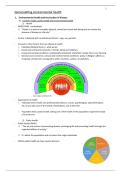
- Centre: individual with constitutional factors = age, sex, genetics
- Around it: other factors that can influence health
o Individual lifestyle factors = what we do
o Social and community networks = friends, family and relatives
o Living and working conditions: employed/unemployed, study/don’t study, how is our housing
o General socio-economic, cultural and environmental conditions: policy in Belgium affects us
al equally, climate here compared to other countries, culture, air pollution, …
- Approaches to health
o Individual level: health care professionals (doctors, nurses, psychologists, physiotherapists,
etc.) try to take care of the health of individuals, one at the time
o Population level: public health, taking care of the health of the population in general instead
of one-by-one
2) Public health
- Public health (WHO)
“The art and science of preventing disease, prolonging life and promoting health through the
organized efforts of society.”
It’s about the population and not about the single individuals
- Within public health we have several domains
, 2
a) Surveillance
The process used to collect, manage, analyse, interpret, and report information
on the status of diseases, conditions, or populations
- Where?
- Who? Establish health objectives and priorities
- When?
- Important to know whether we have a health problem, where we have it, who has it and when
- In surveillance they count the number of people with a specific disease, so we can have an idea of
for instance how many beds we need to free in the emergency rooms
- Ex. COVID-19
b) Health services
- They plan health services
How many hospitals do we need? How many beds do we need in each hospital?
If we don’t know how many people are sick (surveillance), we cannot plan for it
- We also decide on which tests do we have to do to diagnose people and what algorithms
It’s a whole process and the health services take care of deciding what is the best process
patients have to follow, because each process has some consequences
c) Disease prevention
- Primary prevention: prevent people from getting a disease
Ex. recommendations Covid-19 wash your hands, keep your distance, stay at home
- Secondary prevention: early detection of the disease
Screening programs, for example breast cancer screening
Screening before you show any symptoms
- Tertiary prevention: once the disease is established, what can we do so we can slow the
progression
Ex. dementia
, 3
d) Health promotion
- Empowering people
About telling people what they can do in order to stay healthy or reduce risks
- Just telling people is not enough (ex. you need to walk more instead
of taking the car)
It has to come with some help from the government to facilitate
the health promotion
It’s not possible in every country (ex. USA)
e) Health protection
- About the governance, protecting the population
Ex. protecting the population from contamination of drinking water
- Ex. air pollution
If a country surpasses this level of air pollution, they have to pay
3) Environmental health
- Environmental health covers all physical, chemical and (non-infectious) biological factors external
to the human body, which may affect health
- Non-infectious: COVID is not part of environmental health
- Example: only the red circle is environmental health, not the uptake of fatty acids
In the process of frying the fries, we get acrylamide which is related to health
- Diet can also be a part of environmental health, but it depends on how you look at it
It’s about the chemicals that you ingest trough diet
The fatty acids that the food contains is about nutritional health
, 4
- Disciplines
o Environmental toxicology: study of causal mechanisms between exposure and subsequent
development of disease in animal models or cells
o Environmental (and occupational) epidemiology: study of associations between exposure to
environmental/occupational agents and subsequent development of disease in populations
o Health protection: sub-discipline of public health that has the objective of minimizing the
exposure to health hazards in order to protect the population by ensuring environmental,
occupational, toxicological and food safety
o Policy: legislation to protect the population
- Research oriented: environmental toxicology and environmental and occupational epidemiology
Complimentary disciplines: what the toxicologists see in the lab might not apply to the real
world and the other way around (they have to work together)
- Policy related health: health protection and policy
- 2 different views of the same thing
Epidemiologists provide evidence in the real world, toxicologists in a controlled environment
in a lab
Check to see if it’s a causal relationship
B) Historical case studies: Belgium, London and Barcelona
1) Belgium: The Meuse Valley fog of December 1930
- One of the first areas in the industrialised Europe
- 1930: there was a huge fog covering the whole of Belgium
- Respiratory symptoms in only a couple of days
- There was 60 deaths, which was 10 times the mortality rate for that region = a lot
- They didn’t know what the problem was
International attention
In the UK was that on the news → hypothesizing about the cause
Samenvatting environmental health
1. Environmental health and the burden of disease
A) Context: health, public health and environmental health
1) Health
- WHO (1948 - constitution)
“Health is a state of complete physical, mental and social well-being and not merely the
absence of disease or infirmity.”
- Centre: individual with constitutional factors = age, sex, genetics
- Around it: other factors that can influence health
o Individual lifestyle factors = what we do
o Social and community networks = friends, family and relatives
o Living and working conditions: employed/unemployed, study/don’t study, how is our housing
o General socio-economic, cultural and environmental conditions: policy in Belgium affects us
al equally, climate here compared to other countries, culture, air pollution, …
- Approaches to health
o Individual level: health care professionals (doctors, nurses, psychologists, physiotherapists,
etc.) try to take care of the health of individuals, one at the time
o Population level: public health, taking care of the health of the population in general instead
of one-by-one
2) Public health
- Public health (WHO)
“The art and science of preventing disease, prolonging life and promoting health through the
organized efforts of society.”
It’s about the population and not about the single individuals
- Within public health we have several domains
, 2
a) Surveillance
The process used to collect, manage, analyse, interpret, and report information
on the status of diseases, conditions, or populations
- Where?
- Who? Establish health objectives and priorities
- When?
- Important to know whether we have a health problem, where we have it, who has it and when
- In surveillance they count the number of people with a specific disease, so we can have an idea of
for instance how many beds we need to free in the emergency rooms
- Ex. COVID-19
b) Health services
- They plan health services
How many hospitals do we need? How many beds do we need in each hospital?
If we don’t know how many people are sick (surveillance), we cannot plan for it
- We also decide on which tests do we have to do to diagnose people and what algorithms
It’s a whole process and the health services take care of deciding what is the best process
patients have to follow, because each process has some consequences
c) Disease prevention
- Primary prevention: prevent people from getting a disease
Ex. recommendations Covid-19 wash your hands, keep your distance, stay at home
- Secondary prevention: early detection of the disease
Screening programs, for example breast cancer screening
Screening before you show any symptoms
- Tertiary prevention: once the disease is established, what can we do so we can slow the
progression
Ex. dementia
, 3
d) Health promotion
- Empowering people
About telling people what they can do in order to stay healthy or reduce risks
- Just telling people is not enough (ex. you need to walk more instead
of taking the car)
It has to come with some help from the government to facilitate
the health promotion
It’s not possible in every country (ex. USA)
e) Health protection
- About the governance, protecting the population
Ex. protecting the population from contamination of drinking water
- Ex. air pollution
If a country surpasses this level of air pollution, they have to pay
3) Environmental health
- Environmental health covers all physical, chemical and (non-infectious) biological factors external
to the human body, which may affect health
- Non-infectious: COVID is not part of environmental health
- Example: only the red circle is environmental health, not the uptake of fatty acids
In the process of frying the fries, we get acrylamide which is related to health
- Diet can also be a part of environmental health, but it depends on how you look at it
It’s about the chemicals that you ingest trough diet
The fatty acids that the food contains is about nutritional health
, 4
- Disciplines
o Environmental toxicology: study of causal mechanisms between exposure and subsequent
development of disease in animal models or cells
o Environmental (and occupational) epidemiology: study of associations between exposure to
environmental/occupational agents and subsequent development of disease in populations
o Health protection: sub-discipline of public health that has the objective of minimizing the
exposure to health hazards in order to protect the population by ensuring environmental,
occupational, toxicological and food safety
o Policy: legislation to protect the population
- Research oriented: environmental toxicology and environmental and occupational epidemiology
Complimentary disciplines: what the toxicologists see in the lab might not apply to the real
world and the other way around (they have to work together)
- Policy related health: health protection and policy
- 2 different views of the same thing
Epidemiologists provide evidence in the real world, toxicologists in a controlled environment
in a lab
Check to see if it’s a causal relationship
B) Historical case studies: Belgium, London and Barcelona
1) Belgium: The Meuse Valley fog of December 1930
- One of the first areas in the industrialised Europe
- 1930: there was a huge fog covering the whole of Belgium
- Respiratory symptoms in only a couple of days
- There was 60 deaths, which was 10 times the mortality rate for that region = a lot
- They didn’t know what the problem was
International attention
In the UK was that on the news → hypothesizing about the cause


