

FEMINIST
PHILOSOPHY:
CLASS 1: INTRODUCTION
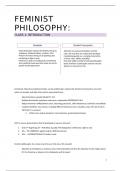
FEMINISM FEMINIST PHILOSOPHY
Mary Richardson attacks the Rokeby Venus by Attention to womens limitations on their
Velasquez, National Gallery, London, 1914 roles, the way they are valued and devalued.
Protest of women being on all paintings but Considering gender as a complex interaction
not having a right to vote of (race, class, ability, sexuality)
Feminism is both an intellectual commitment How this might transform feminist philosophy
and a political movement that seeks an end to itself, feminine in philosophy and the role the
gender-based oppression. absence or presence it has.
Feminisms: historical evolutions/trends: can be problematic, reduces the feminist movement to one story
when it is broader and older than what is represented here.
- Liberal feminism: gender EQUALITY, 70’s
- Relational feminism: questions male norm, emphasizes DIFFERENCES, 80’s
- Radical feminism: OPRESSION by men, reforming patriarchy, 1987 (MacKinnon, feminism unmodified)
- Complex identities: ALL women, including different elements (race, sexuality, class), 90’s but Truth in
1851 (Ain’t I a women)
o Critical race, lesbian feminism, trans feminism, postcolonial feminism
NOT in waves: general idea is that it developed in waves is incorrect
1. End 19th beginning 20th : POLITICAL equality, Mill (Subjection of Women), right to vote
2. 60s – 70s: FREEDOM, against sexism, SDB (Second sex)
3. 90’s-…: INTERSECTIONALITY, Butler, Lorde
Feminist philosophy: (is a more recent focus in this class, 90s onward)
- Attention to limitations on womens roles, intersectionality and how the attention to this might chance
FP, the feminine or absence of in philosophy and its impact
1
, - 70’s: beginning, more women in higher education + feminist movements, responding to not being
included or taken seriously in academics (Hypathia)
APPROACHES INTERVENTIONS TOPICS
Methodologies (introducing How they intervened and Overlooked and
feminine concern in them) transformed traditional areas undertheorized topics
Analytic fem Aesthetics Autonomy
Pragmatist fem Ethics Rape
Psychoanalytic fem Epistemology The body
Important to realize that there is a link between SOCIETY and PHILOSOPHY:
- Feminist phil evolves with social emancipation struggles
- Theories and concepts change
Conflicts between emancipatory goals: for example the fight for right both by black people and
women
The masters tools will never dismantle the masters house (Audre Lorde)
Part 2 of first class: Intersectionality
What is intersectionality?
- Collins and Bilge: How intersecting power relations influence social relations, an analytic tool which
views different categories as interrelated and mutually shaping one another -> Understanding
complexity
Origin?
Crenshaw: demarginalizing the intersection of race and sex: BUT some take a broader view, not starting with
Crenshaw
- The discrimination of black women on different levels
- Analogy of traffic in an intersection, identifying the cause of an accident is not easy -> Only providing
legal relief when they can identify the specific cause of the accident
o It is seen that in the cases where it is not easy to identify the cause, no one is held
responsible, no treatment is administered
Bilge: fungibility of intersectionality:
- As an “ideograph”, intersectionality encompasses a broader intellectual and political project of
researching and confronting the multiple oppressions faced by Black and other racialized women.
2
, - Both genealogies (a shorter or longer one) one fact remains, intersectionality is the fruit of the labour
of racialized women.
A racialized habitus is a CONSTITUTIVE component of intersectionality (and still the most common
understanding is gender+)
Intersectionality and feminism:
Davis: intersectionality touches the long and painful legacy of its exclusions, promises to address and redress ->
Seems to claim intersectionality without taking into account the genealogy
Intersectionality wars: Nash (how do we tell its story and who gets to tell it)
1. Progress reading
- Feminism + intersectionality = third wave, ‘progress’
2. Alternative reading: cooptation of intersectionality
(cooptation = absorbing, external actor affirms goal, fake cooperation)
(1) Neutralization (depoliticizing intersectionality): intersectionality as a resistant principle by anti-racist
feminists -> Shortcut to ‘politically correct’ your output (same what happened with diversity)
(2) Extraction (universalizing intersectionality): Extractivism = removal of black feminists from their theoretical
innovation
- Premise : their knowledge is too particular to represent universality
- Justification: master argument = identities as rigid
- Result: purified intersectionality, no exposure to race
(3) Desire for distance (discarding intersectionality):
Wiegman, Tomlinson: Feminist criticism van too quickly discard still useful concepts and categories, replacing
them with new ones in the hope of making its investments come true.
- Torment of hope: desire for distance from prevailing paradigms, concepts and theories that seem
tainted with failure
Different conclusions of the sex wars:
- Ahmed: [T]he presumption of our own criticality can be a way of protecting ourselves from complicity
- Srinivasan: working through the wars can be intellectually productive and thrilling
Intermezzo: The Combahee River Collective Statement
Originating in the historical reality of Afro-American women’s continuous struggle for survival and liberation,
they are committed to struggle against racial, sexual, heterosexual and class oppression:
3
, - Crucial outtake: major systems of oppression are interlocking
- What they believe: Black women are inherently valuable, their liberation is a necessity for their
autonomy.
o Liberation through destruction of the political-economic systems of capitalism and
imperialism as well as patriarchy
o The personal is political: need to articulate the real class situation of persons who are not
merely raceless, sexless workers, but for whom racial and sexual oppression are significant
determinants in their working/ economic lives
o However: they do not have the misguided notion that maleness per se (biological) is the issue
- Problems in organizing black feminists:
o They try to address a whole range of oppressions (not just one front or even two) (“we would
have to fight the world”) (black women free -> everyone to be free)
o Feminism is very threatening to the majority of black people: it calls into question some of
the most basic assumptions about our existence
o Many black women have a good understanding of both sexism and racism, but because of the
everyday constrictions of their lives, cannot risk struggling against them both
- Black feminist issues and projects:
o Publicly address racism in the white women’s movement
o They do not believe that the end always justifies the means: “we believe in collective process
and a non-hierarchical distribution of power
4
PHILOSOPHY:
CLASS 1: INTRODUCTION
FEMINISM FEMINIST PHILOSOPHY
Mary Richardson attacks the Rokeby Venus by Attention to womens limitations on their
Velasquez, National Gallery, London, 1914 roles, the way they are valued and devalued.
Protest of women being on all paintings but Considering gender as a complex interaction
not having a right to vote of (race, class, ability, sexuality)
Feminism is both an intellectual commitment How this might transform feminist philosophy
and a political movement that seeks an end to itself, feminine in philosophy and the role the
gender-based oppression. absence or presence it has.
Feminisms: historical evolutions/trends: can be problematic, reduces the feminist movement to one story
when it is broader and older than what is represented here.
- Liberal feminism: gender EQUALITY, 70’s
- Relational feminism: questions male norm, emphasizes DIFFERENCES, 80’s
- Radical feminism: OPRESSION by men, reforming patriarchy, 1987 (MacKinnon, feminism unmodified)
- Complex identities: ALL women, including different elements (race, sexuality, class), 90’s but Truth in
1851 (Ain’t I a women)
o Critical race, lesbian feminism, trans feminism, postcolonial feminism
NOT in waves: general idea is that it developed in waves is incorrect
1. End 19th beginning 20th : POLITICAL equality, Mill (Subjection of Women), right to vote
2. 60s – 70s: FREEDOM, against sexism, SDB (Second sex)
3. 90’s-…: INTERSECTIONALITY, Butler, Lorde
Feminist philosophy: (is a more recent focus in this class, 90s onward)
- Attention to limitations on womens roles, intersectionality and how the attention to this might chance
FP, the feminine or absence of in philosophy and its impact
1
, - 70’s: beginning, more women in higher education + feminist movements, responding to not being
included or taken seriously in academics (Hypathia)
APPROACHES INTERVENTIONS TOPICS
Methodologies (introducing How they intervened and Overlooked and
feminine concern in them) transformed traditional areas undertheorized topics
Analytic fem Aesthetics Autonomy
Pragmatist fem Ethics Rape
Psychoanalytic fem Epistemology The body
Important to realize that there is a link between SOCIETY and PHILOSOPHY:
- Feminist phil evolves with social emancipation struggles
- Theories and concepts change
Conflicts between emancipatory goals: for example the fight for right both by black people and
women
The masters tools will never dismantle the masters house (Audre Lorde)
Part 2 of first class: Intersectionality
What is intersectionality?
- Collins and Bilge: How intersecting power relations influence social relations, an analytic tool which
views different categories as interrelated and mutually shaping one another -> Understanding
complexity
Origin?
Crenshaw: demarginalizing the intersection of race and sex: BUT some take a broader view, not starting with
Crenshaw
- The discrimination of black women on different levels
- Analogy of traffic in an intersection, identifying the cause of an accident is not easy -> Only providing
legal relief when they can identify the specific cause of the accident
o It is seen that in the cases where it is not easy to identify the cause, no one is held
responsible, no treatment is administered
Bilge: fungibility of intersectionality:
- As an “ideograph”, intersectionality encompasses a broader intellectual and political project of
researching and confronting the multiple oppressions faced by Black and other racialized women.
2
, - Both genealogies (a shorter or longer one) one fact remains, intersectionality is the fruit of the labour
of racialized women.
A racialized habitus is a CONSTITUTIVE component of intersectionality (and still the most common
understanding is gender+)
Intersectionality and feminism:
Davis: intersectionality touches the long and painful legacy of its exclusions, promises to address and redress ->
Seems to claim intersectionality without taking into account the genealogy
Intersectionality wars: Nash (how do we tell its story and who gets to tell it)
1. Progress reading
- Feminism + intersectionality = third wave, ‘progress’
2. Alternative reading: cooptation of intersectionality
(cooptation = absorbing, external actor affirms goal, fake cooperation)
(1) Neutralization (depoliticizing intersectionality): intersectionality as a resistant principle by anti-racist
feminists -> Shortcut to ‘politically correct’ your output (same what happened with diversity)
(2) Extraction (universalizing intersectionality): Extractivism = removal of black feminists from their theoretical
innovation
- Premise : their knowledge is too particular to represent universality
- Justification: master argument = identities as rigid
- Result: purified intersectionality, no exposure to race
(3) Desire for distance (discarding intersectionality):
Wiegman, Tomlinson: Feminist criticism van too quickly discard still useful concepts and categories, replacing
them with new ones in the hope of making its investments come true.
- Torment of hope: desire for distance from prevailing paradigms, concepts and theories that seem
tainted with failure
Different conclusions of the sex wars:
- Ahmed: [T]he presumption of our own criticality can be a way of protecting ourselves from complicity
- Srinivasan: working through the wars can be intellectually productive and thrilling
Intermezzo: The Combahee River Collective Statement
Originating in the historical reality of Afro-American women’s continuous struggle for survival and liberation,
they are committed to struggle against racial, sexual, heterosexual and class oppression:
3
, - Crucial outtake: major systems of oppression are interlocking
- What they believe: Black women are inherently valuable, their liberation is a necessity for their
autonomy.
o Liberation through destruction of the political-economic systems of capitalism and
imperialism as well as patriarchy
o The personal is political: need to articulate the real class situation of persons who are not
merely raceless, sexless workers, but for whom racial and sexual oppression are significant
determinants in their working/ economic lives
o However: they do not have the misguided notion that maleness per se (biological) is the issue
- Problems in organizing black feminists:
o They try to address a whole range of oppressions (not just one front or even two) (“we would
have to fight the world”) (black women free -> everyone to be free)
o Feminism is very threatening to the majority of black people: it calls into question some of
the most basic assumptions about our existence
o Many black women have a good understanding of both sexism and racism, but because of the
everyday constrictions of their lives, cannot risk struggling against them both
- Black feminist issues and projects:
o Publicly address racism in the white women’s movement
o They do not believe that the end always justifies the means: “we believe in collective process
and a non-hierarchical distribution of power
4


