Applied Cognitive
Psychology
Chapter 3.2: Eyewitness Identification, and Chapter 8: Witness Interviews and Crime Investigations
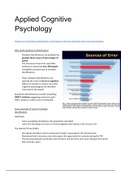
Why study eyewitness identification?
- Mistaken identifications are probably the
greatest direct cause of miscarriages of
justice
The Innocence Project has used DNA
evidence to exonerate over 300 people
wrongfully convicted due to mistaken
identifications
- These mistaken identifications are
typically the result of errors in cognition
(failure to encode or retrieve correctly).
Cognitive psychologists are therefore
interested in the subject
Eyewitness identifications provide compelling,
DIRECT evidence suggesting someone’s guilt.
Other evidence is often just circumstantial.
Some examples of cases of mistaken
identification:
Adolf Beck
- Twice wrongfully identified as the perpetrator and jailed
- Led to the founding of a Court or Criminal Appeals and Enquiry in the UK and in SA
The Eikenhof Three (1993)
- Wrongfully identified, almost sentenced to death, instead given life imprisonment
- Maintained their innocence even when given the opportunity for amnesty during the TRC
- The actual perpetrator eventually came forward, and the three men were released from prison
after serving 5 years
,The possibility of false identifications is acknowledged within the legal system:
- In the South African Law Journal, several early articles acknowledged the dangers, e.g. in 1926:
“... mistaken identity is the most likely and common cause of miscarriages of justice, and such
miscarriages not only shock the public conscience but give rise to doubt and uneasiness as to
the administration of justice”
- Similarly, the 11th report of the English Criminal Law Revision committee, 1972, says: “We
regard mistaken identification as by far the greatest cause of actual or possible wrong
convictions.”
SA’s legal approach to the problem:
The criminal justice system is very much aware of the problem of false identification, and has tried to
institute solutions – some being more effective than others.
False IDs are an issue of perception, memory and identification i.e. heavily psychological
SA’s criminal justice system has “cautionary rules” that emphasise the necessity of caution in cases
where there are…
- Single witnesses (however, this posed problems for cases such as those of rape)
- Identification evidence. Acknowledges the risk involved with this type of evidence
- Acquaintanceship (when those involved know each other)
The most popular “remedy” for the problem of false identifications has been to require lineups / ID
parades and to modify their structure and rules of procedure:
- Requires a minimum number of people in the parade e.g. 8 in South Africa
- The lineup must be “live” as opposed to photos
- The witness must be warned that the perpetrator may not be in the lineup
- The lineup must be administered “blindly”: it must be run by police not involved in the arrest of
the suspect in order to mitigate the effects of vested interests
According to Signal Detection Theory (SDT), eyewitness recognition hits decrease, as do false alarms, as
the criterion for choosing becomes stricter
,Steps in the process of criminal justice
Errors can occur at any step in this process
Estimator VS System Variables (Wells, 1978)
During criminal proceedings, certain variables of the crime are of more use to the case than others.
- System variables are variables that are under the control of the criminal justice system. Police
procedures that law enforcement has control over and can affect identification.
If we determine that the manner in which the police conduct an identification procedure affects
the accuracy of the evidence collected, we can take action to modify the procedures in light of
this research and thus improve the quality of the evidence p resented in court.
- Estimator variables are aspects of the witness or situation that may affect the accuracy of
identification evidence, but aren’t under the direct control of the criminal justice system and
can’t be changed after the fact.
e.g. race of the witness/perpetrator; distance between them; duration of the event; lighting; age
of the witness; stress and arousal
, Some terminology:
A parade = a lineup
Parallel parades = more than
one
Foils = the people in the
lineup other than the
suspect (presumed
innocents)
Instructions = what the
witness is told e.g. “the
suspect may not actually be
in the lineup”
The first step in the process of criminal justice: witnessing the crime (estimator variables)
Witness factors:
- The own-group bias: we are b etter able to recognise members of our own race, age, sex group
etc
The Innocence Project has estimated that about three-quarters of DNA exoneration cases
involve mistaken eyewitness identification evidence, and in about half of all those cases the
erroneous identification was made by a witness identifying a suspect of another ethnicity.
Individuals are 1.4 times more likely to correctly identify own group members and 1.56 times
more likely to falsely identify out group members (Meissner & Brigham, 2001)
You don’t always see a cross-over effect, with, for example, white people being good at
recognising white faces but not black faces, and black people being good at recognising black
faces but not white faces. Some studies find that black participants are also good at recognising
white faces.
This is also seen with other populations such as Asian and white populations in the UK
This effect may be rooted in perceptual learning and the amount of contact one has with
different races. Levin (1996) sees it as a result of automatic racial categorization early on in an
encounter that takes attention away from individuating characteristics of the face. But neither
of these explanations account for the uneven results across groups.
- The age of the witness: very old or very young w
itnesses tend to be less accurate.
Young children can be suggestible, and the memory of the elderly may be faulty
- The sex of the witness: some small differences such as women performing better than men at
face recognition tasks, but worse when under stress
Psychology
Chapter 3.2: Eyewitness Identification, and Chapter 8: Witness Interviews and Crime Investigations
Why study eyewitness identification?
- Mistaken identifications are probably the
greatest direct cause of miscarriages of
justice
The Innocence Project has used DNA
evidence to exonerate over 300 people
wrongfully convicted due to mistaken
identifications
- These mistaken identifications are
typically the result of errors in cognition
(failure to encode or retrieve correctly).
Cognitive psychologists are therefore
interested in the subject
Eyewitness identifications provide compelling,
DIRECT evidence suggesting someone’s guilt.
Other evidence is often just circumstantial.
Some examples of cases of mistaken
identification:
Adolf Beck
- Twice wrongfully identified as the perpetrator and jailed
- Led to the founding of a Court or Criminal Appeals and Enquiry in the UK and in SA
The Eikenhof Three (1993)
- Wrongfully identified, almost sentenced to death, instead given life imprisonment
- Maintained their innocence even when given the opportunity for amnesty during the TRC
- The actual perpetrator eventually came forward, and the three men were released from prison
after serving 5 years
,The possibility of false identifications is acknowledged within the legal system:
- In the South African Law Journal, several early articles acknowledged the dangers, e.g. in 1926:
“... mistaken identity is the most likely and common cause of miscarriages of justice, and such
miscarriages not only shock the public conscience but give rise to doubt and uneasiness as to
the administration of justice”
- Similarly, the 11th report of the English Criminal Law Revision committee, 1972, says: “We
regard mistaken identification as by far the greatest cause of actual or possible wrong
convictions.”
SA’s legal approach to the problem:
The criminal justice system is very much aware of the problem of false identification, and has tried to
institute solutions – some being more effective than others.
False IDs are an issue of perception, memory and identification i.e. heavily psychological
SA’s criminal justice system has “cautionary rules” that emphasise the necessity of caution in cases
where there are…
- Single witnesses (however, this posed problems for cases such as those of rape)
- Identification evidence. Acknowledges the risk involved with this type of evidence
- Acquaintanceship (when those involved know each other)
The most popular “remedy” for the problem of false identifications has been to require lineups / ID
parades and to modify their structure and rules of procedure:
- Requires a minimum number of people in the parade e.g. 8 in South Africa
- The lineup must be “live” as opposed to photos
- The witness must be warned that the perpetrator may not be in the lineup
- The lineup must be administered “blindly”: it must be run by police not involved in the arrest of
the suspect in order to mitigate the effects of vested interests
According to Signal Detection Theory (SDT), eyewitness recognition hits decrease, as do false alarms, as
the criterion for choosing becomes stricter
,Steps in the process of criminal justice
Errors can occur at any step in this process
Estimator VS System Variables (Wells, 1978)
During criminal proceedings, certain variables of the crime are of more use to the case than others.
- System variables are variables that are under the control of the criminal justice system. Police
procedures that law enforcement has control over and can affect identification.
If we determine that the manner in which the police conduct an identification procedure affects
the accuracy of the evidence collected, we can take action to modify the procedures in light of
this research and thus improve the quality of the evidence p resented in court.
- Estimator variables are aspects of the witness or situation that may affect the accuracy of
identification evidence, but aren’t under the direct control of the criminal justice system and
can’t be changed after the fact.
e.g. race of the witness/perpetrator; distance between them; duration of the event; lighting; age
of the witness; stress and arousal
, Some terminology:
A parade = a lineup
Parallel parades = more than
one
Foils = the people in the
lineup other than the
suspect (presumed
innocents)
Instructions = what the
witness is told e.g. “the
suspect may not actually be
in the lineup”
The first step in the process of criminal justice: witnessing the crime (estimator variables)
Witness factors:
- The own-group bias: we are b etter able to recognise members of our own race, age, sex group
etc
The Innocence Project has estimated that about three-quarters of DNA exoneration cases
involve mistaken eyewitness identification evidence, and in about half of all those cases the
erroneous identification was made by a witness identifying a suspect of another ethnicity.
Individuals are 1.4 times more likely to correctly identify own group members and 1.56 times
more likely to falsely identify out group members (Meissner & Brigham, 2001)
You don’t always see a cross-over effect, with, for example, white people being good at
recognising white faces but not black faces, and black people being good at recognising black
faces but not white faces. Some studies find that black participants are also good at recognising
white faces.
This is also seen with other populations such as Asian and white populations in the UK
This effect may be rooted in perceptual learning and the amount of contact one has with
different races. Levin (1996) sees it as a result of automatic racial categorization early on in an
encounter that takes attention away from individuating characteristics of the face. But neither
of these explanations account for the uneven results across groups.
- The age of the witness: very old or very young w
itnesses tend to be less accurate.
Young children can be suggestible, and the memory of the elderly may be faulty
- The sex of the witness: some small differences such as women performing better than men at
face recognition tasks, but worse when under stress