
What are the brain structures that are involved in
stress-fear response? What are the separate
functions?
The brain structures involved in the stress and fear response are primarily
within the limbic system:
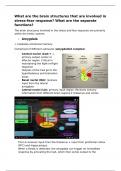
- Amygdala
= mediates emotional memory
Comprised of different subnuclei (amygdaloid complex):
- Central nuclei (CeA) =
primary output center or
effector region. Critical in
maintaining the fight-or-flight
response
Outputs of the CeA go to the
hypothalamus and brainstem
areas
- Basal nuclei (BA): receives
input from the lateral
amygdala
- Lateral nuclei (LA): primary input region. Receives sensory
information from different brain regions thalamus and cortex
The LA receives input from the thalamus + input from prefrontal cortex
(PFC) and hippocampus.
When a threat is detected, the amygdala can trigger an immediate
response by activating the CeA, which then sends output to the
, hypothalamus, brainstem etc includes SNS activation (increased
heart rate, pupil dilation) and hypothalamic activation to trigger the
HPA axis
Neurotransmitters:
- Glutamate NMDA and AMPA receptors
- GABA (gamma-aminobutyric acid) inhibitory neurotransmitters,
balances the excitatory activity of glutamate. GABA receptors:
inhibit amygdala activity
A deficiency in GABAergic activity: hyperactivity of the amygdala, so
excessive fear responses and anxiety
- Norepinephrine (NE) modulates amygdala’s response to stress
and fear, enhancing ability to respond to threats
- Serotonin: low serotonin levels are associated with increased
amygdala reactivity
- CRH: released from hypothalamus, enhancing amygdala’s sensitivity
to stress
Lesions of the amygdala have the effect of flattening emotion
- Prefrontal Cortex (PFC)
= modulates emotional responses by regulating amygdala activity. Region
in the brain responsible for cognitive control, emotional regulation and
executive function
Subregions:
- Dorsolateral prefrontal cortex (dlPFC)


