Viruziekten samenvatting HC.5
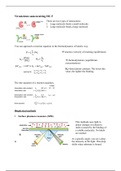
There are two types of interactions:
1. Large molecule binds a small molecule
2. Large molecule binds a large molecule
You can approach a reaction equation in the thermodynamic of kinetic way.
kinetics (velocity of reaching equilibrium)
thermodynamics (equilibrium
concentrations)
KD=dissociation constant. The lower this
value, the tighter the binding.
The rate equation of a reaction equation.
Biophysical methods
Surface plasmon resonance (SPR)
This methods uses light to
detect changes in refractive
index (caused by the binding of
a soluble molecule). No labels
are needed.
At a specific angle, you see a drop
in the intensity of the light. This drop
shifts when substrate is bound.
, In SPR, the light undergoes total
internal reflection. This is
happening when 1 C.
The total internal reflection (resonance angle)
creates a evanescent wave. Plasmons can be
described in the classical picture as an
oscillation of electron density with respect to the
fixed positive ions in a metal. Surface plasmons
interact strongly with light that propagates along
the metal surface (i.e. evanescent wave). At a
specific value of θ1 = θr (≥ θC) the energy (or
So at the resonance angle, light is absorbed and you see a drop in light intensity. This drop
shifts when substrate is bound. The difference between these two drops is called the
critical angle (this is another critical angle then before!!). This SPR angle change is
reported as response units (RU). 1000 RU
= 0.10 = 1 ng per square mm at chip
surface.
a) Start flow of analyte
There are two types of interactions:
1. Large molecule binds a small molecule
2. Large molecule binds a large molecule
You can approach a reaction equation in the thermodynamic of kinetic way.
kinetics (velocity of reaching equilibrium)
thermodynamics (equilibrium
concentrations)
KD=dissociation constant. The lower this
value, the tighter the binding.
The rate equation of a reaction equation.
Biophysical methods
Surface plasmon resonance (SPR)
This methods uses light to
detect changes in refractive
index (caused by the binding of
a soluble molecule). No labels
are needed.
At a specific angle, you see a drop
in the intensity of the light. This drop
shifts when substrate is bound.
, In SPR, the light undergoes total
internal reflection. This is
happening when 1 C.
The total internal reflection (resonance angle)
creates a evanescent wave. Plasmons can be
described in the classical picture as an
oscillation of electron density with respect to the
fixed positive ions in a metal. Surface plasmons
interact strongly with light that propagates along
the metal surface (i.e. evanescent wave). At a
specific value of θ1 = θr (≥ θC) the energy (or
So at the resonance angle, light is absorbed and you see a drop in light intensity. This drop
shifts when substrate is bound. The difference between these two drops is called the
critical angle (this is another critical angle then before!!). This SPR angle change is
reported as response units (RU). 1000 RU
= 0.10 = 1 ng per square mm at chip
surface.
a) Start flow of analyte