
Chapter one: Introduction to Trade, Transport and Logistics
1. Logistics and Transport
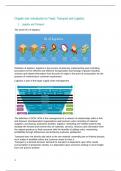
The seven R’s of logistics:
Definition of logistics: logistics is the process of planning, implementing and controlling
procedures for the efficient and effective transportation and storage of goods including
services and related information from the point of origin to the point of consumption for the
purpose of conforming to customer requirement.
Logistics is part of the larger supply chain management.
The definition of SCM: SCM is the management of a network of relationships within a firm
and between interdependent organisations and business units consisting of material
suppliers, purchasing, production facilities, logistics, marketing and related systems that
facilitate the forward and reverse flow of materials, services, finances and information from
the original producer to final consumer with the benefits of adding value, maximising
profitability through efficiencies and achieving customer satisfaction.
Transport does not directly add value to the raw material, assembly part or finished product,
but it makes it available where the customer wants to have it.
Transport is a derived demand: demand for transport is dependent upon other needs
(consumption of production needs), it is dependent upon someone wishing to move freight
from one point to another.
1
, 2. Trading Blocks
Why do countries trade? There are two basic types of trade between countries:
- The first in which the receiving country itself cannot produce the goods or provide the
services in question, or where they do not have enough.
- The second, in which they have the capability of producing the goods or supplying the
services, but still import them.
The comparative advantage, David Ricardo
There is an economic benefit for the Global Economy for a nation, to specialize in
producing those goods for which it had a relative advantage, and exchanging them for the
products of the nations which had advantages in other kinds of product.
Protectionism: protecting jobs (and in particular during periods of crisis). Tariffs (like a tax or
import duties) and non-tariff barriers (quotas in import, export restraints, domestic
subsidising, import deposits, particular Health&Safety standards or technical specifications).
3. Organisations in World Trade
The 10 major regional trading blocks in the world economy:
1. The European Economic Area (EEA)
2. The North American Free Trade Agreement (NAFTA)
3. The Mercado Comun del Cono Sur (MERCOSUR)
4. The Asean Economic Community (AEC)
5. The Common Market of Eastern and Southern Africa (COMESA)
6. The Asia Pacific Economic Cooperation (APEC)
7. The South Asian Association for Regional Cooperation (SAARC)
8. The Indian Ocean Rim Association (IORA)
9. The Latin American Integration Association (LAIA)
10. The Southern African Development Community (SADC)
4. Trade and Distribution
The 4 P’s: product, price, promotion, place (or distribution)
Distribution channels: direct, commission agent, distributor, retailer, local company, license
or franchise.
5. Trade and Law
The basics of a contract. It is an agreement between two or more parties. It discusses term,
responsibilities, court (disputes), force majeure, products and services, pricelists, service
level agreement, termination
6. Introduction to procurement
To fulfil a customer’s need, it is a process:
The ABC analysis
2
,In the X axis you can have: number of suppliers, customers, products…
In the Y axis you can have: purchase volume, product volume, revenue…
7. Import and Export
The export order process:
Enquiry quotation order (purchase) order acknowledgement order process and
progress packing and marking Space booking (e.g.: on a vessel) documents
prepared goods dispatched payment received
The importance of goods description, price description, lead times agreement, payment
terms, order acknowledgement, a proforma invoice… to minimise trade risk.
8. Trade and risk management
Methods of payment:
Country risk:
3
, The seller’ and buyer’s risk. Will I receive money for the goods which I’ve shipped to my
customers? Will I receive the goods which I’ve paid for?
4
1. Logistics and Transport
The seven R’s of logistics:
Definition of logistics: logistics is the process of planning, implementing and controlling
procedures for the efficient and effective transportation and storage of goods including
services and related information from the point of origin to the point of consumption for the
purpose of conforming to customer requirement.
Logistics is part of the larger supply chain management.
The definition of SCM: SCM is the management of a network of relationships within a firm
and between interdependent organisations and business units consisting of material
suppliers, purchasing, production facilities, logistics, marketing and related systems that
facilitate the forward and reverse flow of materials, services, finances and information from
the original producer to final consumer with the benefits of adding value, maximising
profitability through efficiencies and achieving customer satisfaction.
Transport does not directly add value to the raw material, assembly part or finished product,
but it makes it available where the customer wants to have it.
Transport is a derived demand: demand for transport is dependent upon other needs
(consumption of production needs), it is dependent upon someone wishing to move freight
from one point to another.
1
, 2. Trading Blocks
Why do countries trade? There are two basic types of trade between countries:
- The first in which the receiving country itself cannot produce the goods or provide the
services in question, or where they do not have enough.
- The second, in which they have the capability of producing the goods or supplying the
services, but still import them.
The comparative advantage, David Ricardo
There is an economic benefit for the Global Economy for a nation, to specialize in
producing those goods for which it had a relative advantage, and exchanging them for the
products of the nations which had advantages in other kinds of product.
Protectionism: protecting jobs (and in particular during periods of crisis). Tariffs (like a tax or
import duties) and non-tariff barriers (quotas in import, export restraints, domestic
subsidising, import deposits, particular Health&Safety standards or technical specifications).
3. Organisations in World Trade
The 10 major regional trading blocks in the world economy:
1. The European Economic Area (EEA)
2. The North American Free Trade Agreement (NAFTA)
3. The Mercado Comun del Cono Sur (MERCOSUR)
4. The Asean Economic Community (AEC)
5. The Common Market of Eastern and Southern Africa (COMESA)
6. The Asia Pacific Economic Cooperation (APEC)
7. The South Asian Association for Regional Cooperation (SAARC)
8. The Indian Ocean Rim Association (IORA)
9. The Latin American Integration Association (LAIA)
10. The Southern African Development Community (SADC)
4. Trade and Distribution
The 4 P’s: product, price, promotion, place (or distribution)
Distribution channels: direct, commission agent, distributor, retailer, local company, license
or franchise.
5. Trade and Law
The basics of a contract. It is an agreement between two or more parties. It discusses term,
responsibilities, court (disputes), force majeure, products and services, pricelists, service
level agreement, termination
6. Introduction to procurement
To fulfil a customer’s need, it is a process:
The ABC analysis
2
,In the X axis you can have: number of suppliers, customers, products…
In the Y axis you can have: purchase volume, product volume, revenue…
7. Import and Export
The export order process:
Enquiry quotation order (purchase) order acknowledgement order process and
progress packing and marking Space booking (e.g.: on a vessel) documents
prepared goods dispatched payment received
The importance of goods description, price description, lead times agreement, payment
terms, order acknowledgement, a proforma invoice… to minimise trade risk.
8. Trade and risk management
Methods of payment:
Country risk:
3
, The seller’ and buyer’s risk. Will I receive money for the goods which I’ve shipped to my
customers? Will I receive the goods which I’ve paid for?
4


