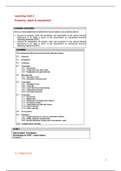
Learning Unit 5
Property, plant & equipment
5.1 Objective:
1
,SCHEMATIC REPRESENTATION OF IAS 16:
Objective:
Prescribe accounting treatment of property, plant & equipment (PPE)
Addressing timing of recognition of assets, determining carrying amount &
related depreciation
Recognition:
Items of PPE recognised as assets on a component basis when it is probable
that:
Future economic benefits associated with assets will flow to entity
Cost of asset can be measured reliably
Initial measurement:
Items of PPE initially recognised as cost.
Costs include = all costs incurred to bring item of PPE to location & working
condition for intended use
If payment deferred = interest at market-related rate must be recognised
If asset acquired in exchange for another = cost of new asset will be at fair
value of asset given up unless:
o Transaction lacks commercial substance or
o Fair value of wither the asset not received nor given up can be
readily measured – in which case cost of new asset measured at
carrying amount of asset given up
Subsequent measurement:
Items of PPE are subsequently measured using 2 methods:
1. Cost model = cost less accumulated depreciation & accumulated
impairment losses or
2. Revaluation model = revalued amount less accumulated depreciation &
accumulated impairment losses since last revaluation
Revaluation: Depreciation:
Increase in value = credit to equity Commence when A available for
– other comp income (revaluation use & continues until derecognised
surplus) – even if idle
o Unless reversal of previous Depreciation amount = cost less
decrease for same asset the residual value
recognised as expense – Method must reflect pattern in
income – P/L which A’s benefits are consumed
Decrease in value = expense – P/L Methods include:
o Unless reversal of previous o Straight line
increase of same asset – debit o Reducing balance
to revaluation surplus – another o Sum of digits
comp income o Production unit
Revaluation surplus = realised to Recognised in P/L
retained earnings o Unless included in carrying
o when asset disposed amount of another A –
o or over its remaining useful life manufactured inventories
directly in statement of
changes in equity
2
, Subsequent measurement:
Items of PPE are subsequently measured using 2 methods:
1. Cost model = cost less accumulated depreciation & accumulated
impairment losses or
2. Revaluation model = revalued amount less accumulated depreciation &
accumulated impairment losses since last revaluation
Derecognition:
A removed from statement of fin position
o on disposal
o or when withdrawn from use – & no expected future benefits from
disposal
Gain or loss on derecognition recognised in P/L section in statement of P/L
PRINCIPLE ISSUES OF ACCOUNTING FOR PPE
1. Recognition of PPE as assets
2. Determination of carrying amounts
3. Related depreciation charges & impairment losses
NATURE OF PPE
Tangible A = ‘fixed A’
Held for use in production of goods, supply of services, rental to others or
admin purposes
Expected to be used during more than 1 fin year
Intention to use A to generate revenue rather than to sell them
RECOGNITION OF PPE ASSETS
= Resource controlled by entity as result of past events from which future
economic benefits are expected to flow to entity
Entity controlling asset = power to obtain future economic benefits of
resource & can restrict access of others to asset
Past events = date of acquisition or date of completion on which asset
becomes ready for intended use
Future economic benefits = revenue from goods sold or services rendered,
cost savings & other benefits resulting from use of A
5.2 Background:
The standard shall be applied to PPE except when another standard requires or
permits a different accounting standard (tangible long-term assets)
3
, Standard also applies to the following:
a) Where other standards may require recognition of an PPE item based on
approach different from that in the standard (leases),
- other aspects of accounting treatment for these A, incl. depreciation –
prescribed by this standard
b) Investment property being accounted for in accordance with cost model
The standard does not apply to (this does not form part of this module):
a) PPE items classified as held for sale in accordance with IFRS 5 Non-current
assets held for sale and discontinued operations (done in later studies);
b) biological assets related to agricultural activity;
c) the recognition and measurement of exploration and evaluation assets; or
d) mineral rights and mineral reserves such as oil, natural gas and similar
non-regenerative resources.
IAS 16 allows 2 alternative accounting treatments for PPE:
After initial recognition of an PPE item at cost – assets may either be shown:
1. At cost less accumulated depreciation & accumulated impairment losses =
cost model
2. At a revalued amount = being the fair value of the A on date of
revaluation less accumulated depreciation & accumulated impairment
losses since last revaluation = revaluation model
5.3 Definitions:
CARRYING AMOUNT
amount at which an asset is recognised in the statement of financial
position
after deducting any accumulated depreciation and accumulated
impairment losses
(Impairment does not form part of this module).
COST
amount of cash or cash equivalents paid and
the fair value of the other consideration given to acquire an asset
at the time of its acquisition or construction or,
4
Property, plant & equipment
5.1 Objective:
1
,SCHEMATIC REPRESENTATION OF IAS 16:
Objective:
Prescribe accounting treatment of property, plant & equipment (PPE)
Addressing timing of recognition of assets, determining carrying amount &
related depreciation
Recognition:
Items of PPE recognised as assets on a component basis when it is probable
that:
Future economic benefits associated with assets will flow to entity
Cost of asset can be measured reliably
Initial measurement:
Items of PPE initially recognised as cost.
Costs include = all costs incurred to bring item of PPE to location & working
condition for intended use
If payment deferred = interest at market-related rate must be recognised
If asset acquired in exchange for another = cost of new asset will be at fair
value of asset given up unless:
o Transaction lacks commercial substance or
o Fair value of wither the asset not received nor given up can be
readily measured – in which case cost of new asset measured at
carrying amount of asset given up
Subsequent measurement:
Items of PPE are subsequently measured using 2 methods:
1. Cost model = cost less accumulated depreciation & accumulated
impairment losses or
2. Revaluation model = revalued amount less accumulated depreciation &
accumulated impairment losses since last revaluation
Revaluation: Depreciation:
Increase in value = credit to equity Commence when A available for
– other comp income (revaluation use & continues until derecognised
surplus) – even if idle
o Unless reversal of previous Depreciation amount = cost less
decrease for same asset the residual value
recognised as expense – Method must reflect pattern in
income – P/L which A’s benefits are consumed
Decrease in value = expense – P/L Methods include:
o Unless reversal of previous o Straight line
increase of same asset – debit o Reducing balance
to revaluation surplus – another o Sum of digits
comp income o Production unit
Revaluation surplus = realised to Recognised in P/L
retained earnings o Unless included in carrying
o when asset disposed amount of another A –
o or over its remaining useful life manufactured inventories
directly in statement of
changes in equity
2
, Subsequent measurement:
Items of PPE are subsequently measured using 2 methods:
1. Cost model = cost less accumulated depreciation & accumulated
impairment losses or
2. Revaluation model = revalued amount less accumulated depreciation &
accumulated impairment losses since last revaluation
Derecognition:
A removed from statement of fin position
o on disposal
o or when withdrawn from use – & no expected future benefits from
disposal
Gain or loss on derecognition recognised in P/L section in statement of P/L
PRINCIPLE ISSUES OF ACCOUNTING FOR PPE
1. Recognition of PPE as assets
2. Determination of carrying amounts
3. Related depreciation charges & impairment losses
NATURE OF PPE
Tangible A = ‘fixed A’
Held for use in production of goods, supply of services, rental to others or
admin purposes
Expected to be used during more than 1 fin year
Intention to use A to generate revenue rather than to sell them
RECOGNITION OF PPE ASSETS
= Resource controlled by entity as result of past events from which future
economic benefits are expected to flow to entity
Entity controlling asset = power to obtain future economic benefits of
resource & can restrict access of others to asset
Past events = date of acquisition or date of completion on which asset
becomes ready for intended use
Future economic benefits = revenue from goods sold or services rendered,
cost savings & other benefits resulting from use of A
5.2 Background:
The standard shall be applied to PPE except when another standard requires or
permits a different accounting standard (tangible long-term assets)
3
, Standard also applies to the following:
a) Where other standards may require recognition of an PPE item based on
approach different from that in the standard (leases),
- other aspects of accounting treatment for these A, incl. depreciation –
prescribed by this standard
b) Investment property being accounted for in accordance with cost model
The standard does not apply to (this does not form part of this module):
a) PPE items classified as held for sale in accordance with IFRS 5 Non-current
assets held for sale and discontinued operations (done in later studies);
b) biological assets related to agricultural activity;
c) the recognition and measurement of exploration and evaluation assets; or
d) mineral rights and mineral reserves such as oil, natural gas and similar
non-regenerative resources.
IAS 16 allows 2 alternative accounting treatments for PPE:
After initial recognition of an PPE item at cost – assets may either be shown:
1. At cost less accumulated depreciation & accumulated impairment losses =
cost model
2. At a revalued amount = being the fair value of the A on date of
revaluation less accumulated depreciation & accumulated impairment
losses since last revaluation = revaluation model
5.3 Definitions:
CARRYING AMOUNT
amount at which an asset is recognised in the statement of financial
position
after deducting any accumulated depreciation and accumulated
impairment losses
(Impairment does not form part of this module).
COST
amount of cash or cash equivalents paid and
the fair value of the other consideration given to acquire an asset
at the time of its acquisition or construction or,
4